

Índice
Subscription and live-cam creators run nine distinct role domains: strategy, production, distribution/promotion, community management, monetization operations, analytics, legal/compliance, technical operations, and creator wellbeing. Community management and monetization operations demand attention first, since they drive retention and revenue directly. When you start hiring, moderators come before editors, promoters, and bookkeepers.
TL;DR:
- Community management is critical early on and demands immediate attention once live chat or DM traffic makes it impossible to respond quickly alone.
- Hiring should follow a specific sequence: moderators first, then editors, promoters, and bookkeepers, based on revenue stabilization needs.
- Keeping billing, refund, and dispute processes solid for subscriptions before adding tips or pay-per-view content prevents costly errors later.
- A weekly workflow prioritizes content production, promotion, and live hosting, with community and moderation work increasing during live events.
- Fanspicy consolidates multiple creator roles into one platform, saving time and simplifying revenue management, especially for solo creators.
Índice
- What Are the Core Content Creator Roles on a Subscription Platform?
- How Do Content Creator Roles Map to Monetization Models?
- What Does a Realistic Weekly Workflow Look Like?
- When Should You Hire or Outsource Creator Roles?
- What Legal and Wellbeing Rules Should Every Creator Follow?
- What’s the 30/90-Day Plan for New Creators?
- Why Treating Your Creator Roles Like a Small Business Changes Everything
- How Fanspicy Supports Every Creator Role
- Sources
What Are the Core Content Creator Roles on a Subscription Platform?
Each domain covers a specific job, and knowing the boundaries helps you decide what stays on your plate and what gets handed off.
- Estratégia: setting your niche, pricing tiers, and content calendar. Deliverables include a quarterly content plan and a pricing structure reviewed monthly.
- Production: filming, editing, and prepping content for release. Deliverables include raw footage, edited clips, and a content library organized by tier.
- Distribution/promotion: getting your content and profile in front of new fans across social channels. Deliverables include posting schedules, cross-promotion campaigns, and teaser content.
- Community management: replying to DMs, running chat during live shows, and handling fan requests. Deliverables include response-time targets and moderation logs.
- Monetization/business ops: managing tiers, PPV pricing, and payout tracking. Deliverables include a pricing sheet and a revenue reconciliation routine.
- Analytics/optimization: watching churn, ARPU, and engagement by content type. Deliverables include a weekly metrics review.
- Legal/compliance: consent documentation, age verification, and copyright awareness. Deliverables include signed releases and a compliance checklist.
- Technical operations: stream setup, equipment, and platform troubleshooting. Deliverables include tested gear and backup connectivity.
- Creator wellbeing: scheduled rest and boundary-setting. Deliverables include off-hours blocks and a burnout check-in.
Community management, technical operations, and moderation spike hard during live events. Production and distribution, by contrast, run on a schedule you can plan around days in advance.
How Do Content Creator Roles Map to Monetization Models?
Subscriptions and memberships work as your revenue foundation because they generate predictable recurring income, and that predictability comes from three roles working together: community management keeping subscribers engaged, a steady production cadence giving them reasons to stay, and analytics tracking whether churn is climbing or falling. A membership structure leans even harder on community hosting, since fans expect a sense of belonging on top of paywalled access.
Tips, paid DMs, and pay-per-view (PPV) content work as secondary levers. They pay fast but demand real-time moderation, sharp live-hosting instincts, and a payout tracking system that doesn’t fall apart under volume. Layer them on only after your billing and reconciliation processes hold up.
Before activating any monetization lever, confirm you have:
- Billing rules that define what each tier or PPV price actually unlocks
- Entitlement handling so paying fans get instant access without manual work
- A refund and dispute workflow, written down, not improvised
- One person (even if it’s you) who owns weekly revenue reporting
Dica profissional: Run subscriptions alone for at least one full billing cycle before adding tips or PPV. You’ll spot billing errors and access glitches while the stakes are still low.
Getting billing and dispute handling right before adding variable monetization saves you from refund chaos later.
What Does a Realistic Weekly Workflow Look Like?
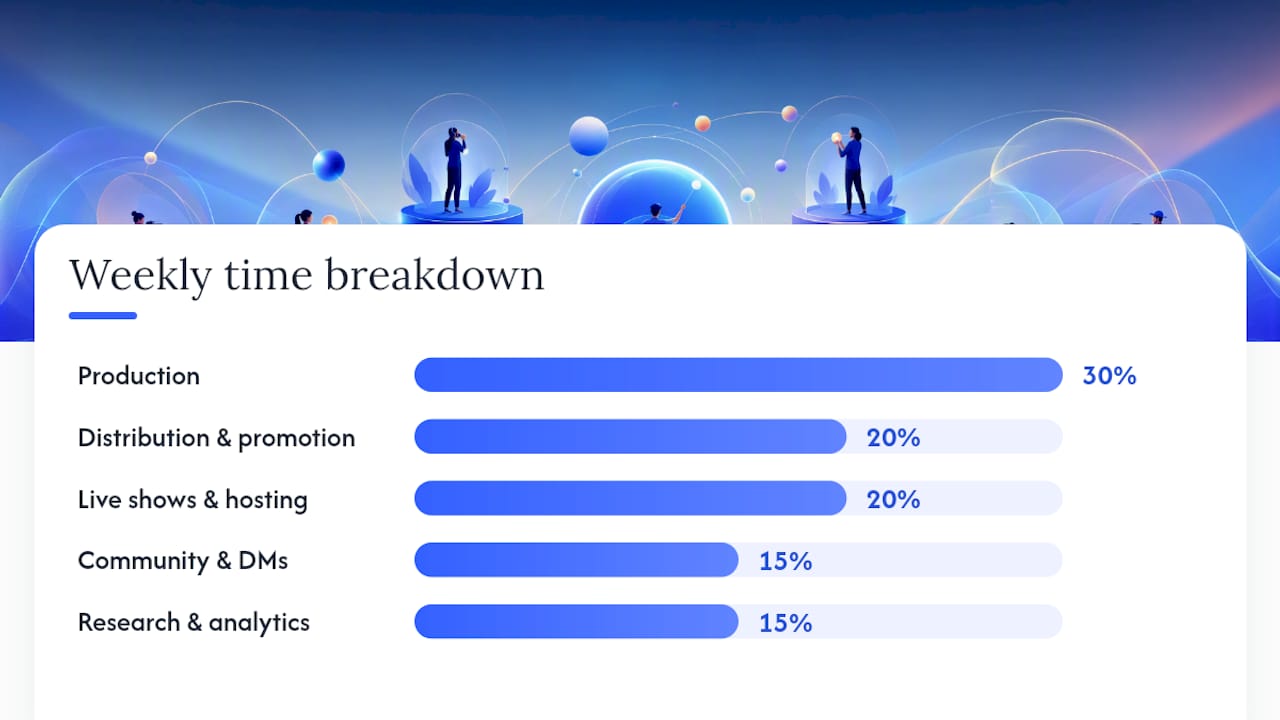
Most solo creators split time hybrid style, moving between host, producer, and community manager in the same afternoon. A typical workflow breaks down like this across a week:
- Content research and planning: roughly 10% of your time
- Production (filming, editing, prepping releases): 30%
- Distribution and promotion across social channels: 20%
- Live shows and real-time hosting: 20%
- DMs, fan requests, and moderation: 15%
- Analytics review and pricing adjustments: 5%
Production, community work, and promotion together eat the bulk of your week, which is exactly why those three domains get outsourced first once revenue allows it.
Two quick comparisons show how this shifts by format. A recorded-batch creator, filming several pieces in one session and releasing on a calendar, shifts that weight into production and distribution instead, freeing up daytime hours for promotion work.
When Should You Hire or Outsource Creator Roles?
Hiring in the wrong order wastes money. Hiring in the right order protects your time exactly when it matters most.
- Moderator first. A moderator handles DMs, chat during live streams, and flags harassment before it escalates. Sample rates run $12 to $18 per hour. Hire once live chat volume or DM traffic makes same-day responses impossible for you alone.
- Video editor next. An editor turns raw footage into polished, tiered content on a consistent schedule. Rates typically run $25 to $75 per video, depending on complexity. Hire once production backlog starts delaying your release calendar.
- Social promoter third. A promoter manages cross-platform posting and top-of-funnel discovery. Sample rates run $15 to $25 per hour. Hire once subscriber growth plateaus despite steady content output.
- Bookkeeper fourth. A bookkeeper reconciles payouts, tracks tax obligations, and catches billing errors. Basic services run $100 to $300 per month. Hire once you add a second monetization lever beyond subscriptions.
Before you hire, put a confidentiality agreement in front of any moderator, set a turnaround SLA with editors, and require promoters to report growth metrics weekly, not just claim results.
What Legal and Wellbeing Rules Should Every Creator Follow?
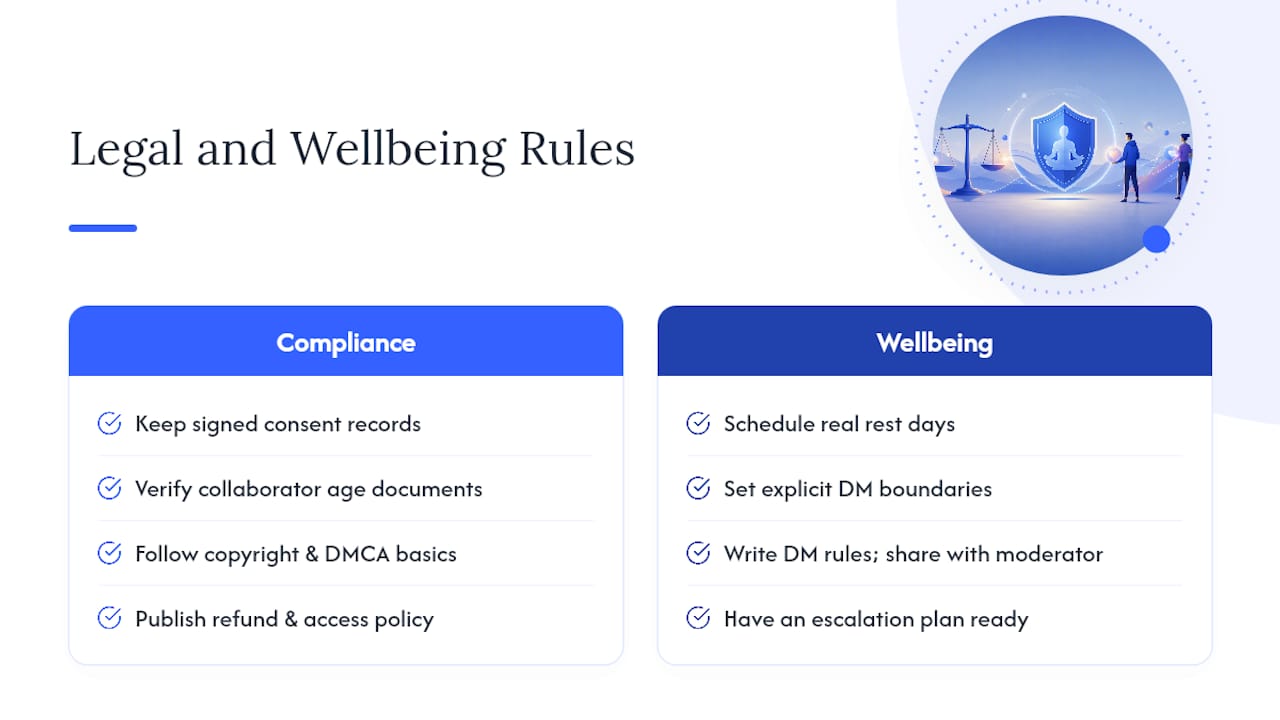
A handful of compliance steps protect both your income and your account standing. Keep signed consent records for anyone appearing in your content, verify age documentation before onboarding collaborators, stay aware of copyright and DMCA basics for anything you didn’t create yourself, and publish a clear refund and access policy so disputes don’t turn into chargebacks.
Wellbeing rules matter just as much. Schedule real rest days, not just slow days. Set explicit DM boundaries so fan conversations don’t bleed into every waking hour. Have an escalation plan ready before you need it, so harassment or abusive messages get handled by policy instead of panic.
Dica profissional: Write your DM boundaries down and share a version with your moderator. A rule that only exists in your head gets broken the first busy weekend.
Skipping either compliance or rest doesn’t just risk your account, it erodes the retention and revenue consistency your business depends on.
What’s the 30/90-Day Plan for New Creators?
Your first month sets the foundation. Your first quarter tests whether that foundation holds under real growth.
First 30 days:
- Define your niche and content pillars clearly enough that a stranger could describe your page in one sentence.
- Build a four-week content calendar covering production and release dates.
- Set subscription tiers with clear pricing and included content.
- Write base moderation rules covering banned language, harassment response, and DM tone.
- Set up a basic analytics dashboard tracking subscribers, revenue, and engagement.
Next 60 days (through day 90):
- Make your first hire, usually a moderator, if revenue comfortably supports it.
- Run small retention tests, like limited-time bundles or renewal incentives.
- Iterate on pricing and tiers based on churn data.
- Add tips or PPV only once your ledger and refund rules are documented and tested.
Watch four numbers throughout: subscriber growth, churn rate, ARPU, and live-event attach rate (how many subscribers show up to paid live sessions). Those four tell you faster than gut feeling whether your role setup is actually working.
Why Treating Your Creator Roles Like a Small Business Changes Everything
Most creators resist splitting their work into roles because it feels like corporate language applied to something personal. It isn’t. The moment I saw a creator hand off moderation and watch her response time (and her sleep) both improve overnight, the framing clicked: this is a small media business, and every unfilled role is unpaid overtime you’re pulling. Combining roles works early on, but ignoring burnout risk while doing it doesn’t. Treat the nine domains as departments to staff as revenue allows, not chores to survive.
— fan
How Fanspicy Supports Every Creator Role
Fanspicy is built to carry the operational weight these nine role domains create, so you’re not stitching together five separate tools to run one business. The platform combines live streaming, tiered subscriptions, PPV content, paid DMs, moderation tools, and built-in analytics, meaning your monetization ops and community management roles run through one dashboard instead of scattered logins.
That consolidation matters most when you’re solo, since every domain you’re not chasing manually is time back in production or on stream. Subscriptions come first for a reason: they give you the predictable revenue base that everything else builds on, and Fanspicy’s tier structure is designed to make that setup fast rather than fiddly. When you’re ready to layer in tips, PPV, or paid DMs, the reconciliation and payout tracking are already there waiting. Start building your role structure at Fanspicy.
Sources
- Content production workflow (industry overview)
- 5 ways creators can make money on social platforms (Forbes)
- Choosing creator platform monetization models for real-world operations