

Índice
TL;DR:
- A content safety checklist is a multi-stage review system that ensures content complies with legal, ethical, and platform standards before and after publication. Incorporating permissions, fact-checking, risk assessment, and AI content labeling, it protects creators from legal issues and monetization loss while maintaining audience safety. Proper documentation, human oversight, and proactive planning are essential for effective content safety management across platforms.
A content safety checklist is a structured, multi-stage review system that verifies every piece of content meets legal, ethical, and platform compliance standards before and after publication. For creators on paid social and adult platforms, skipping this process is not just risky. It directly threatens monetization, account standing, and legal protection. Tools like Azure AI Content Safety and compliance frameworks like the UK Online Safety Act have made formal content review checklists a professional requirement, not an optional extra. The good news: a disciplined checklist protects your income while keeping your audience safe.
What does a content safety checklist actually include?

A comprehensive content safety checklist covers 15–25 points organized across strategy, compliance, and quality assurance. Each category addresses a different failure mode, from copyright violations to harassment risks. Here are the non-negotiable components every creator needs to cover.
Permissions and Consent
Every media asset in your content needs a verified license or written permission. Stock photos, music clips, and video footage all carry copyright. If you feature an identifiable person, you need documented consent before publishing. For adult content creators, this is especially critical. Consent documentation must be time-stamped and explicit, covering exactly what the subject agreed to and what they did not.
Fact-Checking and Source Verification
Every factual claim needs a primary source. Screenshots and archived links for social posts provide traceability and protect you if content is challenged later. Accurate source verification and archiving originals guard against both misinformation accusations and legal challenges. Document your sources in a shared log, not just in your head.
Sensitive Topic Warnings and Crisis Resources
Content covering mental health, self-harm, abuse, or graphic violence requires explicit content warnings placed before the content begins. High-traffic channels should also link to relevant crisis resources within the post or description. This is both an ethical obligation and a platform policy requirement on most major networks.
Pre-Publish Risk Assessment
Assign every piece of content a risk level before it goes live. The scale runs from negligible to high, and each level triggers a different review protocol. A negligible-risk post might only need a self-check. A high-risk post covering legal disputes or explicit material needs a full editorial review with documented sign-off.
Dica profissional: Build your risk levels into a simple spreadsheet or Notion template. Label each content type (tutorial, opinion, explicit, news) with its default risk tier so you are not making judgment calls from scratch every time.
How should you handle ai-generated content in your checklist?
AI-generated and synthetic content carries its own compliance layer that most creators underestimate. The rules are tightening fast, and the consequences of mislabeling are serious.
-
Label all AI-generated or AI-altered content visibly. As of 2026, AI-generated content must carry provenance metadata and visible watermarks. This applies to AI-written text, AI-generated images, voice cloning, and deepfake-style video edits. Platforms and regulators are actively enforcing this.
-
Secure AI-specific consent forms. If you use AI to alter someone’s likeness or voice, your standard consent form is not enough. AI content consent forms must include explicit clauses covering AI transformation. Without this, you face non-consensual use claims even if the original subject gave general consent.
-
Apply strict age verification for any content depicting minors. EU-aligned standards now require government ID verification or approved third-party tools. This is not optional. The UK Online Safety Act assigns content-specific risk levels with proportionate measures including age assurance, and non-compliance carries significant penalties.
-
Configure your content filters with threshold levels. Tools like Amazon Bedrock Guardrails and Azure AI Content Safety use severity settings such as Safe, Low, Medium, and High. Configurable filters set to BLOCK_MEDIUM_AND_ABOVE catch high-risk content without over-blocking professional material.
-
Keep a human reviewer in the loop for flagged content. Automated filters catch patterns, but they miss context. Human-in-the-loop moderation for flagged content reduces litigation risk from edge cases that AI tools misclassify.
Dica profissional: Run a monthly audit of your AI filter settings. Platforms update their detection models regularly, and a threshold that worked in January may under-block by March.
What does a step-by-step content safety workflow look like?
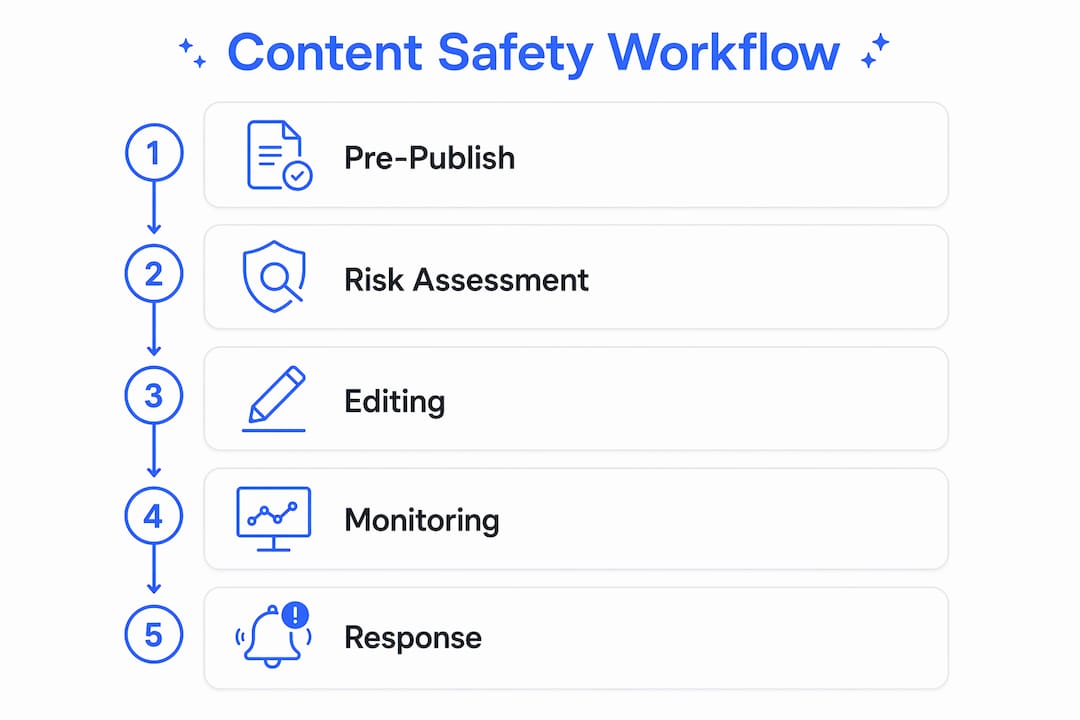
A 3-stage workflow covering pre-publish verification, risk-adjusted editing, and post-publish monitoring is the standard for creators handling sensitive topics. Here is how each stage breaks down in practice.
Pre-publish verification
Confirm source authentication, consent documentation, and legal-risk triage before any content moves to editing. This means checking every asset license, confirming all named individuals have signed consent forms, and flagging any claims that require expert verification. Log each check with a timestamp and the name of the reviewer. Logging legal and safety sign-offs with timestamps and reviewer names protects you during compliance audits and any future disputes.
Risk-adjusted editing
Editing for safety is not about watering down your content. Neutral titling and non-graphic thumbnails prevent platform misclassification and protect monetization for sensitive storytelling. Choose titles that describe the content accurately without triggering algorithmic flags. Use non-graphic language in descriptions and avoid thumbnails that could be misread as violating platform policies. This approach preserves editorial integrity while keeping your content monetization-eligible.
Post-publish monitoring
The work does not stop at publish. The table below maps post-publish actions to their purpose and timing.
| Action | Finalidade | Timing |
|---|---|---|
| Enable comment review queue | Reduces harassment and spam before it reaches your audience | Immediately at publish |
| Monitor platform notifications | Catches policy flags and demonetization alerts early | Daily for first 72 hours |
| Prepare takedown/appeal template | Speeds response to removal notices within the required window | Before publish |
| Adjust monetization settings | Protects revenue if content is reclassified by the platform | Within 24 hours of any flag |
| Archive final published version | Creates a record for liability and compliance review | At publish |
Maintaining a takedown/appeal template ready within 24–72 hours is critical post-publication. Platforms move fast, and a prepared response is always faster than one written under pressure.
What mistakes do creators make with content safety?
Most content safety failures are not caused by bad intentions. They come from treating the review process as a single checkbox rather than a system.
- Treating safety as an afterthought. Creators who review content only after editing miss risks introduced during production. Safety checks belong at every stage, not just before you hit publish.
- Relying only on negative content filters. Filters that only block prohibited content miss a lot. Affirmative content policies that define what is allowed improve AI filter accuracy and reduce over-blocking of legitimate professional content.
- Skipping AI hallucination checks. AI writing tools generate plausible-sounding statistics that are simply wrong. Every number, name, and claim in AI-assisted content needs verification against a primary source before publication.
- Using vague or undefined roles in the review process. Multi-stage content review with clear role definitions and feedback templates prevents publishing mistakes. If everyone is responsible for safety, no one is.
- Ignoring evolving platform policies. Platform content policies update multiple times per year. A content type that was monetization-eligible in 2025 may be restricted in 2026. Subscribe to policy update emails from every platform you publish on.
- Not having a digital privacy protocol. For adult creators especially, protecting your own data is part of content safety. Review your digital privacy practices alongside your content review process.
Key takeaways
A disciplined content safety checklist is the single most effective tool creators have to protect monetization, avoid legal liability, and maintain platform trust across every post.
| Point | Details |
|---|---|
| Use a multi-stage review | Cover pre-publish, editing, and post-publish stages to catch risks at every point. |
| Document consent and sources | Log time-stamped consent and source archives to protect against legal challenges. |
| Label AI content visibly | Apply provenance metadata and watermarks to all AI-generated or AI-altered material. |
| Configure filters affirmatively | Define what content is allowed, not just what is blocked, to improve filter accuracy. |
| Monitor post-publish actively | Track platform flags daily for the first 72 hours and keep a takedown template ready. |
Why i think most creators get content safety backwards
Most creators I have seen treat content safety as a gate at the end of production. They finish the content, then ask whether it is safe to post. That sequence is the problem. By the time you are asking that question, you have already made every decision that creates risk.
The creators who stay monetized and avoid platform strikes build safety into the brief, not the final review. They decide at the concept stage what risk tier a piece of content falls into. That decision shapes the language they use, the sources they cite, the consent forms they collect, and the thumbnails they design. Risk-adjusted storytelling is not a constraint on creativity. It is a discipline that keeps your content alive on the platform long enough to earn.
The other mistake I see constantly is over-reliance on automated tools. Azure AI Content Safety and Amazon Bedrock Guardrails are genuinely useful, but they are not editorial judgment. They catch patterns. They miss context. A human reviewer who understands your audience and your platform’s specific policies will always catch things an algorithm misses. The best workflows I have seen combine both: automated filters as a first pass, human review for anything flagged or high-risk.
Finally, documentation is underrated. Creators who log every consent form, every source check, and every editorial decision with a timestamp are protected when disputes arise. Platforms and legal teams respond to evidence. A well-documented review log is your best defense.
— fan
How Fanspicy supports creators with safety and compliance
Fanspicy is built for creators who take their platforms seriously, and that means giving you the resources to publish with confidence. Whether you are navigating consent documentation, content moderation workflows, or platform compliance requirements, Fanspicy’s creator guides cover the practical steps that keep your content live and your earnings protected.
From content moderation protocols to guidance on protecting your content rights, Fanspicy gives adult creators and influencers the tools to build a compliant, monetization-ready presence. Visit Fanspicy to explore the full library of creator safety and compliance guides built specifically for platforms like yours.
PERGUNTAS FREQUENTES
What is a content safety checklist?
A content safety checklist is a structured review process that verifies content meets legal, ethical, and platform compliance standards before and after publication. It typically covers 15–25 points across permissions, fact-checking, risk assessment, and post-publish monitoring.
How do i handle ai-generated content in my safety review?
Label all AI-generated or AI-altered content with visible watermarks and provenance metadata. Secure AI-specific consent forms for any likeness or voice transformation, and configure content filters with appropriate severity thresholds.
What risk levels should i assign to my content?
Assign risk levels from negligible to high based on content type and subject matter. High-risk content covering explicit material, legal disputes, or sensitive topics requires full editorial review with documented sign-off before publication.
How quickly should i respond to a platform takedown notice?
Prepare a takedown and appeal template before you publish. Responding within 24–72 hours of a removal notice is the standard window for most platforms, and a prepared template makes that timeline achievable.
Why do affirmative content policies outperform negative filters?
Affirmative policies define what content is allowed rather than only blocking what is prohibited. This approach improves AI filter accuracy and reduces over-blocking of legitimate professional content, keeping more of your work monetization-eligible.