

Índice
TL;DR:
- Content creation for marketing involves planning, producing, and distributing digital content to engage audiences and achieve business goals. Strategies that focus on owned formats, clear goals, and AI integration outperform scattered, superficial efforts. Building a focused, strategic plan with measurable objectives and leveraging AI tools enhances efficiency and content visibility.
Content creation for marketing is the end-to-end process of planning, producing, and distributing digital content designed to engage a defined audience and achieve measurable business goals. The global creator economy has surpassed $250 billion with 207 million creators worldwide. That scale means the competition for attention is fiercer than ever. Marketers who treat content as a strategic asset rather than a publishing calendar consistently outperform those who simply post more. Tools like Grammarly, HubSpot, and Copy.ai are now standard parts of the workflow, and organic search drives 75% of B2B content consumption, making every piece you publish a long-term investment.
What are the core steps in content creation for marketing?
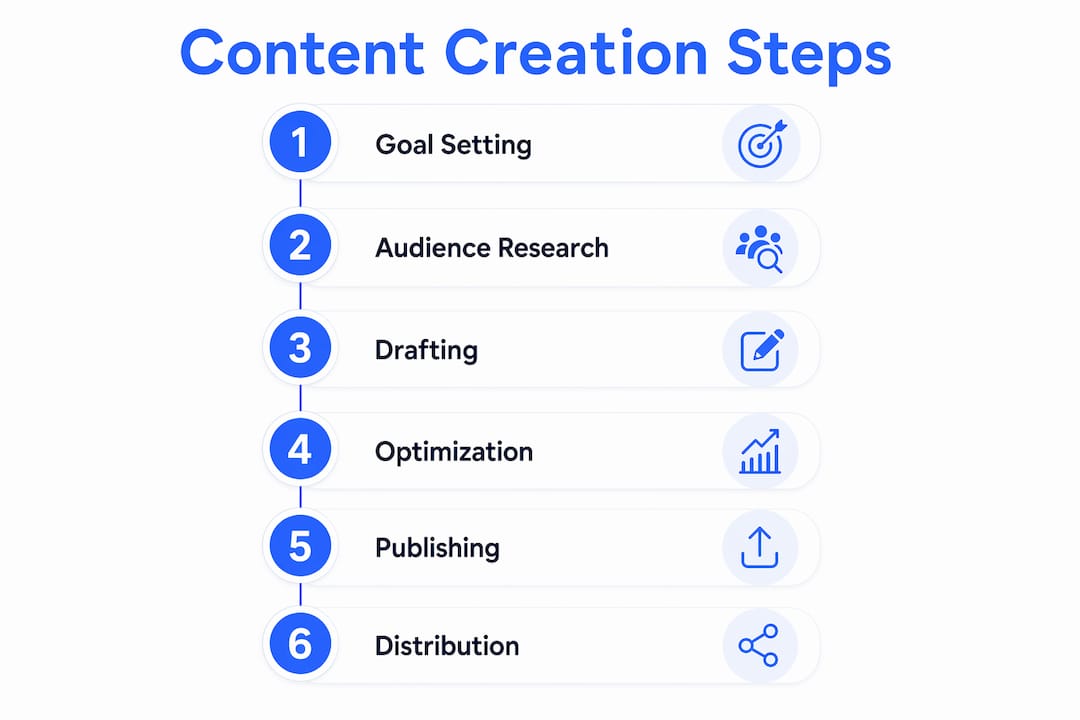
Content marketing content creation follows six core activities: goal setting, research, drafting, optimization, publishing, and promotion. Most frameworks treat these as sequential, but the best teams run them in parallel with AI assistance at every stage. Understanding where each step fits prevents the most common failure mode: producing content with no clear purpose.
Stage 1: Goal Setting. Every piece of content needs a measurable objective before a single word is written. Are you driving organic traffic, generating leads, or building brand authority? HubSpot’s research consistently shows that marketers with documented goals outperform those without them.
Stage 2: Audience Research. Use tools like SparkToro, Google Search Console, or Reddit to find the exact questions your audience is asking. This is where AI research tools like Perplexity or ChatGPT add real speed. They surface related questions and entity clusters that manual research misses.
Stage 3: Drafting and Optimization. AI drafting tools cut production time significantly. Grammarly handles clarity and tone. Surfer SEO or Clearscope handles keyword density and entity coverage. The goal is a draft that is both readable and structured for AI citation.
Stage 4: Publishing and Distribution. Publishing without a distribution plan wastes the production investment. Email lists, social channels, and syndication partners each serve different audience segments. Map each piece to at least two distribution channels before you hit publish.
Dica profissional: Map every content piece to a specific buyer journey stage: awareness, consideration, or decision. Content that does not connect to a stage has no measurable pipeline impact, and that is the clearest sign you have a production schedule instead of a strategy.
True strategy, as experts consistently warn, requires aligning content with buyer journeys and measurable goals. A calendar full of topics is not a strategy. A calendar full of topics tied to pipeline stages, audience questions, and distribution plans is.
Which content types and formats perform best?
Content creation now spans blog posts, videos, short clips, podcasts, infographics, interactive tools, and AI-generated visuals. Each format requires a different production workflow and serves a different marketing objective. The table below compares the most common formats across the dimensions that matter most to marketers.

| Format | Best Use Case | Production Time | AI Discoverability | Platform Ownership |
|---|---|---|---|---|
| Blog / SEO article | Lead generation, organic traffic | Médio | Alta | Owned |
| Short-form video | Brand awareness, social reach | Baixa | Baixa | Rented |
| Long-form video | Education, product demos | Alta | Médio | Rented |
| Podcast | Thought leadership, loyalty | Médio | Médio | Misto |
| Infographic | Data storytelling, backlinks | Médio | Médio | Owned |
| Interactive tool | Lead capture, engagement | Alta | Alta | Owned |
| Email newsletter | Retention, direct audience | Baixa | Baixa | Owned |
Blog posts and SEO-focused content remain the top-performing channels for ROI according to a HubSpot survey of 1,500 marketers. That finding holds because owned content compounds over time. A blog post published today can drive traffic for three years. A social post disappears in 48 hours.
The smartest content marketing strategies stack 3–4 owned formats to build a durable audience. Stacking owned formats creates an audience moat that rented social platforms cannot replicate. Algorithm changes on Instagram or TikTok can cut your reach overnight. Your email list and your blog cannot be taken from you.
Dica profissional: Start with one or two platforms before scaling. Focusing on 1–2 channels first gives you clean engagement data and prevents the burnout that comes from spreading production resources too thin.
For creators on paid social platforms, the format mix looks different. Short-form video drives discovery, while long-form content and direct messaging build the subscriber relationships that generate recurring revenue. You can explore content format variety and how different formats map to monetization goals in more detail.
How does AI transform content creation workflows?
AI has moved from a novelty to a core production tool in content marketing strategies. AI-integrated workflows cut production timelines by 50% or more, which directly increases Go-To-Market velocity without adding headcount. That is not a marginal improvement. It means a team of three can produce what previously required a team of six.
The productivity gains show up across every stage of production:
- Research: AI tools like Perplexity and ChatGPT surface competitor gaps, audience questions, and entity clusters in minutes instead of hours.
- Drafting: Copy.ai, Jasper, and similar tools generate first drafts that writers refine rather than build from scratch.
- Editing: Grammarly and Hemingway Editor handle readability and tone at scale.
- SEO optimization: Tools like Surfer SEO score content against top-ranking pages and flag missing entities in real time.
- Distribution: A consolidated GTM AI platform that integrates research, drafting, and distribution reduces manual handoffs and keeps messaging consistent across channels.
Two optimization concepts are reshaping how marketers think about content visibility. Answer Engine Optimization (AEO) is the practice of structuring content so AI systems like ChatGPT and Perplexity cite it directly in responses. Generative Engine Optimization (GEO) extends that logic to ensure content appears in AI-generated summaries across search engines. Both require entity-rich phrasing, clear topic sentences, and structured headings. The modern marketing program must optimize for AI citation to drive brand visibility in answer engines, which now appear on roughly 16% of all search queries.
The most common pitfall with AI-assisted content is using it as a replacement for strategy rather than an accelerant. Teams that feed AI tools a clear brief, a defined audience, and a mapped buyer journey get dramatically better output than teams that prompt their way to a finished article without any strategic foundation.
How to build a strategic content plan that drives results
A content plan without a content mission is just a list of topics. The mission statement defines who you serve, what problems you solve, and what outcome your content drives. Every piece you produce should pass a simple test: does it serve the mission?
Here is a practical sequence for building a content plan that connects to marketing objectives:
- Define your content mission. Write one sentence: “We create content for [audience] that helps them [solve problem] so they can [achieve outcome].”
- Identify your audience’s top 10 questions. Use Google Search Console, AnswerThePublic, Reddit, and SparkToro. These questions become your content briefs.
- Map questions to buyer journey stages. Awareness questions get educational content. Consideration questions get comparison content. Decision questions get case studies and demos.
- Select two channels and two formats. Do not diversify until you have baseline performance data from a focused effort.
- Set a publishing cadence you can sustain. Consistency beats volume. Successful content marketing relies on creation, curation, and conversation, not quantity.
- Build owned assets first. An email list, a resource library, and a blog give you distribution you control. Social platforms give you reach you rent.
- Track performance at the piece level. Measure organic traffic, time on page, leads generated, and assisted conversions. Not just pageviews.
- Review and adjust monthly. Drop formats and topics that do not move metrics. Double down on what does.
The goal-setting step deserves extra attention. 58% of B2B marketers report only moderate content marketing success, and unclear goals are the most cited reason. A goal like “increase brand awareness” is not measurable. A goal like “generate 500 organic sessions per month from blog content within 90 days” is. The difference between those two goals determines whether your content program has a strategy or just a schedule.
High-quality content also shortens the sales process. 61% of buyers report shorter sales cycles when content addresses their needs directly. That means every well-targeted piece you publish is doing sales work without adding to your headcount.
For creators building paid subscriber bases, the same principles apply. Consistent, problem-solving content on the right channels builds the trust that converts casual followers into paying subscribers. Fanspicy’s guide on promoting paid content covers distribution tactics that apply directly to this goal.
Key takeaways
Effective content creation for marketing requires a documented strategy, owned distribution channels, and AI-integrated workflows to produce consistent, measurable results.
| Point | Details |
|---|---|
| Strategy beats production volume | Map every content piece to a buyer journey stage and a measurable goal before publishing. |
| Owned formats compound over time | Blog posts, email lists, and resource guides build durable audience assets that social platforms cannot replicate. |
| AI cuts production time in half | Integrated AI workflows reduce timelines by 50% or more, increasing output without adding headcount. |
| Start narrow, then scale | Focus on 1–2 platforms first to gather clean engagement data before expanding to new channels. |
| Clear goals drive success | 58% of B2B marketers report only moderate success, most often because goals are vague or undocumented. |
What i’ve learned after years of watching content programs fail
The most common mistake I see is treating a content calendar as a strategy. Teams fill a spreadsheet with topics, assign writers, hit publish on schedule, and then wonder why traffic is flat six months later. A calendar is logistics. Strategy is the layer underneath it that connects every piece to an audience problem, a buyer journey stage, and a measurable outcome.
The second mistake is chasing every new format. Short-form video is hot, so everyone pivots to Reels. Podcasts trend, so everyone launches a show. The result is thin content spread across five platforms with no depth on any of them. The creators and marketers I have seen build real audiences pick two formats, get genuinely good at them, and then expand. That discipline is harder than it sounds when every platform is pushing you to post more.
AI has genuinely changed the math on production. I was skeptical early on, but the 50% reduction in production time is real when AI is integrated properly across research, drafting, and optimization. The caveat is that AI amplifies your strategy if you have one, and amplifies your lack of strategy if you do not. Garbage in, garbage out still applies.
The shift toward AEO and GEO is the most underrated change in content marketing right now. Most teams are still optimizing purely for Google’s blue links. The teams building entity-rich, clearly structured content are getting cited in ChatGPT and Perplexity responses today. That is a distribution channel most of their competitors are completely ignoring.
My honest advice: document your content mission, own your distribution, and integrate AI at every production stage. Those three moves will put you ahead of the majority of content programs running in 2026.
— fan
Take your content strategy further with Fanspicy
Building a content strategy that actually drives revenue requires more than good writing. It requires the right platform, the right formats, and a clear promotion plan.
Fanspicy supports creators and marketers who want to turn content into consistent income. Whether you are building a paid subscriber base, exploring live content formats, or looking for a platform that gives you direct control over your audience and revenue, Fanspicy is built for that. The platform combines paid social media, live cam, and creator monetization tools in one place. Visit Fanspicy to explore how the platform supports your content and promotion strategy, or check out the social media content marketing guide for platform-specific tactics.
PERGUNTAS FREQUENTES
What is content creation for marketing?
Content creation for marketing is the strategic process of planning, producing, and distributing digital content to attract and engage a defined audience and drive measurable business outcomes. It spans formats including blog posts, video, podcasts, infographics, and interactive tools.
What are the best content types for marketing ROI?
Blog posts and SEO-focused content are the highest-ROI channels according to a HubSpot survey of 1,500 marketers. Owned formats like email newsletters and resource guides compound in value over time, unlike social posts that lose reach within 48 hours.
How does AI improve content marketing workflows?
AI-integrated content workflows cut production timelines by 50% or more, according to Copy.ai research. Tools like Grammarly, Surfer SEO, and Jasper handle editing, optimization, and drafting, freeing teams to focus on strategy and distribution.
How many platforms should i focus on first?
Start with one or two platforms before scaling. A focused approach produces cleaner engagement data and prevents resource burnout. Expand to additional channels only after you have established baseline performance metrics on your initial platforms.
Why do most content marketing programs underperform?
58% of B2B marketers report only moderate content marketing success, most often because goals are unclear or undocumented. Confusing a production schedule with a strategy is the root cause. True strategy connects every content piece to a buyer journey stage and a measurable pipeline goal.