

Spis treści
TL;DR:
- Localized content involves adapting brand messages, visuals, tone, and formats to resonate naturally within specific markets, beyond simple translation.
- Effective localization fosters authentic connections, improves trust, and boosts revenue by aligning with cultural values and norms.
Localized content is one of those concepts that sounds simple until you try to execute it. Most marketers assume it means translation. It doesn’t. What is localized content, really? It’s the practice of adapting brand messages, visuals, tone, formats, and cultural references so content feels native to a specific market rather than imported. The distinction matters enormously. A translated page reads correctly. A localized page resonates. For content creators and marketing professionals competing for attention across borders, that gap between correct and resonant is where revenue lives.
Spis treści
- Key Takeaways
- What localized content actually means
- Why localization matters for marketing success
- Common localization mistakes marketers make
- How to build a localized content strategy
- Measuring and optimizing localized content
- My honest take on localization after years in content strategy
- Take your content strategy further with Fanspicy
- FAQ
Key Takeaways
| Point | Details |
|---|---|
| Localization goes beyond translation | Effective localized content adapts tone, imagery, cultural references, and formats for each specific market. |
| Cultural misalignment is costly | Nearly 41% of marketers have had to revise or pause campaigns due to localization mistakes. |
| Governance prevents brand drift | Without early standards and oversight, local teams diverge from global brand positioning. |
| AI needs human backup | Almost 48% of marketers require human native speaker review before publishing AI-localized content. |
| Measure locally, not globally | Set market-specific KPIs and baselines within the first 6 months for accurate performance tracking. |
What localized content actually means
The definition of localized content covers far more ground than swapping words from one language to another. Localized content adapts brand messages across language, imagery, tone, and formats to feel genuinely native to a target market. That means reconsidering color choices (white signals mourning in several Asian cultures, not purity), adjusting humor that doesn’t survive cultural translation, reformatting dates and currencies, and selecting imagery that reflects the local audience rather than a generic stock photo library.
Understanding where localization sits relative to two neighboring practices helps clarify the work involved:
| Approach | What it changes | Who does it |
|---|---|---|
| Translation | Words only | Translator |
| Localization | Language, format, tone, visuals, cultural context | Localization specialist + native reviewer |
| Transcreation | Full creative reimagining for emotional impact | Creative copywriter with cultural expertise |
Transcreation is the most intensive form. Think of a global ad campaign where the slogan gets completely rewritten for each market because a word-for-word version would sound absurd or offensive. Localization sits in the middle: thorough cultural adaptation without a full creative rebuild.
Cultural context is what makes the difference between content that’s understood and content that drives authentic connections. A product description can be grammatically perfect in Spanish and still feel cold, corporate, or out of touch with a Mexican versus an Argentine audience, because regional references, formality levels, and humor conventions differ significantly between them.
Pro Tip: When briefing localization teams, always specify the target region, not just the language. “Spanish” is not a market. “Mexico City professionals aged 25 to 40” is a market.
Why localization matters for marketing success
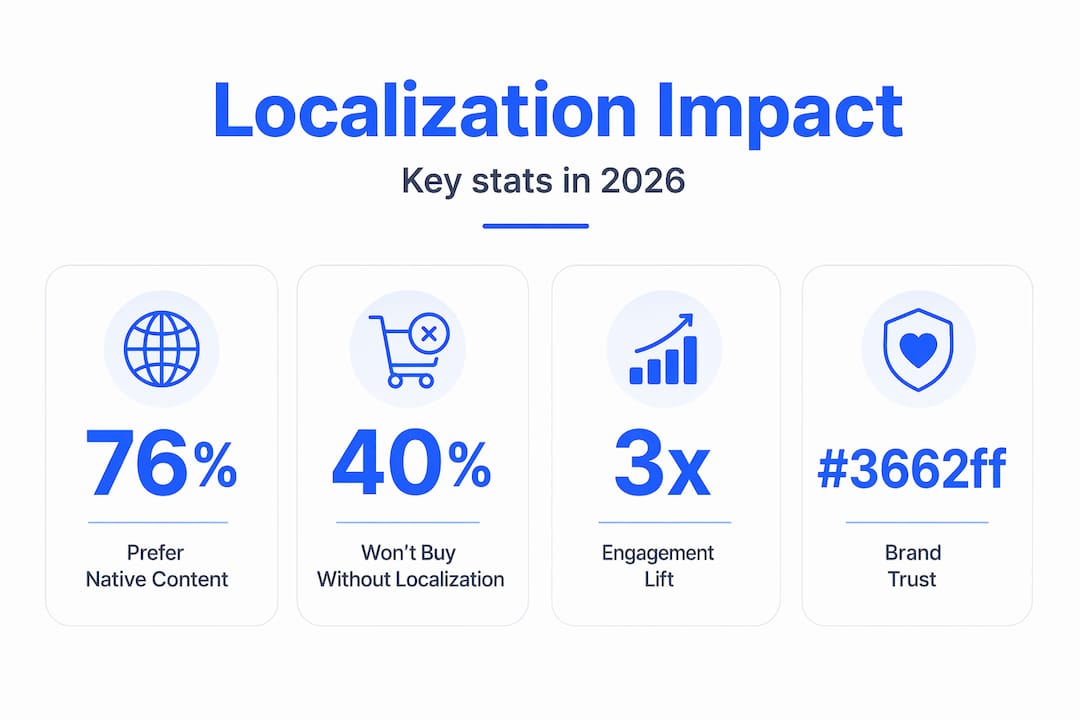
The numbers behind consumer preference for native language content are striking. 76% of consumers prefer buying from websites that present information in their native language, and 40% will simply never purchase from a site that isn’t available in their language at all. That’s not a preference. That’s a hard exit.

Beyond language, cultural alignment shapes purchase decisions in ways that are harder to measure but equally real. When a brand’s messaging reflects local values, local humor, and local visual norms, trust builds faster. When it doesn’t, something feels off to the reader even if they can’t name exactly why.
The cost of getting this wrong is concrete:
- Nearly 41% of marketers have had to revise or pause campaigns post-launch because of localization issues.
- 39% reported individual localization mistakes that cost more than $10,000 to fix.
- 40% lost competitive opportunities directly because localization was too slow or too poor to support market entry timing.
There’s also a subtler cost: brand perception damage. A localization error doesn’t just lose a sale. It signals to local audiences that the brand didn’t care enough to do it properly. That signal is hard to walk back once it lands.
“Aligning messaging with local values fosters authentic connections that global campaigns simply cannot achieve.” — Luth Research
For content creators, this logic applies to every market you want to reach. A creator on a global platform who speaks only to one cultural register will always be leaving audience segments untouched.
Common localization mistakes marketers make
Localization failures tend not to come from dictionary errors. Almost 23% of marketers identify cultural tone sounding “off” as their biggest mistake, well ahead of terminology or grammar problems. This is a meaningful finding. It means the failure mode most marketers should worry about isn’t inaccuracy. It’s inauthenticity.
Here are the most common errors worth understanding before you invest in a localization program:
-
Translating idioms literally. “Break a leg” is motivating in American English. Translated word for word into many other languages, it’s alarming or meaningless. Every language carries idioms with zero literal equivalents, and they require creative substitution, not word mapping.
-
Ignoring UI constraints. German text typically expands by 30% compared to its English source. Arabic requires full right-to-left redesigns. Korean often contracts. If your design team doesn’t account for these changes from the start, you’ll end up with broken buttons, truncated headlines, and layouts that fall apart.
-
Skipping native speaker review. AI-generated or machine-translated content can pass a surface read and still contain culturally tone-deaf phrasing. Human native speakers catch what automated tools miss, especially in humor, formality, and cultural sensitivity.
-
Localizing inconsistently across touchpoints. A brand that localizes its website but leaves its social ads, customer support, and email campaigns in generic global English creates a fragmented experience. Audiences notice the inconsistency even when they can’t articulate it.
-
Treating localization as a one-time project. Markets shift, cultural conversations move fast, and what resonated in 2023 may feel dated or misaligned today. Localized content requires ongoing maintenance, not a single launch effort.
Pro Tip: Always run a cultural readiness check before launch. Brief a native speaker from your target market to review content not just for accuracy, but for whether it sounds like something a local brand would actually say.
How to build a localized content strategy
A successful localized content strategy operates on three layers at once: market adaptation, technical localization, and search optimization. Treating them as separate projects is where most teams lose time and consistency.
Start with market-specific research before writing a single word. Understand the search behavior, local competitors, preferred content formats, and cultural values of the audience you’re targeting. Experts recommend establishing market-specific baselines within the first six months of entering a new market so you have real performance data to optimize against.
The strategic framework breaks down like this:
| Layer | What it covers | Priority |
|---|---|---|
| Market adaptation | Cultural references, tone, imagery, local values | High for all content |
| Technical localization | UI design, character limits, RTL support, date formats | High for product content |
| Search optimization | Local keyword research, regional search intent | High for organic content |
On the governance side, localization must be treated as a product function, not a translation task handed off to a freelancer. Without governance structures, local teams adapt messaging in ways that gradually diverge from global brand standards. This brand drift is one of the most damaging long-term effects of under-resourced localization programs.
- Build a localization style guide for each major market, covering tone, approved terminology, and cultural sensitivities.
- Prioritize content types: product pages and conversion copy need deep localization; blog articles may need moderate adaptation.
- Use AI to handle volume and first drafts. Have native human reviewers approve anything customer-facing.
Pro Tip: Don’t localize everything at once. Map your content by conversion value and start deep localization with high-traffic, high-intent pages first. Build the governance infrastructure in parallel so you’re not retrofitting it later.
For creators working across markets, the same logic applies at a smaller scale. Adapting your brand voice, visual presentation, and communication style for different audience segments is localized content marketing in practice. Fanspicy’s guide on adult marketing strategies covers relevant examples of how market-specific adaptation works in creator contexts.
Measuring and optimizing localized content
Getting localization right is not a one-and-done process. Effective measurement requires setting KPIs that reflect local market behavior rather than applying global benchmarks uniformly across every region.
Useful metrics to track by market include:
- Organic traffic from local-language searches, not just overall traffic.
- Conversion rates segmented by region and language version of a page.
- Bounce rates on localized pages compared to source language versions.
- Customer support volume related to confusion, which often signals localization gaps.
- Social engagement patterns, including whether local audiences share, comment, and engage in ways that indicate cultural relevance.
Iterative testing drives the most improvement. Run A/B tests on localized headlines, calls to action, and imagery choices. Collect feedback from local audiences through surveys or community channels. Treat each localized market as its own content product with its own optimization cycle.
The compounding benefit here is real. Markets where localization is treated as an ongoing practice rather than a setup task consistently outperform markets where brands localize once and walk away. Audiences in well-localized markets show higher lifetime value, stronger brand affinity, and lower churn.
My honest take on localization after years in content strategy
I’ve watched brands spend enormous budgets on market research for new regions and then hand the actual localization to the cheapest available option. The research tells you what matters to the audience. The localization is how you act on that knowledge. Disconnecting the two makes the research useless.
In my experience, cultural context transforms localization from an operational task into a genuine competitive advantage. Brands that understand this treat localization the way they treat product development: with dedicated resources, clear ownership, and continuous improvement cycles.
The mistake I see most often is treating localization as something you do after the “real” work of content creation is finished. It should be built into the process from the brief stage. When you know from day one that a campaign will run in five markets, those markets should shape the creative, not be bolted on afterward.
I’ve also seen brand drift happen in ways that were genuinely difficult to reverse. A regional team adapts messaging to feel locally relevant, then another regional team does the same, and eighteen months later the global brand barely holds together as a coherent identity. Governance structures that establish brand standards early are the only real protection against this. Not trust. Not good intentions. Structure.
— fan
Take your content strategy further with Fanspicy
If you create content for diverse audiences and want your work to connect across markets, the strategy matters as much as the content itself. Fanspicy is built for creators who understand that reaching a global audience takes more than publishing volume.
Fanspicy’s platform gives creators the tools to build audience relationships across regions with content that actually lands. Whether you’re adapting your brand voice for new markets or refining how you present your work to international subscribers, the creators on Fanspicy are doing exactly that. Explore somlusolme’s profile to see how top creators on the platform approach audience engagement and market presence. If you’re mapping your localized content approach for 2026, Fanspicy’s creator business models guide is a practical place to start.
FAQ
What is the definition of localized content?
Localized content is brand messaging adapted beyond translation to include cultural references, tone, imagery, and formats specific to a target market. The goal is for content to feel native to the audience, not imported.
How is localization different from translation?
Translation changes words. Localization changes the full experience of content, including cultural context, visual choices, and tone, so the audience connects emotionally rather than just understanding literally.
Why is localized content important for marketers?
76% of consumers prefer native language information, and 40% will not buy from sites not in their language. Localization directly affects trust, conversion, and competitive positioning in new markets.
What are the most common localized content mistakes?
The biggest mistake is cultural tone misalignment, not grammar errors. Nearly 50% of marketers cite messaging that felt culturally off as their primary localization failure, and 41% had to revise or pause campaigns as a result.
How do you measure localized content performance?
Track local-language organic traffic, regional conversion rates, and bounce rates on localized pages. Set market-specific KPIs within six months of launch and run iterative A/B tests on localized creative elements.