
目次
TL;DR:
- Relying on a single platform exposes creators to sudden algorithm changes that can significantly reduce their reach and income. Diversifying to alternative platforms offers benefits like content ownership, direct audience relationships, lower fees, and flexible monetization options. Focusing on two to three platforms and using owned media builds creator independence and resilience against platform risks.
You built your audience on one platform. Then one algorithm update wiped out 70% of your reach overnight. That is not a hypothetical. That is the documented reality of single-platform dependence for thousands of creators right now. Why creators need alternative platforms has never been a more urgent question. The answer goes beyond just hedging your bets. It is about owning your business, controlling your income, and building something no platform can take from you.
目次
- Key takeaways
- Why creators need alternative platforms: the risk you are ignoring
- Benefits of alternative platforms for monetization and audience growth
- Types of alternative platforms worth knowing
- Building a multi-platform presence without burning out
- How to evaluate and choose the right alternative platform
- My take on platform independence
- Build your creator independence with Fanspicy
- よくあるご質問
Key takeaways
| Point | Details |
|---|---|
| Algorithm risk is real | A single update can cut organic reach by 70%, making platform diversification a survival strategy. |
| Cost savings add up fast | Moving to alternative platforms can save creators over $22,000 per year in fees. |
| Decentralized platforms drive engagement | Audiences on independent platforms express more authentic feedback and deeper emotional investment. |
| The COPE method prevents burnout | Creating once and publishing everywhere keeps content consistent without multiplying your workload. |
| Own your audience data | Email lists and private communities give you direct access no algorithm can remove. |
Why creators need alternative platforms: the risk you are ignoring
Most creators treat platforms as partners. They are not. Platforms are gatekeepers with goals that have very little to do with your business. Their algorithms optimize for ad inventory and session time, not for making sure your best content reaches your most loyal fans.
This is what makes the “rented land” model so dangerous. You spend years building an audience on someone else’s property. Then the landlord changes the rules.
The consequences are not abstract:
- Algorithm shifts have been documented to cut organic reach by 70% with no warning and no appeal process.
- Platforms can suspend or permanently ban accounts, taking years of audience-building with them.
- API pricing changes can eliminate the scheduling and analytics tools your entire workflow depends on overnight.
- Monetization terms shift constantly, and creators have zero leverage to negotiate.
“The great creator exodus is driven by a fundamental misalignment between what platforms need and what creators need. Platforms optimize for engagement metrics. Creators need sustainable income.” — Clapper Blog
The creators who survive these shifts are the ones who treated platform presence as a distribution channel, not a foundation. Your foundation has to be something you control. That is the core argument for platform diversity and the reason this conversation matters more than ever.
Benefits of alternative platforms for monetization and audience growth
Platform independence is not just about risk management. The advantages of diverse platforms are genuinely additive to your income, your audience quality, and your creative longevity.
Here is what creators actually gain by expanding beyond a single platform:
-
Greater content ownership. On most major platforms, the terms of service grant them sweeping rights over your content. Independent platforms typically return full ownership to you, which matters when your content is your primary asset.
-
Direct audience relationships. Decentralized and independent platforms are not optimizing for time-on-site. Audiences on these platforms express richer, more emotional feedback in comment sections, which translates to stronger community and higher conversion rates for paid offerings.
-
Real cost savings. Creators who have moved from subscription-heavy platforms to leaner alternatives report saving over $22,000 annually in fees. That is not a marginal difference. That is money that goes directly to your bottom line.
-
Monetization flexibility. Alternative platforms often support models major platforms do not: pay-per-view content, live tipping, subscription tiers, and one-time purchases. This variety matters enormously for creators in adult content, coaching, or niche entertainment where hybrid monetization outperforms single-stream revenue.
-
Reduced creative burnout. When you stop chasing one platform’s algorithm, you get to create content that actually fits your audience. 45% of full-time creators report burnout tied to multi-platform pressure, but strategic platform selection and smart content repurposing cuts that pressure significantly.
プロのアドバイス Before adding any new platform, ask: does my ideal audience actually spend time here, or am I just chasing distribution volume? Presence without the right audience is just noise.
Types of alternative platforms worth knowing
Not all alternatives are built the same, and the right choice depends entirely on your content type, audience, and monetization goals. Here is a breakdown of the major categories and what makes each worth considering.
| Platform Type | 最適 | Key Advantage |
|---|---|---|
| Decentralized social | Community building, authentic feedback | No central algorithm suppressing reach |
| Newsletter platforms | Long-form content, direct subscriber access | Full ownership of subscriber list |
| Self-hosted sites | Permanent content archives, full control | No third-party dependency |
| Paid subscription/fan platforms | Premium content, recurring revenue | Direct monetization without ad revenue reliance |
| Hybrid OTT/podcast apps | Audio and video creators | Discovery to monetization funnel in one product |
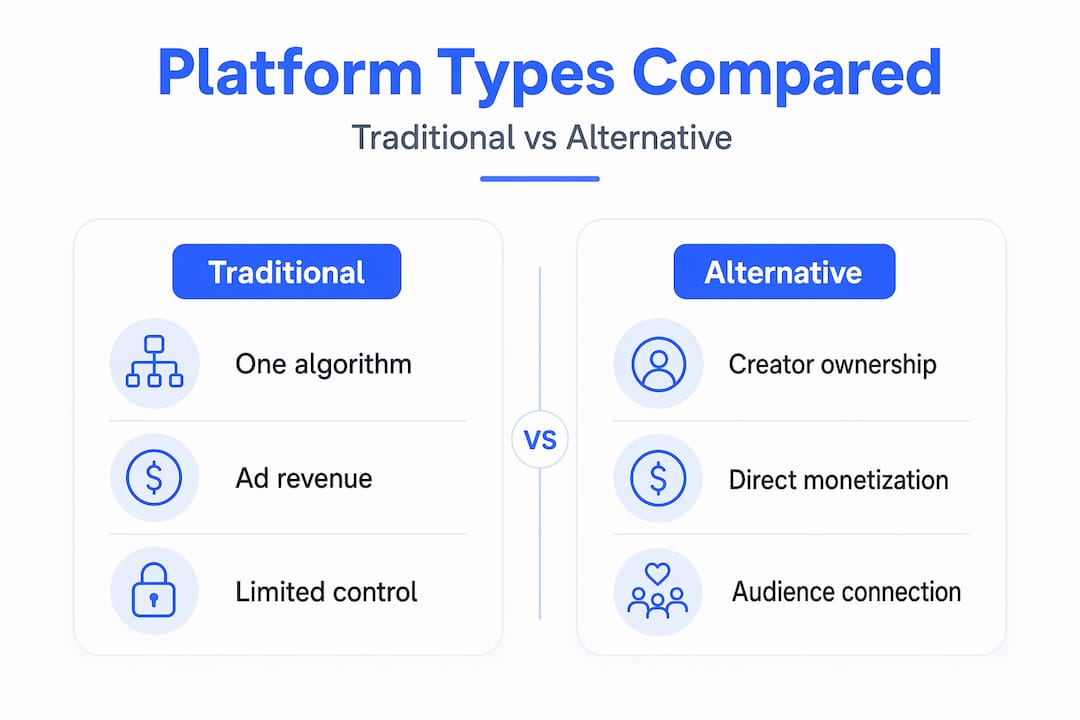
The most important insight here is about the hybrid approach. Successful creators do not abandon major platforms entirely. Instead, they use them purely as discovery engines and funnel audiences toward owned or independent premium content. You use the reach of large platforms to get found, then move your most engaged audience to a space where you control the relationship and the revenue.
This is why platform diversity for creators is about architecture, not just hedging. You are designing a system.
- Decentralized platforms like Mastodon or Bluesky let you tap into audiences that actively distrust algorithmic feeds, making engagement per follower significantly higher.
- Newsletter platforms with exportable subscriber lists give you something irreplaceable: contact data you actually own.
- Paid fan platforms, particularly those designed for adult content and subscription media, give you monetization structures that general platforms cannot or will not offer.
Building a multi-platform presence without burning out
The biggest mistake creators make when they decide to diversify is trying to be everywhere at once. That is how you end up producing mediocre content on six platforms instead of great content on two or three.
Here is a practical approach that works:
-
Pick 2 to 3 platforms based on your audience, not trends. Focusing on fewer platforms where your ideal audience actually lives consistently outperforms spreading yourself thin across every emerging channel. Research where your specific niche communities gather before committing.
-
Adopt the COPE strategy. Create Once, Publish Everywhere means you produce a single source-of-truth piece of content, then adapt it for each platform’s format. A long video becomes a clip, a caption, a newsletter section, and a community post. This approach keeps output consistent without requiring proportionally more creative energy.
-
Prioritize quality over posting frequency. Algorithms reward consistency, but audiences reward quality. One excellent post that earns shares and saves outperforms five forgettable ones in almost every metric that matters for long-term growth.
-
Use scheduling tools carefully and back up everything. Automation is useful, but platform API changes have wiped out creator workflows without notice. Maintain local or cloud backups of your content and engagement data so no single platform change can erase your work.
-
Build owned media in parallel. An email list is the most resilient audience asset a creator can have. Private community memberships and direct subscriber channels mean you maintain access to your audience regardless of what happens to any platform.
プロのアドバイス Set up a simple content calendar that maps one core piece of content per week to three platform-specific formats. You will stay consistent without tripling your production workload.
How to evaluate and choose the right alternative platform
Picking the wrong alternative platform costs you time, money, and sometimes audience trust. Before you commit, run through these criteria:
- Fee structure. What percentage of your revenue does the platform take? Some take 5%, others take 20% or more. Switching to alternatives with better fee terms has made a material difference for many creators.
- Monetization tools available. Does the platform support the revenue models you want? Subscriptions, tips, pay-per-view, live sessions, and merchandise integration are not universally available.
- Technical overhead. Self-hosted solutions give maximum control but require maintenance. Hosted platforms are simpler but add dependency. Choose based on your actual technical comfort level.
- Community culture. A platform with highly engaged users in your niche is worth more than a larger platform where your content gets lost. Look at how existing creators in your category are performing there.
- Discovery and growth potential. Some platforms favor new creators; others heavily advantage established accounts. Early adopter advantage is real, but only on platforms with genuine growth trajectories.
- Data portability. Before you invest time on any platform, check whether you can export your subscriber list, content, and analytics. If you cannot, you are back to rented land.
The importance of creator independence comes down to one question: if this platform disappeared tomorrow, what would you still have? If the answer is “nothing,” that is your signal to diversify now, not after the next algorithm change.
You can get more grounded guidance on platform selection strategies in our breakdown of fan platforms built specifically for creators who want more control over their income.

My take on platform independence
I have watched creators lose years of work in a single afternoon because a platform decided their content violated a policy that did not exist the week before. I have also seen creators who built on three or four channels, including owned ones, absorb those same shocks without missing a payment.
What I have learned is that over-reliance on any single platform is not just a business risk. It is a psychological one. When your income depends entirely on one algorithm, you start creating for the algorithm instead of your audience. That shift is subtle at first, then it becomes corrosive.
The hard lesson I keep coming back to: the creators who thrive long-term are the ones who treated major platforms as traffic sources, not homes. They built their homes somewhere they owned. Email lists. Private communities. Subscription platforms where they control the pricing, the content format, and the relationship.
Burnout from managing too many channels is real. I am not going to pretend otherwise. But the solution is not one platform. The solution is fewer platforms, chosen strategically, with owned media at the center.
My practical advice: pick your two best-performing platforms for discovery, pick one owned channel for monetization, and stop there until the system runs itself. Add a fourth only when the first three are genuinely stable.
— fan
Build your creator independence with Fanspicy
If you are ready to stop building on rented land and start earning on your own terms, Fanspicy is built for exactly that transition.
Fanspicy is a paid social media and live cam platform designed for creators who want subscription-based income, direct fan engagement, and monetization structures that major platforms simply will not offer. You keep more of what you earn, you own your audience relationship, and you are not subject to the content restrictions that have pushed adult creators and niche influencers off conventional platforms. Creators like somlusolme そして Jackie Pott are already using Fanspicy as a primary revenue platform. If you want to see what recurring subscriber revenue looks like in practice, this is a strong place to start.
よくあるご質問
Why do creators need alternative platforms?
Relying on one platform exposes creators to sudden algorithm changes that can reduce reach by 70% overnight, along with policy shifts, monetization cuts, and account risks they have no control over.
What are the main benefits of alternative platforms for creators?
Alternative platforms offer greater content ownership, better monetization options like subscriptions and pay-per-view, direct audience access, and significantly lower fees, with some creators saving over $22,000 per year by switching.
How many platforms should a creator actually use?
Most creators perform best on 2 to 3 focused platforms rather than spreading effort across many. The key is choosing platforms where your specific audience is already active, not where the overall user numbers are biggest.
What is the COPE strategy for multi-platform content?
COPE stands for Create Once, Publish Everywhere. You produce one core piece of content and adapt it into multiple formats for different platforms, which keeps output consistent without multiplying your creative workload.
How does Fanspicy help creators diversify their income?
Fanspicy gives creators access to subscription-based revenue, live cam monetization, and direct fan payments on a platform built specifically for adult and niche content creators who need income structures that mainstream platforms do not support.