

Indice dei contenuti
TL;DR:
- A smart, repeatable content workflow is more effective than high-volume posting for creator success.
- Combining automation with human review optimizes content quality and engagement.
- Regularly reviewing and refining your workflow ensures long-term growth and sustainability.
Most creators believe that posting more content automatically leads to more fans and higher earnings. That assumption costs time, energy, and real money. Short-form video and UGC consistently outperform high-volume posting strategies on paid social platforms. What actually separates thriving creators from burned-out ones is not output volume but a smart, repeatable custom content workflow. This article breaks down exactly how to build, refine, and optimize that workflow so you can produce content your audience craves without running yourself into the ground.
Indice dei contenuti
- What is a custom content workflow?
- Key elements of an efficient workflow
- Common pitfalls and how to avoid them
- Implementing and optimizing your workflow
- Why workflow mastery beats content quantity
- Take your custom content workflow further with Fanspicy
- Frequently asked questions
Punti di forza
| Point | Details |
|---|---|
| Workflow efficiency matters | A well-structured custom workflow means higher engagement and less creator burnout. |
| Balance automation and creativity | Use AI for scaling, but always add human review to keep content authentic. |
| Short-form and UGC dominate | Prioritize short videos and user content for paid social success. |
| Constant iteration fuels growth | Regularly optimize your workflow to stay ahead and connect with your fans. |
What is a custom content workflow?
A custom content workflow is a structured, repeatable process you design specifically for your content style, platform, and audience. Unlike generic content schedules, a custom workflow accounts for your unique creative process, the specific demands of paid social platforms, and the types of content that actually convert casual viewers into paying subscribers.
Think of it like a production line you build yourself. Every step, from the initial idea to the final post, has a defined place and purpose. A content creation workflow removes guesswork and replaces it with intentional decisions that compound over time.
The core stages of a custom content workflow include:
- Ideation: Generating content ideas based on audience data, trends, and personal brand direction
- Creation: Producing the actual content, whether video, photos, written posts, or live sessions
- Review: Checking for quality, consistency, and alignment with your brand voice
- Publishing: Scheduling and distributing content across your paid platforms at optimal times
- Tracking: Measuring performance metrics to understand what resonates and what falls flat
Each stage feeds into the next. Skip one and the whole system weakens. A streamlined workflow boosts content output consistency and engagement on paid social platforms, which is why top creators treat their workflow as seriously as the content itself.
Here is a quick look at how workflow stages impact key creator outcomes:
| Workflow stage | Primary benefit | Impact on engagement |
|---|---|---|
| Ideation | Fresh, relevant content ideas | High: keeps audience interested |
| Creation | Consistent quality output | High: builds trust and loyalty |
| Review | Brand alignment and polish | Medium: reduces churn |
| Publishing | Optimal timing and reach | High: maximizes visibility |
| Tracking | Data-driven improvement | Very high: compounds over time |
Understanding the content types for revenue that perform best on your specific platform is also a critical part of building your workflow from the ground up. Short-form video and user-generated content tend to dominate engagement metrics, so your workflow should prioritize producing these formats efficiently and consistently.
Key elements of an efficient workflow
Knowing the stages is one thing. Building a workflow that actually runs smoothly is another. Efficiency comes from combining the right tools, habits, and creative instincts in a way that fits your specific situation.
Here are the essential elements to focus on:
- A content calendar: Map out your posting schedule at least two weeks in advance. This prevents last-minute scrambles and keeps your publishing rhythm consistent.
- Ideation systems: Use audience polls, comment analysis, and platform analytics to generate ideas your fans actually want to see.
- Automation tools: Schedule posts, automate replies to common messages, and use batch creation sessions to maximize your production time.
- Human review checkpoints: Every piece of content should pass through a personal quality check before going live.
- Platform-specific formatting: Tailor each piece of content to the platform’s native format, aspect ratio, and audience expectations.
AI for social media scale confirms that creativity and automation must work together. AI can accelerate content production, but it needs human review to avoid generic, forgettable output. Your personality and perspective are what fans pay for. Automation handles the repetitive logistics so you can focus on that.
Here is a comparison of manual versus automated workflow approaches:
| Approach | Velocità | Quality control | Scalability | Best for |
|---|---|---|---|---|
| Fully manual | Slow | Alto | Basso | Small, highly personal content |
| Fully automated | Fast | Basso | Alto | High-volume, low-touch content |
| Hybrid | Balanced | Alto | Medium-high | Most paid social creators |
The hybrid model wins for most creators on paid platforms. You get the speed benefits of automation without sacrificing the authentic connection that drives subscriptions. Explore social media marketing tips to find the right balance for your niche, and consider the content curation role in keeping your feed fresh without burning out your creative energy.
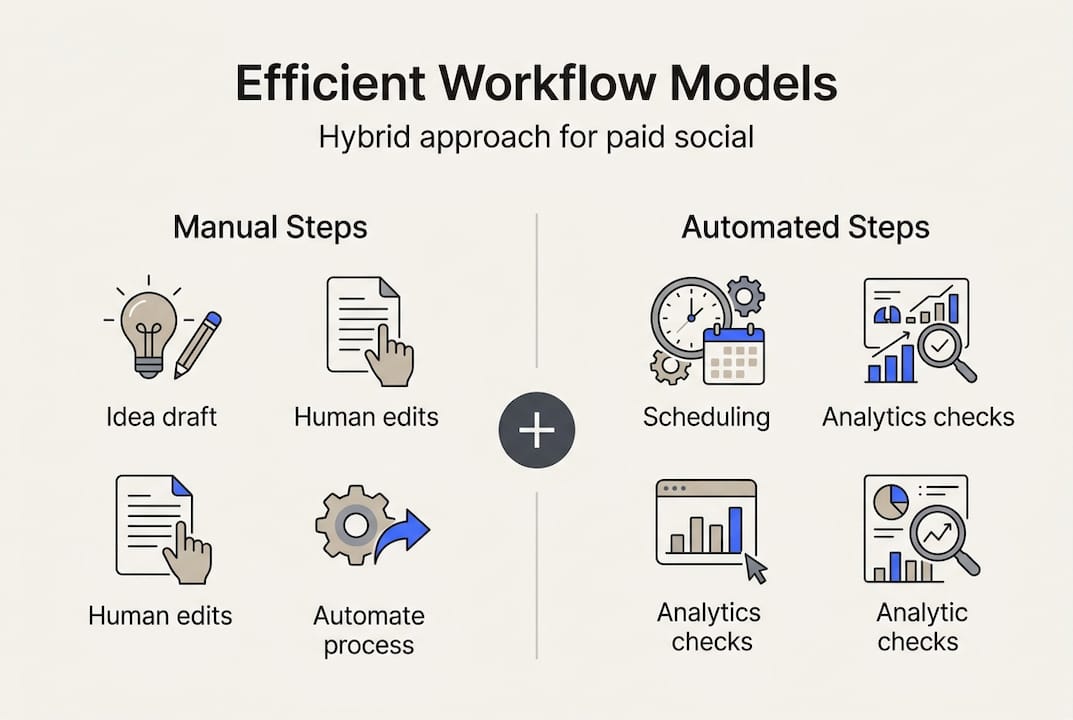
For deeper strategic frameworks, expert content strategies offer practical models you can adapt to your own workflow immediately.
Pro Tip: Use AI tools to generate your first draft or outline for captions, scripts, and post ideas. Then rewrite them in your own voice. This cuts production time significantly while keeping your content feeling personal and genuine.
Common pitfalls and how to avoid them
Even well-designed workflows break down. Knowing where creators most often go wrong helps you sidestep those mistakes before they cost you subscribers or momentum.
The most common workflow pitfalls include:
- Over-relying on automation: Scheduling tools and AI assistants are useful, but they cannot replicate your voice or respond to real-time audience shifts. Creators who automate everything often see engagement drop because fans can feel the disconnect.
- Ignoring performance metrics: Posting without checking your analytics is like driving with your eyes closed. Your data tells you exactly what your audience wants more of and what they skip.
- Skipping audience feedback: Comments, DMs, and poll responses are free market research. Creators who ignore this feedback miss obvious opportunities to improve content relevance.
- Not optimizing for platform specifics: What works on one platform rarely translates directly to another. Aspect ratios, caption lengths, posting times, and even tone vary significantly between platforms.
- Treating the workflow as permanent: Platforms evolve, audience tastes shift, and your own creative direction changes. A workflow that worked six months ago may already be outdated.
“The most successful paid creators treat their workflow as a living system, not a fixed rulebook. They review, adjust, and improve it regularly based on what the data and their audience tell them.”
Human creativity is key and creators should avoid relying solely on automation for engaging paid social content. Your audience follows you for a reason. Protect that reason by staying actively involved in every piece of content you publish.
For fresh ideas that keep your content feeling original, browse content creation ideas to spark new directions without starting from scratch.
Pro Tip: Block one hour each month specifically for a workflow review session. Look at your top-performing content, your worst-performing content, and any production bottlenecks you hit during the month. Then make one or two targeted adjustments. Small, consistent improvements add up fast.
Implementing and optimizing your workflow
Building a workflow that actually sticks requires a structured starting point and a commitment to ongoing refinement. Here is how to get it running from day one.
- Audit your current process: Write down every step you currently take from idea to published post. Identify where you lose the most time or energy.
- Define your content pillars: Choose three to five content themes that align with your brand and audience interests. These pillars guide your ideation and keep your feed cohesive.
- Set up your tools: Choose a content calendar tool, a scheduling platform, and a basic analytics dashboard. Keep it simple at first.
- Create a batch production schedule: Dedicate specific days to filming, editing, and scheduling rather than doing everything daily. Batching is one of the most effective ways to reduce decision fatigue.
- Establish feedback loops: After each publishing cycle, review your metrics and note what surprised you. Use those insights to adjust your next cycle.
- Test platform variations: Experiment with different formats, posting times, and caption styles on each platform. Track results and double down on what works.
Iterative workflow refinement leads to higher engagement and streamlined production for paid platforms. The creators who grow fastest are not the ones who get it perfect on the first try. They are the ones who test quickly, learn fast, and adjust without ego.

Exploring business models for creators can also reveal new revenue streams that your workflow should be designed to support. Pair that with subscription content tips to build a recurring revenue engine that your workflow feeds consistently.
For a detailed workflow optimization guide, Buffer’s resource library offers practical frameworks you can adapt directly to your paid social setup.
Pro Tip: Set one measurable goal for each workflow element every month. For example, aim to increase your average video watch time by 10% or reduce your content production time by 20%. Tracking specific numbers keeps your optimization focused and motivating.
Why workflow mastery beats content quantity
Here is the uncomfortable truth most platforms and marketing gurus will not say out loud: posting more content without a strong workflow actively hurts your brand. It trains your audience to expect mediocrity. It dilutes the moments that actually matter. And it burns you out faster than almost anything else in the creator economy.
Creators who master workflows see longer-lasting engagement compared to those relying on mass content output. That is not a minor difference. It is the gap between a creator who builds a loyal, paying community and one who chases trending formats until they quit.
Workflow mastery creates consistency, and consistency builds trust. Fans on paid platforms are not just buying content. They are buying a relationship and a reliable experience. A polished workflow lets you deliver that experience without burning through your creative energy. Explore workflow process insights to see how top creators structure their systems for long-term sustainability.
The creators we see thriving on paid platforms are not the ones posting ten times a day. They are the ones who post with intention, engage with purpose, and refine their process constantly.
Take your custom content workflow further with Fanspicy
Building a custom content workflow is only half the equation. The other half is having the right platform to support it. Fanspicy is built for paid social creators who want more than just a place to upload content. It is a space designed to help you connect deeply with your audience, monetize your workflow efficiently, and grow sustainably.
Whether you want to see how a creator like somlusolme structures their workflow or draw inspiration from profiles like jackiepott, Fanspicy gives you real examples of what a high-performing content workflow looks like in practice. Start exploring Fanspicy today and find the tools, community, and platform features that make your workflow work harder for you.
Frequently asked questions
How long does it take to set up a custom content workflow?
Most creators can establish a basic workflow in a few hours, but full optimization takes several weeks of testing and refinement before it runs smoothly.
Which content types are best for paid social engagement?
Short-form video and UGC currently perform best for audience interaction and conversion on paid social platforms.
Can I automate my workflow without sacrificing quality?
Automation speeds up production, but human review prevents generic output and keeps your content feeling personal and authentic.
How often should I review and update my workflow?
Monthly reviews are recommended so you can adjust for platform updates and audience trends, ensuring your workflow stays efficient and engaging over time.