

Indice dei contenuti
A good social media marketer ties every post to a goal, knows exactly who the audience is, shows up in the conversation instead of just broadcasting, and tests one change at a time so the results teach something. Tools and trends change every quarter. Those four habits do not. This guide walks through them in order, with the numbers, rules and routines that make them work, plus the legal basics many beginners learn too late.
TL;DR
- Start with a SMART goal tied to a business result, not a vague wish to “grow” an audience.
- Pick the one or two platforms where your audience actually spends time, and master their formats before adding more.
- Follow a value-first content mix such as 80/20, reply fast, and treat comments as part of the strategy.
- Test one variable at a time, use AI for speed but keep a human reviewing tone and quality, and disclose every paid relationship clearly.
Indice dei contenuti
- What a good social media marketer actually does
- Start with goals you can measure
- Know your audience before you pick a platform
- Build a content mix that earns attention
- Engage like a person, not a broadcast channel
- Test one thing at a time
- Use AI to move faster, and keep humans in charge
- Follow the disclosure rules
- Our perspective: marketing for people who own their audience
- Put your skills to work on a platform you control
- A 90-day plan to get good, fast
- Common mistakes to avoid
- FAQ
- Sources
What a good social media marketer actually does
The job title sounds like “person who posts.” In practice it is closer to a small business role: part strategist, part writer, part analyst, part community host. The best marketers can explain why a post exists, who it is for, and what success looks like before it goes live.
That is also what separates them from people who only know the tools. Anyone can schedule a week of content in an afternoon. A good marketer can look at the results two weeks later and say what to keep, what to drop and what to try next.
The skill set people usually list includes copywriting, basic design sense, platform knowledge, customer service and analytics. All of those matter. But they sit on top of three habits: clarity about goals, empathy for the audience and discipline in measurement. If you are early in your career, build those three first and the craft skills follow quickly.
Start with goals you can measure
The most common beginner mistake is confusing activity with progress. Posting daily, gaining followers and collecting likes feel productive, yet none of them guarantees a sale, a signup or a subscriber. Forbes Advisor makes the same point: before posting, step back and look at the wider business goals, because follower count and sales are not the same thing.
The standard fix is the SMART framework: goals that are specific, measurable, attainable, relevant and time-bound. Buffer’s guide gives a clear example: instead of “grow our audience,” aim to increase followers by 20% over six months to build brand awareness. Hootsuite adds that each goal should connect to a broader business objective and a clear measure of return, so the work can be explained to the people who fund it.
Here is how that looks when you move from vague to useful:
| Vague goal | SMART version | What you track |
|---|---|---|
| Get more followers | Add 20% more followers in six months | Follower growth per month |
| Drive traffic | Send 500 link clicks a month to the signup page by the end of the quarter | Link clicks, signups |
| Be more engaging | Raise average comments per post from 5 to 12 in 90 days | Comments, saves, shares |
| Make sales | Convert 2% of profile visitors into paying customers this quarter | Conversion rate, revenue |
The numbers in the second column are illustrations of the format, not benchmarks. Set yours from your own baseline: measure the last 30 to 90 days first, then decide what a realistic improvement looks like.
Know your audience before you pick a platform
Being everywhere is not a strategy. Practitioners consistently warn that spreading resources too thin produces mediocre results on every channel. A better approach, as Buffer lays out, is to focus on the platforms where your target audience is most active and learn the formats that perform best there.
Audience research does not need to be fancy. Start with three questions:
- Who is the person you want to reach, and what do they already follow?
- Which platforms do they use daily, not just have an account on?
- What do they want from a brand there: entertainment, answers, deals, a sense of belonging?
Demographics help you make the first cut. According to Centro di ricerca Pew, 63% of U.S. adults aged 18 to 29 use TikTok, compared with 12% of those 65 and older. If your customer is a retiree, a TikTok-first plan will struggle no matter how good the videos are. If your customer is a college student, skipping short video is a risk.
Age is only the start. Look at your own data too: where your current customers come from, what they comment on, which questions land in your inbox. The audience you have is the best clue to the audience you can win.
Build a content mix that earns attention
Once you know who you are talking to, decide what to say. Good marketers plan a mix instead of improvising each day.
The 80/20 rule and its cousins
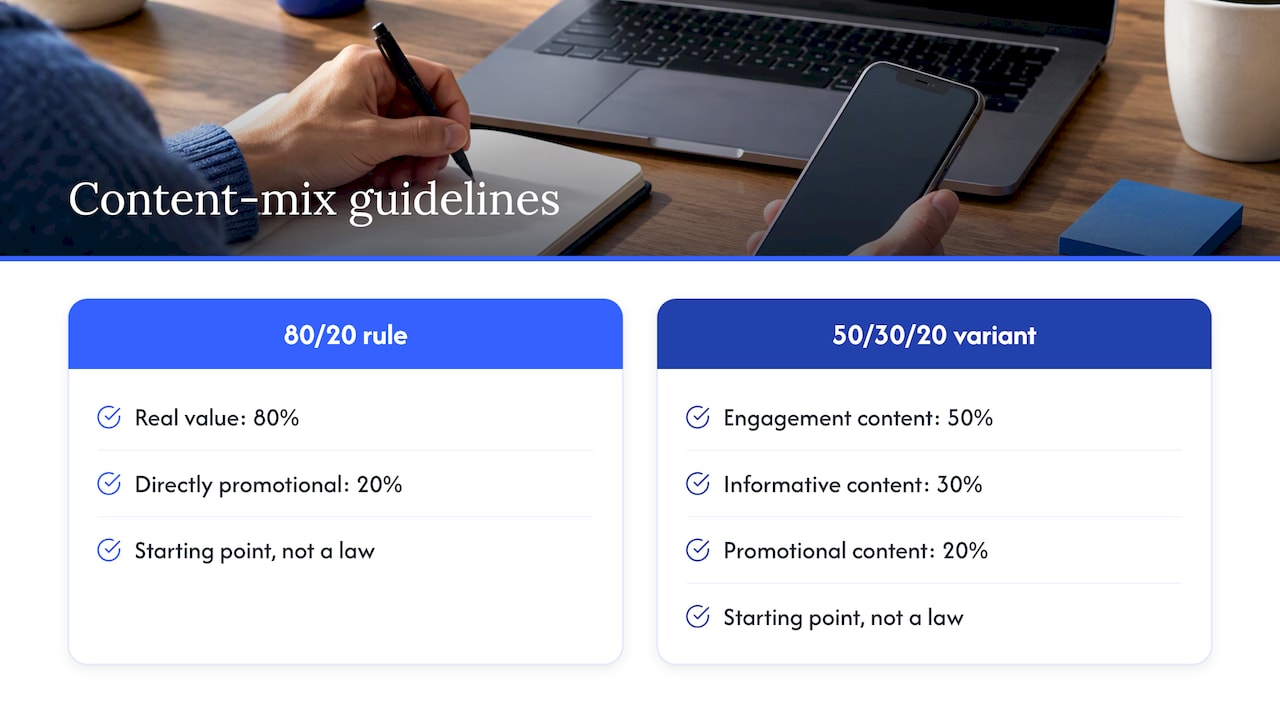
A widely used guideline is the 80/20 rule: about 80% of content gives real value, such as education, inspiration or behind-the-scenes looks, while only about 20% is directly promotional. Done this way, sales posts feel welcome instead of intrusive.
You will also see the 50/30/20 variant, which one marketing agency describes as 50% engagement content, 30% informative content and 20% promotional. This answers a common question from newer marketers. It is a rule of thumb, not a law, and neither split is a guaranteed formula. Treat them as starting points and adjust once your own numbers show what your audience rewards.
Differentiate instead of imitate
Copying whatever is trending is tempting, and it rarely pays. An American Marketing Association summary of a study of 199 large consumer-facing retail brands on X over five years found that firms whose content diverged from their closest competitors came out ahead. You do not need a big budget to apply that. You need a point of view: a recurring format, a tone of voice or a topic only you can cover credibly.
Plan the pipeline
A workable weekly routine looks like this:
- Monday: review last week’s numbers and pick one thing to test.
- Tuesday and Wednesday: create and schedule the week’s posts.
- Daily, 20 to 30 minutes: reply to comments and messages, and engage with other accounts in your niche.
- Friday: note what worked, save the best performers as templates, collect ideas.
Creators who sell directly to fans follow the same logic. If you want to see how a value-first mix looks in a niche where trust drives revenue, our guide to social media content marketing for adult creators and the ultimate social media checklist translate these principles into a concrete routine.
Engage like a person, not a broadcast channel
Social media has moved from one-way broadcasting to two-way conversation. According to the AMA research summary cited above, brands and firms that build community, ask for feedback and encourage user-generated content outperform those that only push promotional messages.
This matters for reach as well as loyalty. Industry guidance such as Adobe’s social media guide notes that many algorithms weigh early momentum, so engagement in the first hour after posting can lift how far a post travels. Replying quickly is therefore a visibility lever, not just good manners.
Practical ways to put that into practice:
- Be online when you publish. Post when you can answer comments for the next 30 to 60 minutes.
- Ask real questions. “Which of these would you use?” gets better answers than “Thoughts?”
- Reply with substance. A sentence that moves the conversation forward beats an emoji.
- Go to where people are talking. Comment on other accounts in your niche, answer questions in the replies, and use direct messages to help, not to pitch.
- Use scheduling tools, but do not hide behind them. Automation handles delivery. It cannot hold a conversation.
Test one thing at a time
Most beginners put their energy into producing more. The marketers who improve fastest put theirs into learning faster. Hootsuite’s best-practice guide recommends changing one variable at a time, whether that is the posting time, an image format or a caption style. If you change three things at once and a post jumps, you cannot say why.
A simple testing loop:
- Form a hypothesis. “Posts that open with a question will get more comments than posts that open with a statement.”
- Change only that. Keep topic, format and time similar.
- Run it long enough. Five to ten posts per version tells you far more than one.
- Record the result in a shared sheet, including the ones that failed.
- Keep the winner and test the next variable.
Over a few months that sheet becomes your own playbook, and it is worth more than any generic list of tips.
Use AI to move faster, and keep humans in charge
AI tools can draft captions, suggest hooks and repurpose a long video into clips in minutes. Hootsuite reports that leading teams use AI to scale production while requiring human review for quality, tone and brand safety. That is the right model for a solo marketer too.
A useful rule: let AI produce the first draft, then you add the specifics only you know, such as a customer story, a real number or a joke that fits your audience. Read every line aloud before it goes out. If it could have been posted by any brand in your category, rewrite it.
Follow the disclosure rules
If you work with influencers, creators or affiliates, or you are one yourself, you need to understand disclosure. The U.S. Federal Trade Commission’s influencer disclosure guide says that when there is a financial, employment, personal or family relationship between an endorser and a brand, including free or discounted products, it must be clearly disclosed. The disclosure should be hard to miss, placed with the endorsement itself and written in the same language as the post. Vague tags such as “collab” or “spon” do not meet that standard, according to the FTC.
This rule applies in the United States. If you run campaigns elsewhere, check the advertising rules of each country you target. For anything beyond the basics, such as contracts, giveaways or regulated products, ask a qualified advertising or marketing lawyer.
Two habits keep you safe: write the disclosure into your brief so partners never have to guess, and review published posts to confirm it is visible without tapping “more.”
Our perspective: marketing for people who own their audience
We run a marketplace where independent creators sell subscriptions, exclusive content, private messages, live streams, bundles and tips directly to fans. That gives us a particular view of what good social media marketing is for.
For a creator, social media is the top of the funnel. Reach is only useful if it turns into people who choose to pay, and that choice depends on trust built through consistent, honest, value-first posting. The marketers and creators we see doing well treat every public post as an invitation, then use direct, paid spaces to deepen the relationship.
That is why we care about audience ownership. Followers on a rented feed can vanish with an algorithm change or a policy update. A paying community is something you can plan around. It is also why we built Fanspicy so creators pay no fee to join and keep a higher share of what they earn. We would rather your marketing effort end in income you control.
If you market in a niche with stricter rules, the basics get even more important: know each platform’s content policy, separate public promotion from paid content and moderate your community. Our guides to NSFW marketing e content moderation steps for adult creators go deeper on that.
— fan
Put your skills to work on a platform you control
If you are practicing social media marketing for yourself or for a creator client, a good test is whether your campaigns end in revenue the creator can keep. Creators can unirsi a Fanspicy to sell exclusive content, paid posts and tips, and the main platform supports subscriptions, private messages and live streams. If you already have an audience elsewhere, the platform is built to make moving your content over straightforward, so you can test the waters without starting from zero.
For promotion ideas that fit a paid-content model, see 7 media marketing ideas for adult creators e top promotion strategies for adult creators.
A 90-day plan to get good, fast
Skills compound when you practice them on a schedule. Here is a plan you can start this week.
Days 1 to 30: foundation
- Write one SMART goal and the single number that tracks it.
- Define your audience in a paragraph, then check it against platform data.
- Choose one or two platforms. Audit the last 30 to 90 days of posts as a baseline.
- Pick your content mix, for example 80/20, and list five recurring topics.
Days 31 to 60: rhythm
- Publish on a steady schedule you can sustain, even if that is three times a week.
- Reply to every comment for the first hour after posting.
- Run your first two single-variable tests and log the results.
Days 61 to 90: refinement
- Double down on the formats that beat your baseline.
- Drop what did not work, without sentiment.
- Build a one-page report: goal, results, what you learned, what you will test next.
- Add a second skill, such as basic video editing or email capture.
By the end you will have something more persuasive than a certificate: a record of decisions, tests and results. That is what clients and employers want to see.
Common mistakes to avoid
- Chasing vanity metrics. Likes feel good, but connect your reporting to actions that matter to the business.
- Posting without listening. If you never read comments, you miss the best content ideas you will ever get.
- Going on every platform. Depth beats breadth.
- Changing everything at once. You will not know what worked.
- Skipping disclosure. It is simple to do and costly to ignore.
- Letting AI flatten your voice. Speed is useful only if the result still sounds like someone.
FAQ
How do I become good at social media marketing?
Practice on a real account with a measurable goal. Learn one platform well, publish consistently, reply to your audience and run small tests, then record what you learn. A few months of documented results teach more than any list of tips.
What is the 50/30/20 rule in social media marketing?
It is a content-mix guideline: about 50% engagement content, 30% informative content and 20% promotional content, as described by one marketing agency. It is a starting point, not a requirement. Many marketers prefer the 80/20 split of value to promotion, and the right ratio is the one your own data supports.
Do I need to be on every platform?
No. Concentrate on the platforms where your audience is most active and learn their formats. Spreading yourself thin across many networks usually produces average results on all of them.
Do I need to disclose free products or paid partnerships?
In the U.S., yes. The FTC says any relationship that involves something of value, including free or discounted products, should be disclosed clearly and close to the endorsement. Rules differ by country, so check local guidance if your campaign runs abroad.
Sources
- Your Complete Guide to Social Media Marketing in 2026, Buffer
- Social media best practices for 2026, Hootsuite
- Social Media Marketing: The Ultimate Guide for Businesses, Forbes Advisor
- Standing Out in the Scroll, American Marketing Association
- Demographics of Social Media Users and Adoption in the United States, Pew Research Center
- Disclosures 101 for Social Media Influencers, FTC
- The Definitive Guide to Social Media Marketing, Adobe
- What Is the 50/30/20 Rule for Social Media?, Motionwave Digital