

Table des matières
Every online creator knows the struggle of turning digital applause into real income. Payment processing stands at the heart of this challenge, quietly shaping how quickly and safely your earnings travel from a subscriber in Brazil or Canada to your own bank account. For those building audiences worldwide on platforms like OnlyFans and Fansly, understanding digital payment systems that reshape how creators earn is more than a technical detail—it directly affects your payout speed, security, and subscriber satisfaction.
Table des matières
- Defining Payment Processing for Content Creators
- Types of Payment Systems Used by Adult Platforms
- How Payment Gateways Manage Transactions and Security
- Global Compliance and Regulatory Considerations
- Fees, Payout Schedules, and Revenue Impact
- Risks, Chargebacks, and Fraud Prevention Tactics
Principaux enseignements
| Point | Details |
|---|---|
| Understanding Payment Processing is Crucial | It is essential for content creators to grasp how payment processing affects their earnings, subscriber experience, and access to funds. |
| Choosing the Right Payment Systems | Creators should assess their audience demographics to select payment methods that optimize subscriber retention and revenue potential. |
| Monitoring Fees and Payout Schedules | Understanding how processing fees, platform cuts, and payout timings impact cash flow is vital for sustaining profitability. |
| Implementing Robust Fraud Prevention | Creators must focus on multiple layers of fraud prevention to reduce chargebacks and protect their revenue from dishonest practices. |
Defining Payment Processing for Content Creators
Payment processing for content creators means the complete system that transfers money from your audience directly to your account. It’s the technical and financial backbone that turns engagement into actual earnings. When a subscriber pays you on a platform, renews their membership monthly, or tips during a live stream, payment processing is what makes that transaction happen behind the scenes. This involves capturing payment information, verifying the transaction, moving funds between accounts, and managing the entire flow of money from your fans to your bank account.
Understanding this concept matters because digital payment systems reshape how creators earn. Your payment processor handles multiple critical functions simultaneously: it validates that a customer’s credit card or payment method is legitimate, authorizes the transaction with their bank, settles the funds into your account, and protects both you and your subscribers from fraud. For creators building audiences on platforms like OnlyFans alternatives and live cam sites, payment processing determines how quickly you access your earnings, what fees you pay, and which payment methods your subscribers can use. A smooth payment experience keeps subscribers happy and willing to renew, while payment friction causes cancellations and lost revenue.
The system also includes security measures that protect sensitive financial information. Payment processors encrypt data, comply with industry standards like PCI DSS, and manage chargebacks when disputes arise. They handle currency conversion if your subscribers are spread across different countries, meaning you can monetize a global audience without manually managing multiple payment accounts. This is what creates the democratization of creator earnings—someone in Brazil can support you, someone in Canada can subscribe, and someone in Australia can tip, all through one unified payment system.
Pro tip: Choose a payment processor that supports your creators in multiple countries and offers transparent fee structures so you know exactly what percentage goes to processing versus what lands in your account.
Types of Payment Systems Used by Adult Platforms
Adult platforms rely on multiple payment systems because no single option works for every creator and subscriber. The most common system is traditional credit card processing, where customers enter their card details and funds move directly to the platform’s payment processor. However, adult content platforms face stricter underwriting from payment processors compared to mainstream services, meaning they often need specialized processors who understand the industry. E-wallets like PayPal alternatives specifically designed for adult creators have become increasingly popular because they add a layer of privacy for subscribers who prefer not to have adult platform charges visible on their credit card statements. This privacy factor is crucial for subscriber retention, especially in markets where social stigma exists around adult content consumption.
Cryptocurrency payments have emerged as another critical option, particularly for creators operating in regions where traditional payment processors restrict adult content transactions. Bitcoin, Ethereum, and stablecoins allow direct creator-to-subscriber transactions without intermediaries blocking the payment. Digital payment technologies in adult platforms manage high-risk transactions by combining multiple payment rails so that if one processor restricts a transaction, subscribers can use an alternative method. Mobile payments and local payment methods also matter in global markets. A creator with subscribers in Southeast Asia might accept mobile money transfers, while someone with European fans might integrate regional payment systems. The choice of payment systems directly impacts your earning potential because each method has different fees, settlement times, and geographic reach.
The payment infrastructure you choose determines operational costs that eat into your revenue. Credit cards typically charge 2.9% to 3.9% plus per-transaction fees, while cryptocurrency might only cost 1% but requires subscribers to have crypto wallets. E-wallets fall somewhere in the middle. Many successful creators use a hybrid approach: offering credit cards as the primary option for ease of use, e-wallets for privacy-conscious subscribers, and crypto for tech-forward fans. This multi-option strategy maximizes your addressable subscriber base and reduces payment friction. Platforms like OnlyFans alternatives that support multiple payment systems see higher conversion rates because subscribers choose their preferred method rather than abandoning if one option fails.
Pro tip: Analyze your subscriber demographics to determine which payment systems matter most for your audience, then prioritize those while maintaining backup options to capture subscribers who can’t use your primary payment method.
Here’s a comparison of payment system options for adult content platforms:
| Payment Method | Avantages | Drawbacks | Meilleur pour |
|---|---|---|---|
| Credit Cards | Widely accepted, familiar process | Higher fees, privacy concerns | Mainstream global audiences |
| Portefeuilles électroniques | Enhanced privacy, easy sign-up | Not always accepted, moderate fees | Privacy-conscious subscribers |
| Crypto-monnaie | Low fees, global access | Volatility, requires crypto wallets | Tech-savvy users, restricted regions |
| Mobile Payments | Fast, popular in some regions | Limited availability, local focus | Fans in Asia, Africa, Europe |
How Payment Gateways Manage Transactions and Security
Payment gateways are essentially the security checkpoints between your subscriber and their bank account. When someone tries to pay you, the gateway immediately performs multiple verification steps to confirm the transaction is legitimate. It checks whether the card details match the cardholder’s information on file, verifies the card hasn’t been reported stolen, confirms sufficient funds exist, and screens against known fraud patterns. This all happens in milliseconds. The gateway then sends an authorization request to the subscriber’s bank, which either approves or denies the payment. If approved, the funds move into a holding account before settling into your creator account, usually within 1 to 3 business days. This buffer period allows both the payment processor and the bank to catch fraudulent transactions before money permanently changes hands.

Advanced security methods like tokenization and authentication protect cardholder data throughout this process. Tokenization replaces sensitive card numbers with unique tokens that can be used for future transactions without storing the actual card data. This means even if a hacker breaches the payment gateway’s servers, they won’t find usable credit card numbers. Multi-factor authentication adds another layer by requiring subscribers to confirm their identity through multiple verification methods, such as a password plus a code sent to their phone. Machine learning algorithms monitor transaction patterns in real time, flagging suspicious activity like someone trying to purchase from five different countries in one hour or spending amounts far above their typical behavior. These systems learn continuously, becoming smarter at distinguishing between legitimate purchases and fraud attempts.
For creators, understanding these protections matters because chargebacks and fraud directly impact your earnings. When a subscriber disputes a transaction claiming it was unauthorized, the payment processor investigates and often reverses the payment. Repeated chargebacks can damage your account standing or result in higher processing fees. Payment gateways combat this by maintaining detailed transaction records, encryption protocols that comply with PCI DSS standards, and fraud detection systems that catch problems before they become your problem. Some gateways now use blockchain technology to enhance security through cryptographic verification and decentralized record keeping, creating an immutable transaction history that’s nearly impossible to manipulate. The bottom line: a reputable payment gateway does the heavy lifting of keeping both you and your subscribers protected.
Pro tip: Request detailed transaction reports from your payment gateway so you can monitor for unusual patterns, and immediately report any suspicious activity to prevent fraud from escalating and affecting your account status.
Global Compliance and Regulatory Considerations
When you operate as a creator across borders, you’re operating within multiple legal jurisdictions simultaneously. A subscriber in Germany falls under GDPR data protection rules. Someone in California is protected by state privacy laws. Someone in the United Kingdom answers to different regulations entirely. Your payment processor must comply with all these rules at once, and any failure on their part becomes your problem. This fragmented regulatory environment means that platforms supporting creators globally must invest heavily in compliance infrastructure just to legally process payments. Global regulatory compliance requirements evolve continuously as governments introduce new AML/KYC (anti-money laundering and know-your-customer) requirements, data privacy standards, and sanctions screening measures. Your payment processor needs to verify subscriber identities, screen transactions against sanctions lists, and maintain records proving they’ve done so. This verification process protects you because it prevents your account from being used for illegal activities.
Data protection laws create specific obligations that directly affect how your subscriber information gets stored and used. The European Union’s GDPR requires explicit consent before collecting personal data and grants subscribers the right to request deletion of their information. California’s CCPA gives consumers similar rights. Payment processors must encrypt data in transit and at rest, meaning subscriber payment information gets scrambled both when it’s being transmitted and when it sits in storage. Adult content platforms face additional scrutiny because regulators view them as higher risk. This means your processor might require more thorough identity verification, maintain stricter separation of funds, or undergo more frequent audits. Some traditional payment processors simply refuse to work with adult content creators altogether, which is why specialized processors have emerged to fill that gap.
The practical reality for you as a creator is that payment service licensing and security standards vary dramatically by region. Your processor needs proper licensing to operate legally in each country where your subscribers live. They must comply with card network security standards like PCI DSS if they handle credit cards. They might need to maintain insurance against fraud and cybersecurity incidents. All these compliance costs get passed through to creators in the form of processing fees. When choosing a payment processor, verify that they explicitly support your content category in the regions where you have subscribers. A processor that claims to support adult creators but operates without proper licensing in key markets creates legal risk for you. Ask directly about their compliance certifications, their fraud prevention measures, and how they handle subscriber data.
Pro tip: Request your payment processor’s compliance documentation and certifications upfront, particularly for the countries where your top subscribers are located, to ensure you’re protected if regulatory issues arise.
Fees, Payout Schedules, and Revenue Impact
Every dollar your subscribers send doesn’t reach your bank account intact. Processing fees are the hidden cost of doing business as a creator. A typical credit card transaction costs the platform 2.9% to 3.9% plus a fixed fee per transaction, often between 30 cents and a dollar. That means if someone sends you a $10 tip, you might only see $9.30 to $9.50 after processing costs. On a $100 monthly subscription, you could lose $3 to $4 per subscriber every month. These fees add up dramatically across hundreds or thousands of subscribers. Wire transfers cost more, international transactions incur currency conversion fees, and some payment methods like cryptocurrency require blockchain confirmation fees. Understanding your fee structure isn’t boring accounting work. It directly determines whether you’re building sustainable income or spending your time working for a processor’s profit margin.
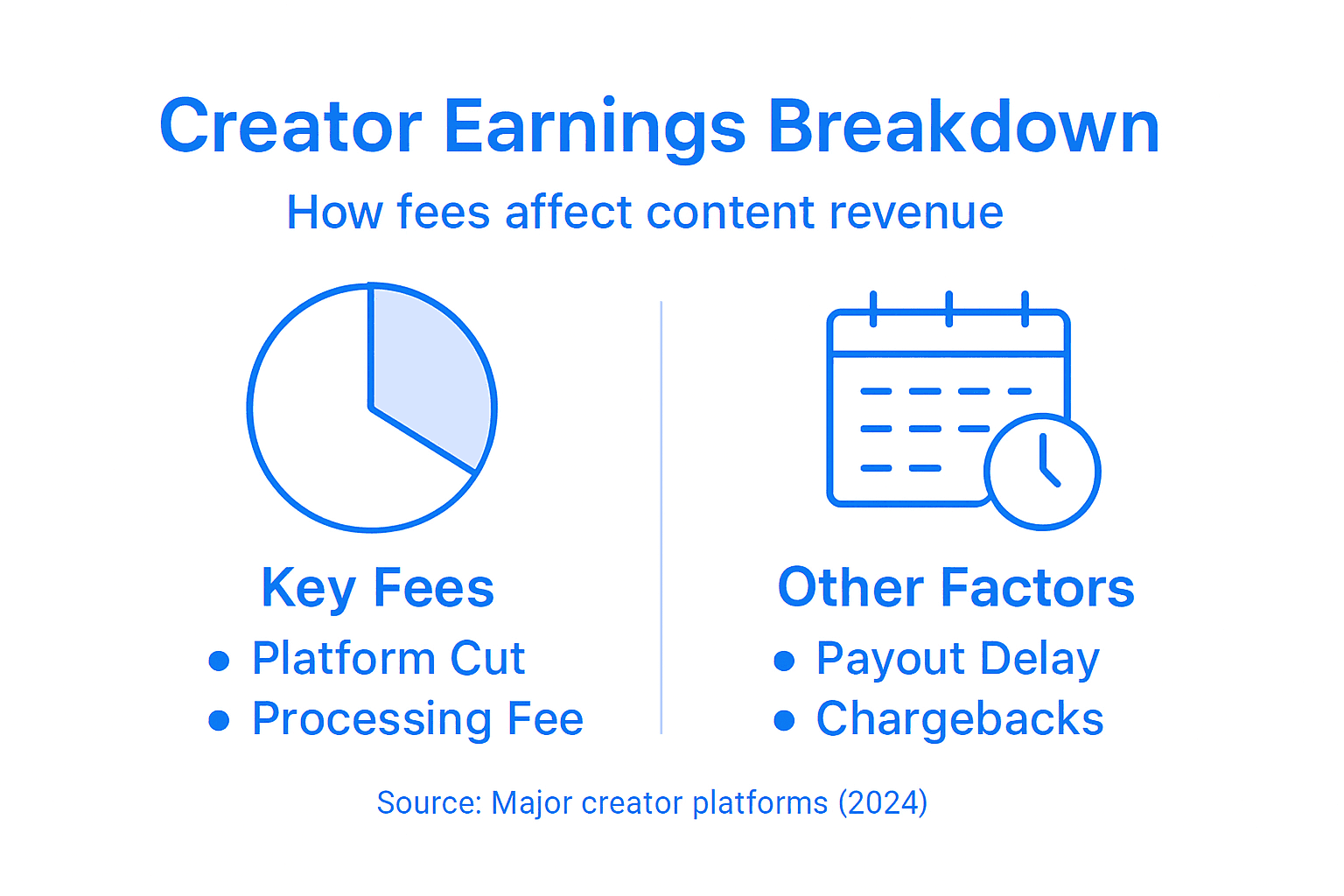
Payout timing affects your cash flow in ways that matter psychologically and practically. Different platforms offer varying payout schedules and minimum thresholds that determine when money actually lands in your account. Some platforms pay monthly on a fixed date like the 15th. Others require you to reach a minimum threshold, like $50 or $100, before you can request a payout. A few pay weekly. If you reach $47 in earnings but the minimum is $50, that money sits trapped until you hit the threshold. Some creators with multiple income streams strategically time their content releases to hit payout minimums on the same day, consolidating their transfers and reducing fees. Others use the delayed payout to their advantage, letting money accumulate so they can request larger transfers less frequently. The timing also matters for tax purposes. If your platform pays monthly, your monthly income varies. If it pays on variable schedules, your accounting becomes messier.
The revenue split is where things get real. Adult content platforms typically take a 20% to 50% cut, leaving you with 50% to 80% of what subscribers pay. This is significantly higher than mainstream platforms like YouTube, which typically takes 45%, leaving creators with 55%. Some platforms offer revenue tiers where your cut improves as you earn more, incentivizing higher earners to stay. Subscription fees work differently than tips. A monthly subscription might generate revenue every single month from the same subscriber, creating predictable income. Tips and one-time purchases are unpredictable. Smart creators build their income around subscriptions because the recurring revenue is knowable, allowing them to plan expenses and investments. When evaluating payment processors and platforms, calculate your actual take-home percentage across all fees and cuts. A platform that takes 30% seems better than one taking 40%, but if the 40% platform has lower processing fees and faster payouts, the math might favor the higher percentage platform.
Pro tip: Build a spreadsheet tracking your gross earnings, all deductions (platform cut, processing fees, payment method fees), and net take-home across all your platforms so you can identify which income streams are truly profitable and which are costing you money to maintain.
The following table highlights typical fees, payout schedules, and factors affecting creator revenue:
| Factor | Typical Range / Practice | Impact on Creators |
|---|---|---|
| Frais de traitement | 2.9%-3.9% per card payment | Reduces each transaction’s net amount |
| Platform Revenue Split | 20%-50% platform cut | Directly determines your total earnings |
| Fréquence de paiement | Weekly, monthly, or threshold | Influences cash flow and income planning |
| Montant minimum du paiement | $50-$100 common | Can delay access to smaller earnings |
Risks, Chargebacks, and Fraud Prevention Tactics
Chargebacks are the nuclear option for angry subscribers, and they directly hurt your bottom line. When someone claims a payment was unauthorized or disputes the transaction for any reason, their bank initiates a chargeback. The funds immediately reverse from your account back to the subscriber. You lose the money, lose the content access for that subscriber, and the payment processor charges you a chargeback fee, typically between $15 and $100 per incident. If you accumulate too many chargebacks relative to your transaction volume, the processor can terminate your account entirely. Unlike traditional e-commerce where chargebacks might happen once per thousand transactions, adult content platforms experience higher chargeback rates because some subscribers intentionally purchase access, consume content, then claim it was unauthorized to get their money back. This creates a financial incentive for fraud that doesn’t exist in most industries. Protecting yourself means understanding the mechanics and implementing preventative layers.
Fraud takes many forms beyond simple chargebacks. Payment fraud tactics have become increasingly sophisticated through AI-driven methods and synthetic identity fraud where criminals create fake identities to open accounts and make fraudulent transactions. A fraudster uses a stolen credit card to buy a month of access to your content, then disputes the charge. Someone uses a compromised account credential to subscribe without actually paying. A bot creates multiple accounts using variations of the same email address to exploit free trial offers. These aren’t random bad luck. They’re systematic attacks targeting the payment processing infrastructure. Your processor should deploy machine learning algorithms that learn from fraudulent patterns, flagging unusual behavior like velocity attacks (many transactions in quick succession), geographic impossibilities (transactions from two countries within minutes), and behavioral anomalies that deviate from your subscriber’s typical patterns.
Your defensive strategy requires multiple layers working together. First, implement strong identity verification by requiring subscribers to provide legitimate payment information tied to real names and addresses. Second, monitor chargebacks obsessively. When disputes arise, document everything: the subscriber’s access logs, content consumption history, IP addresses, and timestamps. Detailed records often win chargeback disputes because they prove the subscriber actually accessed content after paying. Third, establish clear terms of service that explicitly state no refunds for content already accessed. This doesn’t prevent all chargebacks but strengthens your position in disputes. Fourth, use your payment processor’s fraud tools intelligently. Most processors offer advanced settings for velocity checks, address verification, and 3D Secure authentication that adds a second verification step. Fifth, consider requiring payment method verification where subscribers confirm a small test charge before their real subscription begins. This proves they own the payment method. Finally, maintain open communication with your payment processor. Report suspicious patterns early, review your chargeback reports monthly, and ask your processor about payment fraud prevention technologies and controls they recommend for your specific risk profile.
Pro tip: Keep detailed access logs showing exactly when subscribers logged in and what content they viewed, because this documentation is your strongest defense against chargeback claims and often results in disputes being ruled in your favor.
Master Payment Processing with Fanspicy to Maximize Your Earnings
Navigating the complex world of payment processing is one of the biggest challenges content creators face today. From dealing with high fees and delayed payouts to managing chargebacks and fraud, these issues can directly impact your revenue and peace of mind. If you value secure transactions, multiple payment options, and compliance with global regulations as discussed in the article Role of Payment Processing for Creators Online then it is time to consider a platform built with creators like you in mind.
Fanspicy is not just another live cam and social platform. As a trusted OnlyFans alternative, we prioritize fast payouts, transparent fees, and advanced fraud prevention that empower you to focus on what matters most your content and your audience. Visit Piquant pour les fans today to explore how our platform integrates smooth payment processing with powerful compliance measures and diverse payment methods. Don’t let payment friction hold back your growth—join Fanspicy now and experience a new standard in creator monetization.
Questions fréquemment posées
What is payment processing for content creators?
Payment processing for content creators refers to the system that transfers money from subscribers to the creator’s account, managing transactions, verifying payments, and ensuring security throughout the process.
Why is it important for creators to understand payment processing?
Understanding payment processing is crucial for creators because it affects their earnings, the fees they incur, the speed of access to funds, and the overall satisfaction of their subscribers, all of which can impact their revenue and growth.
What types of payment systems are commonly used by adult content platforms?
Adult content platforms commonly use traditional credit card processing, e-wallets for privacy, cryptocurrency for its low fees and global access, and mobile payments tailored to specific regional markets.
How do payment gateways enhance security for creators and their subscribers?
Payment gateways enhance security by verifying transaction legitimacy through multiple checks, using encryption and tokenization to protect sensitive data, and implementing fraud detection systems to monitor and catch suspicious activity.