
Table des matières
The fastest way to grow a podcast comes down to three moves working together: define a specific audience, make your show discoverable in platform search and recommendations, and repurpose every episode into short clips. This week, pick one listener persona, rewrite your next episode title around a clear benefit, and publish two shareable clips from your most recent episode.
TL;DR:
- Make each episode searchable with accurate categories, clean RSS feed details, timestamps, detailed show notes, and transcripts that match listener queries.
- Apple Podcasts defines engaged listeners as people who consume at least 20 minutes or 40% of an episode, whichever comes first; track that, not downloads.
- Use short video to reach new audiences and text communities to retain them; Apple Podcasts says followers listen to roughly 80% more than nonfollowers.
- Wait to buy ads until organic tactics show audience fit, then test one control creative and two variations by cost per new engaged listener.
- Open with the episode’s strongest line rather than a long welcome or sponsor read; completion is shaped heavily in the first 60 seconds.
Table des matières
- How do you define and validate your niche audience?
- How do you optimize your podcast for search and discovery?
- How do you repurpose episodes into clips and video?
- How do you turn social followers into regular listeners?
- How do you build a website and email funnel for your show?
- How do collaborations and guest swaps grow your audience?
- When should you test paid promotion for your podcast?
- What production choices improve listener retention?
- What should you measure, and how do you test changes?
- My 90-day sprint for growing a show from scratch
- Turning engaged listeners into paying fans with Fanspicy
- FAQ
- Sources
How do you define and validate your niche audience?
Narrow beats broad almost every time in podcasting. A show that speaks to “home cooks who batch-cook on Sundays” earns loyal followers and favorable search placement far faster than a show aimed at “people who like food.” Algorithms and search engines both reward specificity because it matches listener intent more precisely, and intent match drives the completion rates platforms use to recommend your show to new listeners.
Building a usable persona takes less time than most creators expect:
- Write down who listens: age range, profession or life stage, and the two or three problems they are trying to solve.
- List the platforms this person already uses daily, whether that is Spotify, YouTube, Reddit, or a specific Discord community.
- Search those platforms for your core topics and note which competitor shows or threads already attract this person’s attention.
- Spend a week observing a relevant subreddit or Discord server to see the exact language your future listeners use to describe their problems.
- Check keyword search volume for your main topics to confirm people are actually searching for them, not just discussing them casually.
Treat the first week after launch (or relaunch) as a validation sprint: confirm the persona against real listener comments, adjust your show description to mirror their language, and flag any mismatch between what you assumed they wanted and what they actually ask for in reviews or social replies. Spotify for Creators recommends narrowing your target audience as a first step before investing in metadata or promotion, since every later tactic performs better once the audience is specific.
How do you optimize your podcast for search and discovery?
Discoverability is a mechanical problem before it is a creative one. Platforms surface shows based on metadata accuracy and listener engagement signals, so getting the technical basics right determines whether your content ever reaches new ears.
- Write episode titles using a formula: primary keyword, then the specific benefit, then an optional curiosity hook, so both search engines and scrolling listeners understand the payoff immediately.
- Use your show description and category selection deliberately. Pick the most accurate category rather than the most popular one, since mismatched categories hurt relevance scoring.
- Keep your RSS feed clean and consistent: correct artwork dimensions, accurate explicit flags, and stable episode numbering all affect how directories index your show.
- Add timestamps and detailed show notes to every episode. They function as both an accessibility aid and a search signal, since platforms and search engines index that text.
- Publish a transcript when possible. Transcripts give search engines far more text to match against listener queries than a short description ever can.
- Add chapters inside the episode file itself, which several podcast apps display as a visual timeline and which helps listeners jump to the sections they care about.
Spotify for Creators lists metadata optimization alongside audience targeting as a core discoverability lever, and Apple Podcasts analytics let you see exactly which episodes convert listeners into engaged listeners once they find your feed. Treat your RSS feed the way you would treat an SEO-optimized webpage: every field is a ranking input, not paperwork.
How do you repurpose episodes into clips and video?
The Infinite Dial 2026 reports that video and audio podcasting expand reach together, with many podcast consumers engaging with both formats. Repurposing is not an optional add-on anymore; it is how most new listeners encounter a show for the first time.
- Pull three clips per episode: one hook (the most surprising or quotable 30 to 60 seconds), one highlight (a self-contained insight or story), and one call-to-action clip that points directly to the full episode.
- Keep short-form clips brief, optimized for platforms like TikTok, Instagram Reels, and YouTube Shorts, since shorter clips consistently hold attention better on vertical feeds.
- Add burned-in captions to every clip. Most viewers watch with sound off, and captions are often the difference between a scroll-past and a full watch.
- Use a consistent thumbnail template across clips so returning viewers recognize your show instantly in a crowded feed.
- Upload full episodes as video to YouTube, using the same show name across platforms and detailed descriptions, exactly as YouTube’s podcast guidance recommends, and organize episodes into a playlist so YouTube can recommend adjacent episodes automatically.
- Mark your timestamps during recording or right after, not days later, so the batching workflow stays fast enough to sustain weekly output.
A realistic cadence is two to three clips published per episode, spread across the week rather than all at once, with full-episode video uploads going to YouTube on the same day the audio episode drops.
How do you turn social followers into regular listeners?
Social platforms split into two broad playbooks. Short-video platforms (TikTok, Reels, YouTube Shorts) reward frequent, hook-first posting and reach new audiences who have never heard of your show. Text-first communities (X, Facebook groups, niche forums) reward conversation and reward you for showing up as a person, not just a feed. Prioritize short video for discovery and text communities for retention.
- Run an AMA tied to a recent episode topic to give existing followers a reason to engage directly with you between releases.
- Create a recurring listener segment, like reading out a question or comment on the next episode, so listeners have an incentive to interact.
- Repurpose a strong episode discussion into a standalone social post that invites replies rather than just promoting the episode.
- Use direct, specific CTAs: “follow the show” performs differently than “subscribe,” since Apple Podcasts documentation notes that followers listen to roughly 80% more of a show than non-followers and receive automatic downloads once they follow.
Conseil de pro : Build a simple caption template around recurring episodic “moments,” like a weekly quote-of-the-episode, so every social post feels familiar to followers without feeling repetitive to write.
The goal of every social post is not virality for its own sake. It is moving someone one step closer to pressing play on a full episode.
How do you build a website and email funnel for your show?
Platform algorithms change without warning. An email list and a website are the two channels you fully control, which makes them the most reliable place to protect the audience you have already earned.
- Build a simple landing page with your show description, a prominent subscribe button for each platform, and full show notes for every episode, written with the same keyword awareness you use in your episode titles.
- Offer a lead magnet worth trading an email address for, such as a bonus episode, an early-access window, or a downloadable transcript of a popular episode.
- Write a three-email welcome flow: email one delivers the lead magnet and sets expectations, email two highlights your three best episodes for new listeners, and email three asks directly for a follow and a rating.
- Publish transcripts and chapter markers on your website, not just inside the audio file, so search engines can index that content and send organic traffic back to your show.
- Send a short weekly or biweekly email tied to new episodes, since regular contact with your list measurably increases replay rates compared to relying on push notifications alone.
A website built this way becomes a second discoverability surface working alongside Apple, Spotify, and YouTube, rather than a static business card nobody visits.
How do collaborations and guest swaps grow your audience?
Guests are the fastest legitimate way to borrow an audience that already trusts someone else’s recommendation. The quality of that lift depends entirely on how carefully you pick the guest and how much promotional work you both commit to in advance.
- Choose guests whose audience overlaps with your target persona rather than guests who are simply well known, since relevance converts better than reach alone.
- Agree on a cross-promo swap before recording: each side posts about the episode on their own channels and links to it from their own show notes.
- Prepare two or three ready-made clips from the guest episode and send them directly to the guest, so they can post with minimal friction on their end.
- Ask your guest to share the episode link with their email list if they have one, since that channel usually converts better than a single social post.
- Track new followers and website visits in the week following a guest episode to see whether the collaboration actually moved your numbers, not just your vanity metrics.
The clearest sign a collaboration worked is a spike in engaged listeners on that specific episode, followed by a smaller but real increase in listens to your back catalog over the following weeks.
When should you test paid promotion for your podcast?
Paid acquisition makes sense once you have proof that organic tactics convert, not before. Testing paid ads on a show with no clear audience fit just speeds up spending money on the wrong listeners.
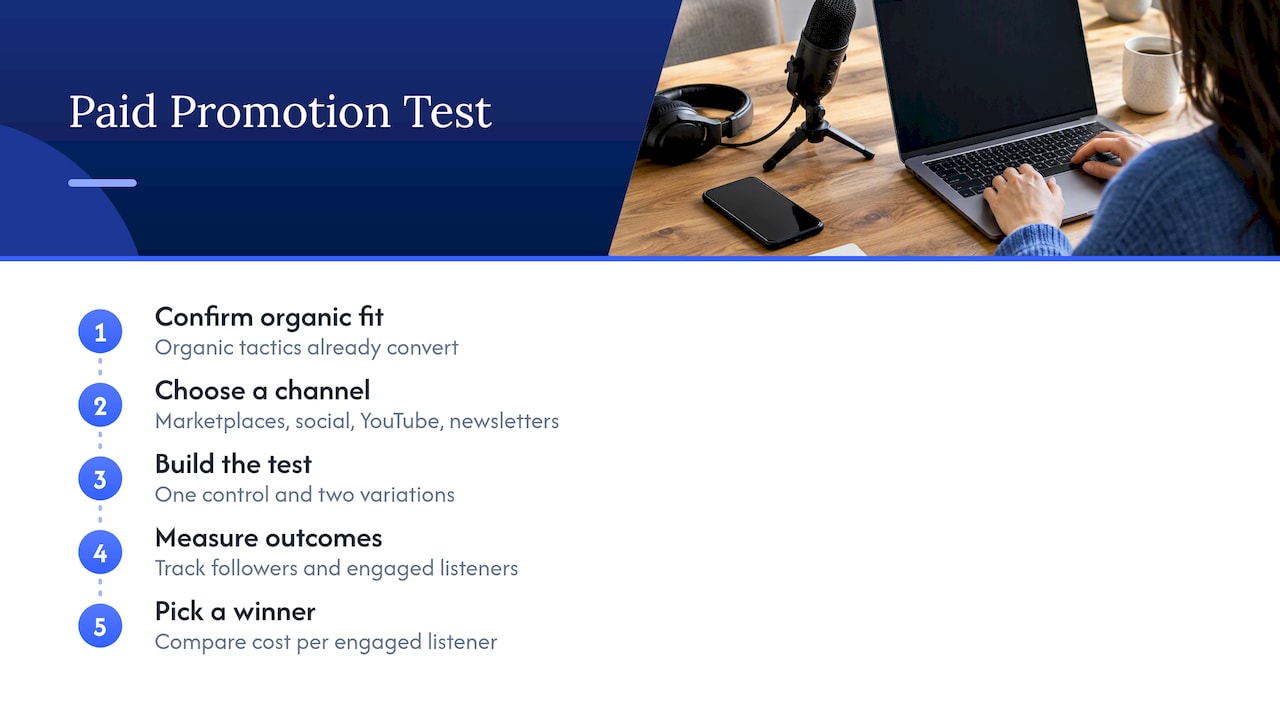
Available channels include podcast-specific ad marketplaces, social ads on the same platforms where you post clips, YouTube video ads placed against similar content, and sponsorships in newsletters whose readers match your persona. Start with a small, structured test rather than a broad campaign: run one control creative and two variations, each on a modest budget, and measure new followers and new engaged listeners rather than raw impressions.
Keep every test creative built around one idea: lead with the hook from your best clip, state the specific benefit of listening, and end with a single CTA, either “follow” or “listen now,” never both. Running two CTAs in one ad usually depresses both actions. Let each test run long enough to collect a meaningful number of clicks before declaring a winner, then redirect budget toward whichever creative produced the better cost per new engaged listener, not simply the lowest cost per click.
What production choices improve listener retention?
Completion rate is the metric that decides whether an episode gets recommended again, and it is won or lost in the first 60 seconds. If a listener is still with you after that window, they are far more likely to finish the episode.
- Open with the most compelling line from the episode, not a lengthy welcome or sponsor read, so new listeners get a reason to stay immediately.
- Cut dead air, false starts, and long tangents in editing; tighter pacing keeps average consumption climbing, which is one of the core metrics inside Apple Podcasts Connect.
- Add a recurring segment listeners can anticipate, such as a regular Q&A or a weekly recommendation, since familiarity increases the odds someone returns for the next episode.
- Offer a listener-only bonus, like an extended cut or an extra segment, to reward people who follow rather than just stream once.
- Place your CTA naturally inside the content, near a genuinely useful moment, rather than bolting it onto the intro or outro where listeners tune it out.
None of these changes requires new equipment or a bigger budget. They require editing with completion rate in mind rather than simply posting the raw recording.
What should you measure, and how do you test changes?
Growth tactics only compound when you track the right numbers and act on what they tell you. Apple Podcasts Connect defines an engaged listener as someone who consumes at least 20 minutes or 40% of an episode, whichever comes first, which gives a far more honest picture of audience health than raw downloads ever could.
| Metric | Where to find it | Good direction |
|---|---|---|
| Followers | Apple Podcasts Connect, Spotify for Creators | Rising week over week |
| Engaged listeners (20 min or 40%) | Apple Podcasts Connect | Rising as a share of total listeners |
| Average consumption | Apple Podcasts Connect | Rising or holding steady per episode |
| YouTube views and watch time | YouTube Studio | Rising, with watch time rising faster than views |
| Traffic sources | YouTube Studio, website analytics | Diversifying beyond one platform |
Run small A/B tests on the variables most within your control: two title variants for the same episode posted on social with identical copy, two thumbnail styles for the same clip, or two CTA phrasings across a week of posts. Compare click-through and new follower counts over 72 hours, keep the winner, and apply it going forward as your default.
Conseil de pro : Treat a test as inconclusive, not failed, if the sample is small; wait for a full week of data before killing a format that only had one weak episode behind it.
Double down on tactics that move engaged listeners and followers together. Kill tactics that move downloads but leave average consumption flat, since that pattern usually means you are attracting attention without attracting the right audience.
My 90-day sprint for growing a show from scratch
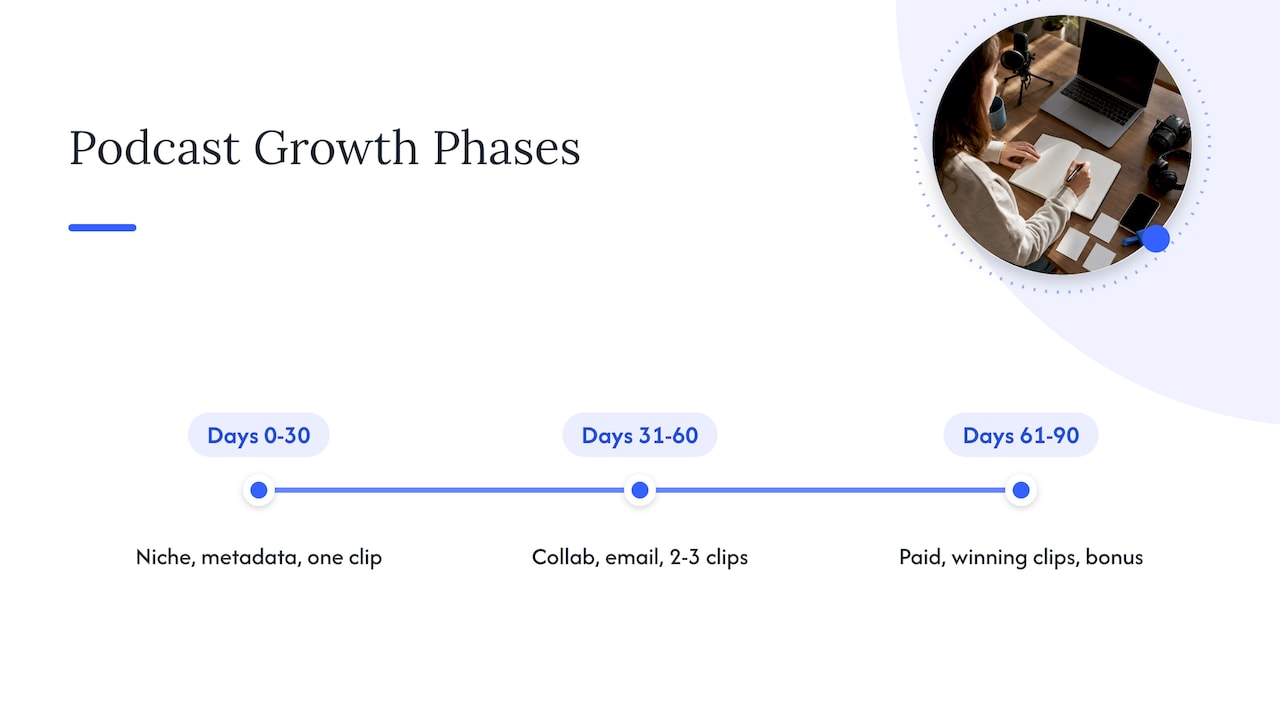
Days 0 through 30: lock your niche, fix every metadata field, and publish one clip per episode without exception. Days 31 through 60: layer in one collaboration, launch your email welcome flow, and raise clip output to two or three per episode. Days 61 through 90: run your first small paid test, double down on whichever clip format already outperforms the rest, and introduce a bonus piece of content for your most engaged followers.
The most common mistakes are changing titles and formats too often to get a clean read, skipping transcripts because they feel tedious, and chasing downloads instead of engaged listeners.
— fan
Turning engaged listeners into paying fans with Fanspicy
Podcast growth tactics earn you listeners. Turning a share of those listeners into paying supporters is a separate problem, and it is one Piquant pour les fans solves well for creators who want direct audience ownership instead of relying on sponsors alone.
We built our platform around subscriptions, paid posts, tips, live streams, and private messages, all of which complement a podcast rather than replace it. A bonus episode, an early-access cut, or a live Q&A with your most engaged listeners are natural products to gate behind a subscription once you know who your superfans are.
- Mention your Fanspicy page once per episode, right after your main CTA, so it never competes with your “follow the show” ask.
- Link your page from your show notes and website, the same owned channels you already built for email capture.
- Offer a low-friction first purchase, like a single bonus clip or a one-off tip option, before asking listeners to commit to a subscription.
Creators migrate existing content over and choose from multiple monetization formats depending on what their audience responds to. If you already have listeners who comment, share, and show up for every episode, set up your Fanspicy page and give them a direct way to support the show they already love.
FAQ
How do I get 1,000 listeners for my podcast?
Focus on a narrow, well-defined audience first, since niche shows convert search traffic and social clips into listens far more efficiently than broad ones. Combine consistent metadata optimization, two to three clips per episode, and one guest collaboration a month, and track engaged listeners rather than downloads to confirm the growth is real.
How do I make my podcast go viral?
There is no reliable formula for virality, but short clips built around a strong hook in the first few seconds have the best odds of being shared widely. Treat virality as a byproduct of consistent clip production and strong editing, not a goal you can engineer directly.
How much do podcasts with 10,000 listeners make?
Earnings at that size vary widely depending on niche, ad rates, and monetization mix, and no single figure applies across shows or platforms. Many creators at this scale combine sponsorships with direct fan monetization, such as subscriptions or paid bonus content, rather than relying on advertising alone.
Why is my podcast not growing?
The most common causes are an undefined audience, metadata that does not match what listeners search for, and a lack of repurposed clips to drive new discovery. Check your engaged listener percentage in Apple Podcasts Connect first, since flat or falling engagement usually points to a content or pacing problem rather than a promotion problem.
How often should I publish new episodes?
Consistency matters more than frequency, so choose a schedule you can sustain indefinitely, whether that is weekly or biweekly, and stick to it. Listeners build a habit around a predictable release day, and that habit is part of what drives follows and repeat listening.
Sources
- Analytics – Apple Podcasts for Creators
- How to grow your podcast audience – Spotify for Creators
- The Infinite Dial® 2026 – Edison Research
- Podcast discovery tips – YouTube Help