

Table des matières
Start by building a permissioned audience, such as an email list, and piloting one revenue stream that matches what your visitors actually came for. Every reliable framework, from Google’s own AdSense guidance to platforms like FanSpicy, points to the same principle: audience fit beats method choice. The core models are attention (ads), product or access (subscriptions, digital goods), services (consulting, courses), and affiliate or sponsored partnerships. Track results in GA4, satisfy FTC disclosure rules, then diversify. The checklist below breaks this into a first move you can make this week.
TL;DR:
- Focus on choosing a monetization method aligned with the page’s intent, such as affiliate links for comparison pages or subscriptions for loyal audiences.
- Track revenue-per-session and conversion events in GA4 to assess pilot success, ensuring metrics meet pre-set minimums without harming user experience.
- Build a permissioned audience through email and analyze high-intent pages to select a pilot that matches visitor behavior, not just high traffic volume.
- Comply with FTC disclosure rules and ad platform policies before launching paid links or ads, and use clear labels like “Ad” or “Sponsored” at the point of recommendation.
- Prioritize testing and measuring one monetization channel at a time over multiple half-finished streams, then refine based on real data before scaling.
Table des matières
- Quick Action Checklist to Start Monetizing in Days or Weeks
- Practical Monetization Methods Grouped by Model and When to Use Each
- How to Instrument and Measure Revenue: Events, KPIs, and Validation
- Disclosure, Platform Rules, and Consent You Must Implement Before Monetizing
- Decision Framework and a 6-Week Pilot Plan to Validate One Monetization Channel
- Tactics to Increase Revenue Once a Model Is Validated
- FanSpicy’s Perspective: Practical Lessons and Common Creator Pitfalls
- The Real Bottleneck Isn’t the Method, It’s the Sequence
- Turn Your Website Traffic Into Direct Fan Revenue With FanSpicy
- Authoritative Docs and Resources to Implement Tracking, Disclosures and Ad Consent
- Sources
- FAQ
Quick Action Checklist to Start Monetizing in Days or Weeks
You do not need six months of planning to see your first dollar. You need a sequence, and most creators skip steps because they chase the flashiest option instead of the one their traffic already supports.
- Build or grow a permission channel, typically an email list, and tag your highest-traffic pages by topic and intent.
- Pull your search console and analytics data to find pages with commercial or transactional intent, not just high pageviews.
- Choose one monetization pilot that matches that intent instead of trying three at once.
- Set up conversion events and a baseline in GA4 before you launch anything.
- Run the pilot for a fixed window, then compare revenue-per-session and any drop in user experience before adding a second stream.
A few things matter more than they look:
- Traffic that arrives through search with a buying question converts better on affiliate or product offers than on display ads.
- A list of even a modest size gives you a channel you own outright, unlike social reach that a platform algorithm can throttle overnight.
- One clean pilot with real numbers beats three half-built revenue streams with no data behind them.
Conseil de pro : Pick the monetization method your best-performing page already suggests. A recipe blog post ranking for “best stand mixer” wants an affiliate link, not a display ad stack.
Practical Monetization Methods Grouped by Model and When to Use Each
Different pages on your site deserve different monetization models, and the mismatch between method and intent is the most common reason a pilot underperforms. Google’s AdSense monetization guidance groups the realistic options into a handful of buckets, and each one has its own setup demands.
Selling products and digital goods works when you have something specific to sell rather than just attention to rent out. If you are shipping physical goods, factor in fulfillment and payment processing fees from day one. Digital downloads, templates, or presets skip shipping entirely and can launch in a weekend. Either way, instrument a purchase event before your first sale so you know what converted and from where.
Selling access covers memberships, paywalls, and premium newsletters. A freemium model, some content free and the best material gated, tends to convert better than a hard paywall for a new audience because readers need to trust you before they pay. Tiered pricing lets you capture both casual and highly engaged readers without alienating either group. A short trial period reduces the friction of that first payment decision.
Selling expertise through consulting, courses, or workshops monetizes trust directly. Package your offer clearly (a single workshop, a cohort course, a retainer) rather than leaving it vague, and build a simple lead capture form before you build the product. A clear refund policy removes hesitation for first-time buyers.
Selling attention through advertising splits into three flavors: programmatic networks, direct ad sales, and sponsored posts. Programmatic is the lowest effort but pays the least per view. Direct sales and sponsored placements pay more but require you to pitch advertisers yourself. Placement matters as much as volume: an ad wedged into the middle of a paragraph a reader is trying to finish will cost you more in trust than it earns in clicks.
Affiliate marketing performs best on pages where the reader is already comparing options. Match the offer to the page’s intent, use deep links that point to the specific product rather than a homepage, and track the full click-to-purchase path so you know which pages actually convert versus which ones just generate clicks.
Sponsored content and partnerships need a contract that spells out deliverables, timelines, and what you will not do (undisclosed placement, editorial control over unrelated content). Measure a sponsored campaign the same way you measure any other channel: clicks, conversions, and revenue attributed to that specific post.
Donations and microtransactions work best when the ask is specific and tied to a moment, a milestone episode, a big project, rather than a generic “support us” banner that fades into wallpaper.
Some of the strongest performers combine models rather than picking one. Affiliate links inside a free newsletter that also sells a paid tier is a common pairing, and a detailed look at hybrid monetization shows how creators layer subscriptions with tips and paid posts rather than relying on a single stream. A broader rundown of monetization models worth testing is useful if you want more angles before committing to a pilot.
How to Instrument and Measure Revenue: Events, KPIs, and Validation
You cannot judge a pilot you have not measured, and the biggest reason “we tried monetization and it didn’t work” turns out to be false is that nothing was tracked in the first place. Define one conversion event per model before launch: a purchase for products, a signup for subscriptions, a tip received, or an affiliate conversion.
Google’s own ecommerce measurement documentation lays out the standard events: view_item, add_to_cart, begin_checkout, and purchase. Map each one to the page and traffic source that generated it, not just the aggregate total.
- Track revenue-per-session, not raw pageviews, as your primary health metric.
- Watch conversion rate and average order value separately since a fix for one can quietly hurt the other.
- Log refund rate so a spike in “sales” is not actually a spike in disputes.
- If you are paying for traffic, track customer acquisition cost against revenue-per-session before scaling spend.
A useful benchmark to hold onto: instrumenting billable events like purchase, signup, and tip, and comparing revenue-per-session across source and device, is the approach analytics practitioners recommend specifically because pageview counts alone hide which traffic actually pays.
Before trusting any dashboard rollup, run a debug check: fire each event manually and confirm it lands correctly in your analytics tool. A closer look at analytics for creator-driven sites walks through this kind of event validation in more detail.
Disclosure, Platform Rules, and Consent You Must Implement Before Monetizing
Before you launch any paid link or ad unit, three compliance steps protect both your revenue and your credibility. The FTC’s disclosure guidance is specific: financial relationships, affiliate commissions, and sponsorships need to be disclosed clearly and conspicuously, placed next to the link or endorsement rather than buried in a footer or an “about” page.
- Use plain labels like “Ad” or “Sponsored,” or a short line such as “I get commissions for purchases through links in this post,” placed right where the reader sees the recommendation.
- If you plan to run programmatic ads and reach users in the EEA, UK, or Switzerland, Google’s EU user consent policy requires a certified consent management platform integrated with the IAB framework before you can serve personalized ads to that traffic.
- Review your ad network’s placement rules before launch: disguising an ad as content, or placing it to encourage accidental clicks, risks having ads pulled or your account suspended.
A guide to privacy practices on creator platforms covers the consent-flow side of this in more depth if your audience skews international.
Decision Framework and a 6-Week Pilot Plan to Validate One Monetization Channel
Choosing a model comes down to four questions: what does this visitor actually want, where did the traffic come from, how much of your time does the method demand, and how much friction sits between “interested” and “paid.” A page ranking for a comparison query wants affiliate links. A page full of returning, engaged readers wants a subscription offer. A page attracting one-time search traffic with no repeat visits is a better fit for ads than for a membership pitch.
- Week 0: Set up the conversion event, pick the single pilot model, and confirm baseline traffic and revenue-per-session for the pages involved.
- Weeks 1 to 2: Soft launch to a portion of your audience or a subset of pages, watching for early signal without committing your whole site.
- Week 3: Pull the numbers, compare against your baseline, and adjust pricing, placement, or copy based on what actually moved.
- Weeks 4 to 6: Decide to scale or stop based on whether revenue-per-session cleared a minimum you set in advance, and whether user experience metrics like bounce rate held steady.
Conseil de pro : Set your acceptance number before you launch, not after you see the results. Deciding what counts as “working” once the data is in front of you almost always leads to moving the goalposts.
Tactics to Increase Revenue Once a Model Is Validated
Once a pilot clears its bar, the fastest gains come from refining what already works rather than adding a new channel prematurely.
- Build an email lifecycle sequence that nudges trial users toward a paid tier and re-engages lapsed subscribers.
- Test tiered pricing, bundles, and limited-time offers to lift average order value without raising your base price.
- Use on-site recommendations so a reader who converts on one page sees a relevant next offer instead of a dead end.
- Run small A/B tests on your highest-traffic pages first, since a 1% lift there outweighs a 20% lift on a page nobody visits.
Focus improvements on pages already carrying volume. A tweak that raises conversion on a page with ten visitors a month will not move your revenue; the same tweak on your top landing page will.
FanSpicy’s Perspective: Practical Lessons and Common Creator Pitfalls
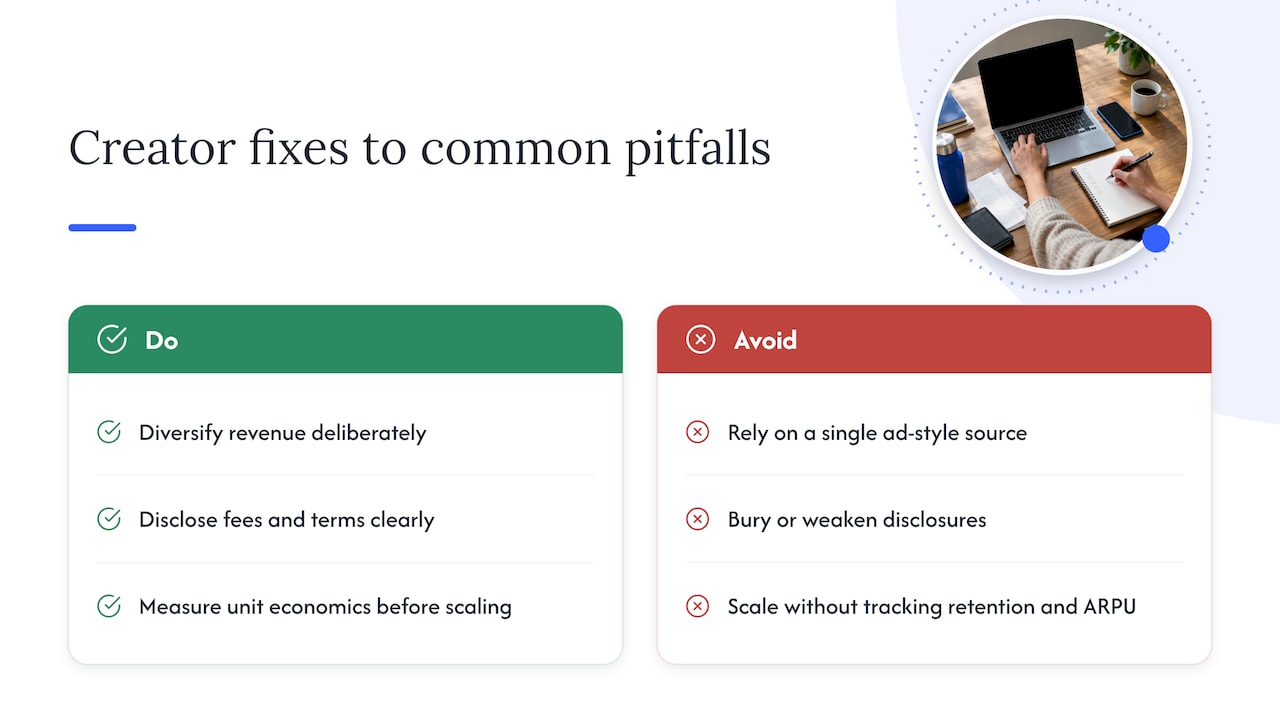
Creators commonly build recurring income through subscriptions, private messages, live streams, and tips, and a few patterns repeat across accounts that struggle. Over-reliance on a single ad-style revenue source leaves creators exposed when reach dips. Weak or buried disclosures erode trust faster than any pricing mistake. And creators who never track unit economics, revenue per subscriber, retention by tier, cannot tell a good month from a lucky one. The fix in each case is the same: diversify deliberately, disclose clearly, and measure before you scale.
The Real Bottleneck Isn’t the Method, It’s the Sequence
Most advice on monetizing a website treats method selection as the hard part: ads or affiliate, subscriptions or courses. That is the wrong place to spend your energy. The harder, more valuable work is sequencing, building permission before pitching, matching offer to intent before writing copy, and measuring before scaling. Creators who skip straight to “which model pays the most” tend to bolt three revenue streams onto a site with no baseline data, then wonder why nothing moves. The conventional wisdom to “just diversify early” is backwards; diversify after one channel proves itself, not before. Prioritize getting one clean, measured pilot right. Everything else, pricing tweaks, bundling, a second stream, works better once you have real numbers instead of guesses.
— fan
Turn Your Website Traffic Into Direct Fan Revenue With FanSpicy
If your monetization pilot points toward paid content, memberships, or direct fan support, FanSpicy gives you a platform built specifically for that path. Creators use it to sell subscriptions, private messages, live streams, and exclusive content, and to collect tips directly from their audience rather than depending on ad rates or affiliate commissions that fluctuate with algorithms you do not control.
This model suits creators who want recurring revenue and a direct relationship with fans instead of a one-time affiliate payout. The platform’s positioning emphasizes letting creators keep more of what they earn, own their audience relationship directly, and migrate existing content over without starting from scratch. If that matches the pilot you are building, become a model on FanSpicy and set up your first subscription tier today.
Authoritative Docs and Resources to Implement Tracking, Disclosures and Ad Consent
- GA4 ecommerce measurement guide for setting up purchase and conversion events correctly.
- FTC disclosure guidance for compliant affiliate and sponsored content labeling.
- Google’s AdSense EU consent policy for CMP requirements before serving personalized ads in the EEA, UK, or Switzerland.
- FanSpicy’s own guide to proven monetization methods for additional models worth piloting.
Sources
- AdSense help: Monetize with different ad types and approaches
- Measure ecommerce | Google Analytics | Google for Developers
- Disclosures 101 for social media influencers | FTC
- Ecommerce tracking in Google Analytics — Loves Data
- Comply with the EU user consent policy – Google AdSense Help
FAQ
How long does it take to start earning from a website?
Timelines depend heavily on traffic and method: an affiliate pilot on an already-ranking page can produce its first commission within weeks, while subscription or membership models typically need a few months to build enough trust and audience size to convert reliably. Measuring revenue-per-session during a pilot, rather than waiting for a lump revenue number, gives you an earlier read on whether a channel is working.
Can I run ads and affiliate links on the same website?
Yes, and combining ads with affiliate links or a subscription tier is one of the most common setups once a single channel is validated. Just be sure disclosures for affiliate content stay clear and separate from ad placements so readers can tell the difference between a paid partnership and a programmatic ad, per FTC disclosure guidance.
Do I need to disclose affiliate links if I do not make many sales?
Yes, disclosure obligations under FTC guidance apply regardless of how much commission you actually earn; the requirement is tied to the existence of a financial relationship, not its size. A short label like “Ad” or a plain sentence noting you earn a commission, placed next to the link, satisfies the FTC’s placement guidance.
What is the best monetization method for a new website?
There is no single best method; the right choice depends on your traffic’s intent and where it comes from, which is why matching model to audience matters more than picking a trending option. A new site with search traffic on comparison-style content generally starts strongest with affiliate links, while a site with a loyal returning audience is better positioned for a membership or subscription pilot.
How do I know if my monetization pilot is actually working?
Compare revenue-per-session and conversion rate against the baseline you set before launch, using GA4 events like purchase or subscription signup rather than relying on pageviews. If those numbers clear the minimum you set in advance without a noticeable hit to bounce rate or time on page, the pilot is working and ready to scale.