

Índice
A FABN is a funding agreement-backed note: a debt security issued by a special purpose vehicle (SPV) and backed by a funding agreement from a life insurance company. The insurer owes principal and interest under the agreement, the SPV passes those payments to noteholders, and that chain is the whole idea. This guide explains each link, how FABNs differ from related products, where the risks sit, and what to examine before judging a specific program.
TL;DR
- A FABN is a note issued by an SPV and backed by a life insurer’s funding agreement, which supplies the principal and interest payments to investors.
- Investors mainly carry the credit risk of the sponsoring insurer, because the notes are effectively tied to its general account.
- FABNs are one type of funding agreement-backed security (FABS). Others include XFABNs and FABCP, which differ mostly in term and extension features.
- Issuance set a record of $79.5 billion across 26 issuers in 2025, according to Fitch Ratings.
- Before assessing a program, look at the funding agreement’s priority in insolvency, the legal structure, liquidity, and any put options.
Índice
- What a FABN actually is
- First, what is a funding agreement?
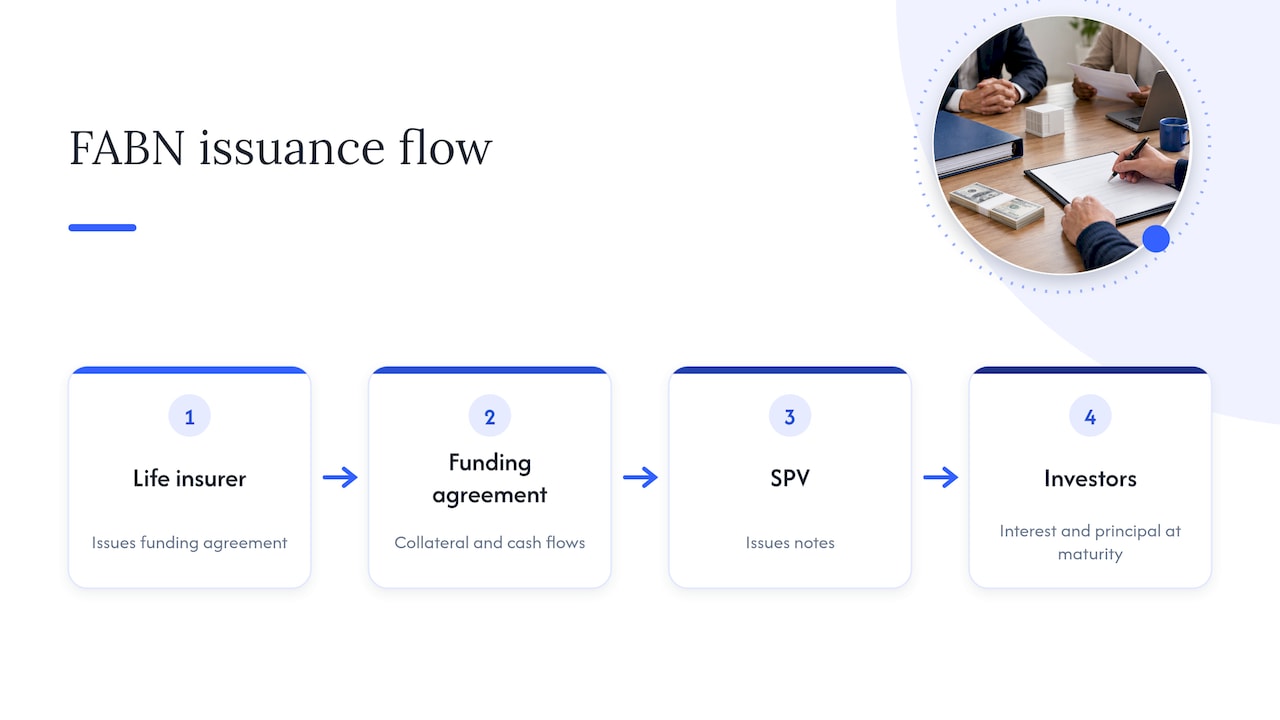
- How the FABN structure works, step by step
- FABN versus other funding agreement-backed securities
- Why life insurers issue FABNs
- The risks investors face
- What to examine in a FABN program
- How big the market has become
- New disclosure rules from the NAIC
- Our perspective: diversified funding works for creators too
- For creators who found this page by accident
- PREGUNTAS FRECUENTES
- Sources
What a FABN actually is
The name breaks into three parts. “Funding agreement” is an insurance contract. “Backed” means the contract is the asset behind the security. “Note” means investors hold debt that pays interest and returns principal at maturity.
The NAIC describes a FABN as a debt instrument issued by an SPV that is collateralized by one or more funding agreements issued by a life insurer. The insurer is not the issuer of the note. It sits one step behind, as the source of the cash flows.
That separation is deliberate, and it explains most of what makes FABNs different from an ordinary corporate bond.
First, what is a funding agreement?
A funding agreement is a deposit-type contract that life insurers write. An IRS memorandum describes it as an arrangement under which an insurer accepts and accumulates funds and makes future payments that are not based on mortality or morbidity contingencies.
In plain terms, nobody has to die or fall ill for the payments to be due. The insurer takes in money and promises to pay interest and return principal on a schedule, much like a debt obligation. That is why the contract can serve as collateral for a note. The cash flows are known in advance rather than triggered by a life event.
The insurer’s other products, such as life policies and annuities, depend on insurance risk. A funding agreement does not, which is why it can be packaged for capital markets investors.
How the FABN structure works, step by step
The mechanics are the same across most programs, even when the details of each sponsor differ.
- The insurer sets up or uses an SPV. The SPV is a separate legal entity created to issue the notes. It is generally structured to be bankruptcy-remote, meaning the insurer’s financial trouble should not pull the vehicle into a bankruptcy on its own.
- The SPV issues notes to investors. These are sold in the capital markets, often under a program that allows repeated issuance over time.
- The SPV uses the proceeds to buy a funding agreement. The insurer receives the cash and issues the agreement to the SPV, matching the note’s terms.
- The insurer pays under the funding agreement. Principal and interest flow to the SPV.
- The SPV pays noteholders. The funding agreement is the SPV’s primary asset and the source of what it pays out.
As the NAIC summarizes it, the insurer pays principal and interest under the agreement and the SPV pays noteholders. Because of this pass-through design, the creditworthiness of the note comes down to the insurer’s ability to honor the agreement.
Which law applies
The legal layers differ. According to AM Best’s rating methodology, the notes are often governed by New York law, while the underlying funding agreements are governed by the laws of the insurer’s home state. That matters when you read offering documents, since two legal systems can touch the same transaction.
FABN versus other funding agreement-backed securities
FABN is the best-known member of a family called funding agreement-backed securities, or FABS. The Federal Reserve’s staff note on the topic explains that FABNs are typically medium-term notes, while the other versions mostly vary by maturity and extension rights. The table below summarizes what the Fed describes.
| Product | Typical term | Distinguishing feature |
|---|---|---|
| FABN | Medium-term | The standard note, usually a fixed maturity |
| XFABN | Shorter maturities | Mensualmente extension options |
| FABCP | One week to six months | Fixed short terms, a commercial paper format |
The NAIC’s 2026 agenda for its statutory accounting working group widens the list. It identifies SPV structures backed by funding agreements that include FABN, FABCP, FABR (repurchase agreements), FABL (loans) and municipal prepay structures. If you see an unfamiliar acronym starting with FAB, it most likely belongs to this family.
Why life insurers issue FABNs
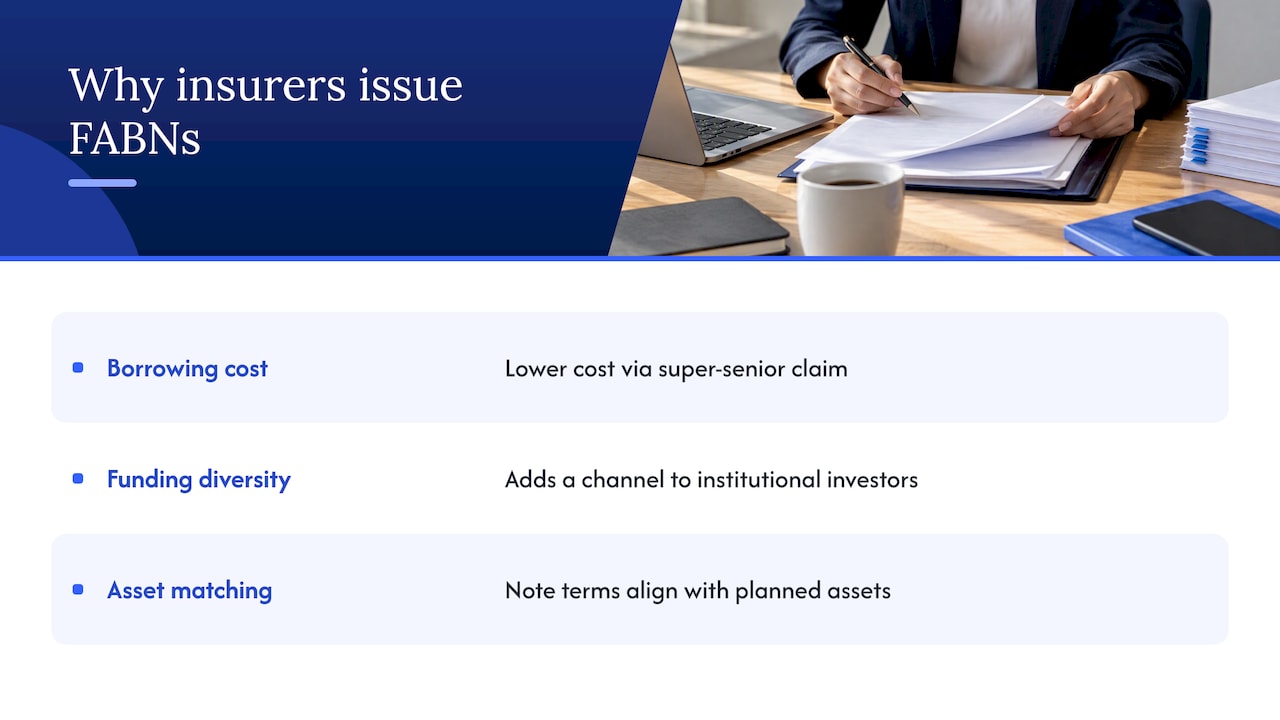
Insurers have several ways to fund themselves. FABNs add another one, and the appeal is mostly about cost and diversification.
Lower borrowing cost. The Federal Reserve notes that FABS let insurers borrow at a lower cost than other debt because the securities rest on a super-senior claim on the insurer’s balance sheet. Funding agreement holders rank ahead of many other creditors, which is why investors may accept a tighter spread.
Funding diversity. The NAIC says FABNs diversify insurers’ funding sources. An insurer that relies on policyholder premiums and traditional debt can add a channel that reaches institutional investors.
Matching to assets. Insurers can set note terms to align with the assets they plan to buy, which is why asset-liability management (ALM) is so central to how these programs are run and judged.
The risks investors face
The structure looks tidy, but it does not remove risk. It moves and concentrates it.
Credit risk of the insurer
Investors face credit risk tied to the insurance company, since FABNs are effectively backed by the insurer’s general account. The SPV has no independent business to fall back on. If the insurer cannot pay, the note’s source of payment weakens. The super-senior ranking helps in insolvency, but it is a legal priority and not a guarantee.
Liquidity and put risk
AM Best describes several pressures that sit with the insurer: ALM mismatches, liquidity stress, put-option risk and refinancing risk at maturity. The NAIC’s list of risks for lenders to the structure includes the possibility that a FABN has optionality letting the holder demand funds unexpectedly, which is the put risk. An insurer that has invested the cash in long-dated assets could face strain if many holders exercised such rights at once.
ALM mismatch
If the insurer’s assets are longer or less liquid than the obligations it owes under the funding agreement, a market disruption can force it to sell assets at a bad time or to refinance on poor terms. The NAIC says robust asset-liability management is essential to how these structures perform.
What this means in practice
For a buyer, the right question is not “is this a safe structure?” but “how strong is this particular insurer and how conservatively does it manage the liabilities?” Two FABNs with similar terms can carry very different risk depending on the sponsor.
What to examine in a FABN program
AM Best’s criteria give a useful checklist, even for readers who are not rating analysts. It looks at the funding agreement’s priority in insolvency, the program’s legal and economic structure, ALM and liquidity, put options and the supporting documentation. Turn that into questions:
- Priority. Does state law give the funding agreement a senior claim, and what does the offering document say about it?
- Structure. Is the SPV truly bankruptcy-remote, and who are the parties?
- Liquidity. How would the insurer meet a wave of redemptions or maturities?
- Put options. Can holders demand early repayment, and under what conditions?
- Documents. Do the program documents match the summary you were given?
None of this replaces a conversation with a licensed investment adviser or a credit analyst. FABNs are generally institutional products, and anyone considering one should have professional guidance and read the full offering documents.
How big the market has become
FABN issuance has grown into a major corner of insurer funding. Fitch Ratings reported that issuance reached a record $79.5 billion across 26 issuers in 2025. The NAIC primer adds that Fitch expects the market to stay robust in 2026, although supply is opportunistic and sensitive to market conditions.
“Opportunistic” is the key word. Insurers tend to issue when spreads are favorable and step back when they are not, so annual totals can swing. The record year says more about the width of the sponsor base than about a permanent trend line.
New disclosure rules from the NAIC
Regulators have noticed how interconnected insurers and capital markets have become through these vehicles. The NAIC adopted disclosure requirements for funding agreements that back SPV issuances, effective for year-end 2026. The same document says the NAIC’s Financial Stability (E) Task Force and Macroprudential (E) Working Group saw a need for better disclosures to monitor those links.
For readers, the practical result is more visibility into how much of an insurer’s balance sheet is tied to these structures. When you review an insurer’s statutory filings, expect clearer information over time.
Our perspective: diversified funding works for creators too
We build a platform for independent creators, so we do not issue notes. But the logic behind FABNs is familiar to us. The NAIC credits these notes with diversifying insurers’ funding sources, and the same principle drives a healthy creator business: relying on one income stream is fragile, and several streams make the whole more resilient.
Creators who combine subscriptions, paid posts, private messages, live streams and tips are less exposed when any one channel slows down. We have written about how hybrid monetization y microtransactions can support that approach. The lesson from the insurance world is the same one we share with creators: know where your cash flow comes from, and do not let one source carry everything.
— fan
For creators who found this page by accident
If your “fabn” search was really about a different kind of income, and you are a creator looking for a place to sell subscriptions, paid posts, private messages and live streams, Fanspicy is built for that. Creators keep control of their audience and can earn from several formats on one platform. You can see how it works on the Fanspicy home page or start from the creator sign-up page.

For fans, the same home page lists creators offering subscriptions, exclusive posts and live streams.
PREGUNTAS FRECUENTES
What does FABN stand for?
FABN stands for funding agreement-backed note. It is a debt security issued by an SPV and supported by a funding agreement from a life insurance company. The insurer’s payments under that agreement are what the SPV uses to pay noteholders.
Is a FABN the same as a bond issued by an insurer?
No. A conventional bond is issued directly by the insurer or its holding company. A FABN is issued by a separate SPV, and the insurer’s obligation runs through a funding agreement. Investors still depend on the insurer’s ability to pay, but the legal route and ranking in insolvency are different.
How does a FABN differ from an XFABN or FABCP?
All three are funding agreement-backed securities. A FABN is typically a medium-term note, an XFABN has shorter maturities with monthly extension options, and FABCP has fixed terms generally from one week to six months, according to the Federal Reserve.
What is the main risk of a FABN?
The main risk is the credit quality of the sponsoring insurer, because the notes are effectively backed by its general account. Liquidity pressure, put options and asset-liability mismatches can all strain the insurer. Review the offering documents and talk to a licensed adviser before investing.
Can individual investors buy FABNs?
The sources reviewed here describe FABNs as capital markets products sold to investors under programs, and they do not set out retail access rules. If you are considering one, ask a licensed broker or investment adviser whether a specific note is available to you and what the offering documents require.
Sources
- Funding Agreement-Backed Notes (NAIC capital markets primer)
- Funding Agreement-Backed Securities in the Enhanced Financial Accounts (Federal Reserve)
- Rating Funding Agreement-Backed Securities Programs (AM Best)
- FABN Disclosure, Statutory Accounting Principles (E) Working Group (NAIC)
- FABNs in Focus: Record Issuance (Fitch Ratings)
- IRS memorandum on funding agreements