

Índice
The fastest route to a growing YouTube audience is a clear channel promise, keyword-targeted long-form videos published on a consistent cadence, YouTube Shorts for discovery, and retention-first packaging that earns every click. That combination, not luck or viral moments, is what separates channels that compound from channels that stall.
Your one-week action checklist:
- Write your one-sentence channel promise (“I help [audience] achieve [result] by [format]”) and update your About box today.
- Film and publish one search-targeted long-form video and one Short this week.
- Open YouTube Studio after 48 hours and check click-through rate (CTR), first-minute retention, and comment count.
TL;DR: Commit to one long-form video per week plus three to five Shorts, optimize every upload for search, and reply to every comment in the first hour. Many creators reach their first 100 subscribers within a few weeks to a few months at that cadence.
Principales conclusiones
Building a YouTube audience requires a clear channel promise, consistent keyword-targeted uploads, Shorts for discovery, and a data-driven iteration loop that compounds with every video published.
| Point | Details |
|---|---|
| Channel promise first | Write one sentence defining who you help and what result they get before filming anything. |
| Shorts drive early discovery | Shorts can deliver 3–10× more views than long-form for channels under 1,000 subscribers. |
| 2% conversion baseline | Using a rough viewer-to-subscriber conversion rate baseline, thousands of views are typically needed to reach the first 100 subscribers. |
| First 48 hours are critical | Reply to comments, share on socials, and pin a comment immediately after publishing. |
| Watch time beats subscriber count | Optimizing for watch time is the leading indicator of subscriber growth, not a lagging one. |
Índice
- How to build a YouTube audience by setting up your channel right
- How to choose a niche that brings viewers back
- How to plan a content mix that compounds over time
- What makes viewers stay: hooks, structure, and thumbnails
- How a consistent publishing schedule builds early traction
- YouTube SEO: how to rank and get suggested
- How to promote your videos and reach new viewers
- How to turn viewers into a loyal community
- How to use YouTube Analytics to improve every upload
- How to get your first 100 and first 1,000 subscribers
- What gear and budget you actually need to start
- Research-backed benchmarks and realistic growth targets
- What actually moves the needle for new creators
- Sources
How to build a YouTube audience by setting up your channel right
A visitor who lands on your channel page decides whether to subscribe in seconds. Your profile photo, banner, and About description need to communicate one thing instantly: what this channel is for and who it serves.
Channel promise first. Before you touch any design asset, write one sentence that defines your channel: who you help, what result they get, and how you deliver it. That sentence becomes the spine of your About description, your banner tagline, and your video intro. Channels with a clear, specific promise convert casual visitors into subscribers far more reliably than channels with vague “lifestyle” or “general tips” positioning.
Profile and banner assets. Your profile photo should be a clear, well-lit headshot or a recognizable logo at 800×800 pixels. The banner (2560×1440 pixels, with the safe zone centered at 1546×423 pixels) should state your channel promise and, if you publish on a fixed schedule, your upload day. New visitors read the banner before they watch a single video, so treat it as a billboard, not decoration.
About box and links. Place your primary keyword in the first 100–150 characters of your description, because that is what appears in search results before the “more” truncation. Follow it with two to three sentences expanding on your promise, then a list of topics you cover, and finally your contact or social links. YouTube allows up to five external links in the banner area; use them for your most active social profiles and any newsletter or community you run.
Upload defaults and verification. In YouTube Studio, set your default upload settings: add your standard tags, select a default category, and enable automatic captions. Upload a channel watermark (a small subscribe button graphic) that appears on all videos at the 20-second mark. Verify your account at youtube.com/verify to unlock custom thumbnails, live streaming, and videos longer than 15 minutes. Custom thumbnails alone can lift CTR by a meaningful margin, so verification is a day-one priority.
Good vs. poor channel description example:
- Poor: “Welcome to my channel! I post videos about fitness, cooking, travel, and more. Subscribe for new content every week!”
- Good: “I help busy professionals lose their first 20 pounds without a gym membership, using 20-minute home workouts and simple meal prep. New videos every Tuesday.”
The second version tells a specific viewer exactly why they should stay. Hootsuite’s channel growth guide consistently flags niche clarity and metadata optimization as the highest-leverage setup steps for new channels.
Consejo profesional: Add a channel trailer of 60–90 seconds that speaks directly to a first-time visitor. Script it around your channel promise: state the problem you solve, show a clip of your best content, and end with a direct subscribe ask. Returning subscribers skip it automatically, so it costs you nothing with your existing audience.
How to choose a niche that brings viewers back
Picking a niche is not about finding the least crowded space. It is about finding the intersection of what you know well, what you genuinely want to make for years, and what people are already searching for on YouTube. All three legs need to hold.
The niche validation framework:
- Skill: What can you teach, demonstrate, or discuss with more depth than a casual observer?
- Passion: What topic could you research and film about for two years without burning out?
- Search demand: Are people typing related phrases into YouTube autocomplete? Do those searches return results with under 100,000 views on the top videos?
When skill and passion overlap but search demand is thin, you have a hobby, not a channel. When demand is high but you lack genuine depth, your content will be outcompeted quickly. The sweet spot is a specific sub-niche where your expertise is real and the search volume is proven but not yet dominated by large channels.
Channel promise template: “I help [specific audience] achieve [specific result] by [format or method].” For example: “I help first-time homebuyers understand the mortgage process through plain-English explainer videos.” That sentence answers the visitor’s implicit question, “Is this channel for me?” before they watch a single frame.
Content pillar mapping. Once you have your promise, build three to four content pillars around it. Each pillar is a broad topic category that supports the promise, and each pillar generates five to ten specific video ideas. A mortgage education channel might have pillars for “loan types,” “credit repair,” “the closing process,” and “first-year homeowner tips.” Every video you make should slot into one of those pillars. This keeps your library coherent and helps YouTube’s algorithm understand what your channel is about.
Quick demand check. Open YouTube and type your core topic into the search bar. Note the autocomplete suggestions; each one is a real query people are typing. Then search each phrase and look at the view counts on the top ten results. If most results have under 200,000 views and the top channels have under 50,000 subscribers, you have found a winnable topic. Tools like TubeBuddy or vidIQ can surface search volume estimates and competition scores directly in the YouTube interface. A 30-minute session using this method can generate ten viable video topics before you film a single frame, which is exactly the research-first approach that OutlierKit’s 2026 strategy framework recommends.
How to plan a content mix that compounds over time
New creators often make one of two mistakes: they post only long-form videos and wonder why discovery is slow, or they post only Shorts and wonder why subscribers never convert. The answer is both, in the right ratio.
Recommended content mix for new channels:
- Long-form (8–20 minutes): 60–70% of your output. This is where subscribers are built. Long-form earns watch time, builds trust, and ranks in search. Aim for about one per week.
- YouTube Shorts (under 60 seconds): 30–40% of your output. Shorts drive discovery at a scale long-form cannot match for small channels. VidGrow reports that Shorts consistently deliver 3–10× more views than long-form for channels under 1,000 subscribers. Aim for several per week.
- Community posts: Start using the Community tab once you reach 500 subscribers. Polls, behind-the-scenes clips, and topic teasers keep your audience engaged between uploads.
Series design. A series is a group of three to six related videos that share a title structure and a logical viewing order. Series increase repeat watch because a viewer who finishes episode one has a clear reason to click episode two. Design your first series around your channel’s core promise: pick a problem your audience has, break the solution into three to six steps, and make each step its own video. Collect the series into a playlist with a keyword-rich title. Playlists extend session watch time, which is a signal YouTube’s algorithm weighs heavily.
Shorts-to-long-form strategy. Every long-form video you publish contains three to five moments that work as standalone Shorts: a surprising stat, a quick how-to, a reaction clip, or a punchy takeaway. Extract those moments and post them as Shorts with a caption that points viewers to the full video. This repurposing approach multiplies your output without multiplying your filming time, and it routes Short viewers into your long-form library where they are more likely to subscribe.
Sample 12-week content calendar (template):
- Weeks 1–4: Publish one long-form search video per week. Extract two Shorts from each. Focus on your highest-demand pillar.
- Weeks 5–8: Add a second long-form topic pillar. Begin a three-part series. Continue Shorts from each long-form.
- Weeks 9–12: Launch your second series. Add one Community post per week. Review analytics and double down on the pillar with the highest average view duration.
Batch filming two to three videos in one session cuts setup time and keeps your publishing cadence consistent even when life gets busy.
What makes viewers stay: hooks, structure, and thumbnails
Retention is the metric YouTube uses to decide whether to recommend your video to more people. Every production decision should serve one goal: keep the viewer watching longer than they planned to.
Hook blueprint. The first 5–10 seconds of your video must deliver on the promise your title and thumbnail made. If your title is “How to Pay Off $20,000 in Debt in 12 Months,” your hook should immediately show the result or the method, not a 30-second intro with your name and logo. A strong hook pattern: state the problem, tease the solution, and tell the viewer what they will know by the end. Viewers who make it past the 30-second mark are far more likely to watch to completion.
Video structure checklist:
- Hook (0–10 seconds): Confirm the title promise. Show the payoff or the problem.
- Setup (10–60 seconds): Briefly explain why this matters and what the viewer will learn.
- Payoff (bulk of the video): Deliver the content in logical steps. Use B-roll, graphics, or demonstrations to maintain visual variety.
- CTA (final 20–30 seconds): Ask for the subscribe after you have delivered value. Tie the ask to the next video or playlist: “If this helped, the next video in this series covers X.”
Thumbnail and title principles. Your thumbnail and title work together as a single unit. The thumbnail should have one dominant visual element (a face with a clear expression, a before/after, or a bold graphic), minimal text (three to five words maximum), and high contrast. The title should be 50–70 characters, front-load the keyword, and create curiosity or urgency without being misleading. Statista’s data on YouTube search result title lengths confirms that title length and packaging directly affect where videos appear in search results.
A/B thumbnail testing is available through YouTube Studio’s “Test and Compare” feature. Upload two thumbnail variants and let YouTube serve them to a portion of your audience. Check CTR after 48–72 hours and keep the winner. This single habit, run consistently, compounds into significantly higher click rates over time.
Consejo profesional: Record your hook last. After you finish filming the full video, you will know exactly what the most compelling moment is. Use that knowledge to write a hook that teases the best part, then film it fresh at the start of your edit session.
How a consistent publishing schedule builds early traction
Consistency is not about posting every day. It is about posting on a schedule your audience can predict and that you can sustain for at least six months without burning out.
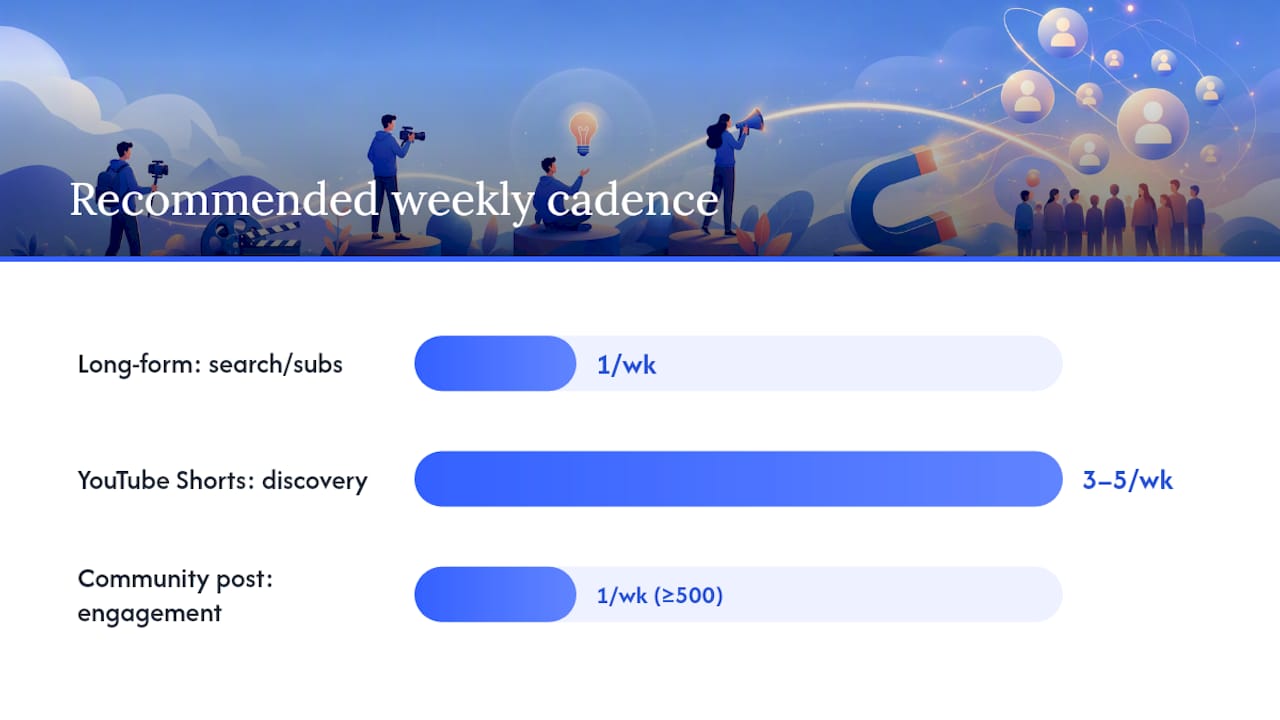
Sustainable cadence recommendations. For most new creators, one long-form video per week plus three to five Shorts is the right starting point. That cadence gives YouTube’s algorithm enough signal to understand your channel, gives viewers a reason to return, and is achievable without a full production team. If one video per week is not realistic given your schedule, one every two weeks is still workable; just be consistent within that interval.
Sample cadence:
| Format | Frecuencia | Propósito |
|---|---|---|
| Long-form (8–20 min) | 1 per week | Search ranking, watch time, subscriber conversion |
| YouTube Shorts | 3–5 per week | Discovery, new audience reach |
| Community post | 1 per week (after 500 subs) | Engagement, retention between uploads |
The first 48 hours after publishing. The launch window matters more than most new creators realize. YouTube’s algorithm evaluates early engagement signals to decide how widely to distribute a new video. Alan Spicer’s 2026 growth framework emphasizes that new channels get most of their early traction from Search and Shorts, which means your first-48-hour actions should focus on driving initial clicks to build that signal.
First-48-hour checklist:
- Post the video link to every social platform where you have an audience.
- Send an email to your list if you have one.
- Pin a comment that adds context or asks a question to prompt replies.
- Reply to every comment within the first hour of publishing.
- Share the video in one or two relevant online communities (forums, subreddits, Discord servers) where it genuinely adds value.
Using Premieres and Community posts. Schedule your video as a Premiere 24–48 hours in advance and share the countdown link on social media. Premieres create a shared viewing event and generate comments before the video is even fully live, which boosts early engagement signals. Follow up with a Community post the day after publishing to remind subscribers who missed the notification.
Consejo profesional: Post your Shorts at the same time you publish your long-form video. A Short that teases the long-form drives viewers directly to the full video during the period when YouTube is actively evaluating it.
YouTube SEO: how to rank and get suggested
Search is where new channels get their first real traction. Before a channel has enough subscribers to drive browse traffic, search is the primary discovery engine, and optimizing for it is the highest-leverage activity you can do before hitting publish.
Keyword placement checklist:
- Place your primary keyword in the first 60 characters of the title.
- Repeat it naturally in the first two sentences of the description.
- Say it aloud within the first 30 seconds of the video (YouTube’s auto-captions index spoken words).
- Include it in at least one chapter title if your video uses chapters.
Description template. The first 150–200 characters of your description appear in search results before truncation, so lead with your keyword and a clear value statement. Follow with a 150-word-plus body that expands on the topic, includes two to three related keywords naturally, and lists timestamps for chapters. End with your standard links (social, newsletter, related playlists). This structure serves both search indexing and viewer navigation.
Tags. Tags carry less weight than they did five years ago, but they still help YouTube understand your video’s topic, especially for new channels with limited watch history. Use five to ten tags: your exact title phrase, two to three close variants, and two to three broader category terms. Avoid tag stuffing; it does not help and can dilute relevance signals.
Chapter strategy. For videos over eight minutes, add chapters using timestamps in the description (format: 0:00 Introduction). Chapters appear as segments in the progress bar and as standalone search results in Google. A well-named chapter like “How to negotiate your salary” can rank independently and drive traffic to your video from outside YouTube.
Playlist architecture. Build one playlist per content pillar and one playlist per series. Name each playlist with a keyword-rich title that matches how your audience would search for that topic. Add every new video to the relevant playlist immediately after publishing. Playlists extend session watch time because YouTube auto-plays the next video, and longer sessions signal to the algorithm that your content is worth recommending.
Consejo profesional: Write your description before you film. Drafting the description forces you to clarify exactly what the video promises and what keywords it should rank for. It also gives you a script outline, which speeds up filming.
How to promote your videos and reach new viewers
Publishing a great video and waiting for YouTube to distribute it is a slow strategy for new channels. Active promotion in the first 48 hours accelerates the algorithm’s evaluation and puts your content in front of people who would never have found it through search alone.
Outbound promotion checklist:
- Share the video link on Instagram, X (formerly Twitter), Facebook, TikTok, and LinkedIn where relevant.
- Post the Short version on TikTok and Instagram Reels to drive cross-platform discovery.
- Embed the video in a blog post or article on your website if you have one.
- Share in two to three niche communities (subreddits, Facebook groups, Discord servers) where the topic is genuinely relevant.
- If you have an email list, send a brief note with the video link and one sentence on why this episode is worth watching.
Sprout Social’s promotion guide highlights cross-posting, embedding, and community sharing as the most reliable organic tactics for early view velocity. YouTube’s own support documentation covers the embedding tools and Promotions tab available directly inside YouTube Studio.
Collaboration outreach. Find two to three creators in adjacent niches (not direct competitors) whose audience would benefit from your content. Reach out with a specific collaboration idea: a guest appearance, a co-produced video, or a shoutout swap. The outreach message should be short, specific, and focused on what the collaboration offers their audience, not yours. Audience fit matters more than subscriber count; a creator with 5,000 highly engaged subscribers in your exact niche is more valuable than one with 50,000 in a tangential space.
YouTube Ads basics. The Promotions tab inside YouTube Studio lets you run a simple ad campaign without a Google Ads account. You set a budget, choose a target audience by interest and geography, and YouTube promotes your video as a skippable in-stream ad. This works best as a launch boost for a video that already has strong organic CTR and retention, not as a substitute for good content. Spending $50–$100 to amplify a video that is already performing well can accelerate its distribution curve. Spending the same amount on a video with weak retention will not fix the underlying problem. For more advanced targeting, Google Ads offers demographic and keyword-level controls that the Promotions tab does not.
How to turn viewers into a loyal community
Subscribers who feel a connection to a creator watch more videos, leave more comments, and share content more often. That connection does not happen automatically; it requires deliberate, consistent interaction.
Comment playbook:
- Reply to every comment within the first hour of publishing. Early replies signal to YouTube that your video is generating engagement, which can boost distribution.
- Pin a comment that adds value: a key resource, a follow-up question, or a teaser for the next video.
- Ask one specific question at the end of each video to prompt replies. “What’s the biggest obstacle you’ve hit with X?” generates more responses than “Let me know what you think.”
- When a viewer suggests a video topic in the comments, acknowledge it publicly. If you make that video, call it out in the intro. Viewers who see their idea become content become loyal advocates.
Community tab strategies. Once you unlock the Community tab (at 500 subscribers), use it to maintain presence between uploads. Post a poll asking viewers to vote on your next topic. Share a behind-the-scenes photo or clip from an upcoming video. Highlight a comment from a viewer who got a result from your advice. These posts take five minutes and keep your channel active in subscribers’ feeds without requiring a full production cycle.
Live streaming for audience building. A monthly live stream, even 30–45 minutes, builds a level of real-time connection that recorded videos cannot replicate. Use live streams to answer questions, preview upcoming content, or do a live walkthrough of a process you normally edit into a polished video. Promote the stream 48–72 hours in advance via Community posts and social media. Viewers who join a live stream and interact are among the most likely to become long-term subscribers.
Using community feedback as a content roadmap. Track which comments ask the same question repeatedly. Those questions are your next video topics. Track which videos generate the most comments per view. Those formats are worth repeating. This feedback loop reduces guesswork and keeps your content aligned with what your audience actually wants, which is exactly the research-first approach that OutlierKit’s strategy framework recommends for topic selection.
How to use YouTube Analytics to improve every upload
Data without a decision framework is just noise. The goal of analytics is not to watch numbers; it is to answer one question after every video: what should I do differently next time?
Primary metrics to track:
- Impressions CTR: The percentage of people who clicked your thumbnail after seeing it. A healthy range for most channels is 4–10%. Below 4% means the packaging needs work.
- Average view duration (AVD): How long viewers watch on average. Higher is better, but context matters; a 10-minute video with a 6-minute AVD is stronger than a 20-minute video with a 4-minute AVD.
- Relative retention: The retention curve in YouTube Studio shows exactly where viewers drop off. A sharp drop in the first 30 seconds means the hook is not delivering on the title promise.
- Subscriber conversion rate: How many viewers subscribe per 1,000 views. The Upvote.club 2026 playbook uses a 2% viewer-to-subscriber baseline as a starting benchmark for conversion math.
- Traffic sources: Where your views are coming from (Search, Browse, Suggested, External). New channels should expect most traffic from Search and Shorts.
Weekly analytics checklist:
- Check CTR and AVD for every video published in the last 30 days.
- Identify the video with the lowest CTR and test a new thumbnail.
- Identify the video with the sharpest early retention drop and rewrite the hook in the description or pinned comment.
- Note which traffic source is growing fastest and create more content optimized for that surface.
Experiment template:
- Hypothesis: “If I change the thumbnail to show a face with a surprised expression, CTR will increase above 5%.”
- Variable: Thumbnail only (keep title and content identical).
- Metric: CTR after 500 impressions.
- Test window: 7 days.
- Decision rule: If CTR increases by more than 1 percentage point, keep the new thumbnail. If not, test a different variable.
Consejo profesional: Sort your videos by “Impressions CTR” in YouTube Studio and look at your top five and bottom five. The top five tell you what packaging your audience responds to. The bottom five are your next A/B test candidates.
How to get your first 100 and first 1,000 subscribers
The first 100 subscribers are the hardest because you have no distribution history and no social proof. The tactics that work at this stage are different from what works at 10,000 subscribers.
Steps to your first 100 subscribers:
- Publish five to ten search-targeted videos on your highest-demand pillar before promoting anywhere.
- Share each video personally with friends, colleagues, and community members who match your target viewer profile. Ask them to watch and leave a comment, not just to subscribe.
- Post in two to three niche communities where your content genuinely helps. Do not spam; add value first, then share the link when it is relevant.
- Reply to every comment. Every single one. At this stage, your comment section is your community.
- Add a clear subscribe CTA at the end of every video, tied to a specific reason: “Subscribe so you don’t miss the next video in this series.”
Steps to your first 1,000 subscribers:
- Increase your Shorts volume to five per week. VidGrow’s 2026 data shows Shorts can produce 3–10× more views than long-form for small channels, making them the fastest discovery engine at this stage.
- Launch your first series and collect it into a playlist. Viewers who watch two or three videos in a row are significantly more likely to subscribe.
- Reach out to two creators in adjacent niches for a collaboration or shoutout swap.
- Run a $50–$100 YouTube Ads promotion on your single best-performing video to accelerate its distribution.
- Post a Community tab poll asking subscribers what topic they want next. This drives engagement and gives you your next video idea simultaneously.
Timeline benchmarks. Most creators who publish one long-form video per week plus three to five Shorts reach 100 subscribers in 6–12 weeks. Reaching 1,000 typically takes 6–12 months at that cadence, though channels that hit a viral Short or a high-demand search topic can compress that timeline significantly. The behaviors that compress the timeline: strong hooks, consistent cadence, active comment replies, and at least one collaboration before 500 subscribers.
Common pitfalls to avoid:
- Posting on five different topics in your first ten videos. Pick one pillar and own it.
- Weak hooks that bury the payoff. If the first 10 seconds do not deliver on the title, viewers leave.
- No clear subscribe reason. “Subscribe for more content” is not a reason. “Subscribe so you get the next video in this series” is.
For more on growing subscribers with proven strategies, Fanspicy’s creator resource library covers conversion tactics that apply across platforms.
What gear and budget you actually need to start
The most common reason new creators delay launching is waiting until they have better equipment. The truth is that audio quality matters far more than camera quality, and a $50 USB microphone will do more for your channel than a $500 camera upgrade.
Starter gear checklist:
- Microphone: USB condenser mic (Blue Yeti, Samson Q2U, or similar, $50–$100). This is your single highest-impact purchase.
- Camera: Your smartphone. Modern smartphones shoot 4K and perform well in decent light. You do not need a dedicated camera until you have validated audience demand.
- Lighting: One ring light or a softbox ($30–$60) eliminates the flat, shadowy look that makes videos feel low-effort.
- Editing software: DaVinci Resolve (free), CapCut (free for basic use), or iMovie (free on Mac). You do not need paid software to start.
- Thumbnail design: Canva (free tier) with a consistent template.
Upgrade path. After you reach 500–1,000 subscribers and have validated that your niche has real demand, consider upgrading in this order: (1) a dedicated mirrorless camera ($400–$700), (2) a second light source for depth, (3) a screen recorder or capture card if your content involves software or gaming. Do not upgrade before you have proof that your audience is growing; equipment does not fix weak content.
Weekly time budget (sustainable cadence):
- Research and scripting: 2–3 hours
- Filming: 1–2 hours
- Editing: 2–4 hours
- Thumbnail and SEO: 30–60 minutes
- Promotion and community replies: 1–2 hours
- Total: 7–12 hours per week
That is a realistic commitment for one long-form video plus three Shorts. If your schedule allows only five to seven hours per week, reduce to one long-form every two weeks and maintain the Shorts cadence.
On paid promotion. Budget $50–$100 for YouTube Ads only after you have at least five published videos and one that is already performing above your channel average on CTR and retention. Paid promotion amplifies what is already working; it does not rescue weak content.
Research-backed benchmarks and realistic growth targets
Setting realistic targets is what separates creators who stay consistent from those who quit after three months. Here are the benchmarks that matter and what to do when you miss them.
Conversion math. The Upvote.club 2026 playbook uses a 2% viewer-to-subscriber baseline as a working benchmark. That math clarifies why volume and discoverability matter: more views at the same conversion rate means faster growth.
Benchmark targets:
| Metric | Target range | Action if below target |
|---|---|---|
| Impressions CTR | 4–10% | Test a new thumbnail; simplify text and increase contrast |
| First-minute retention | 70%+ | Rewrite the hook; deliver on the title promise faster |
| Duración media de la visualización | 40–60% of video length | Tighten the script; cut slow sections in the first half |
| Subscriber conversion rate | 2%+ per 1,000 views | Add a specific, outcome-tied subscribe CTA |
| Shorts view-to-long-form click rate | 1–3% | Add a clear end card or caption pointing to the full video |
Key stat to internalize. VidGrow’s 2026 channel growth data shows Shorts can deliver 3–10× more views than long-form for channels under 1,000 subscribers. That multiplier makes Shorts the most efficient discovery tool available to new creators, but it does not replace long-form. Subscribers acquired through Shorts tend to have lower watch time on long-form unless you actively route them into your library through end cards and playlist links.
Growth expectation reality check. Most channels that follow a consistent, search-optimized strategy see meaningful growth between months three and six, not month one. The first 30 days are about building your library and learning your audience. The next 60 days are about iterating on what the data shows. Channels that quit before month three almost never find out whether their strategy would have worked.
What actually moves the needle for new creators
Most advice about growing a YouTube audience focuses on tactics: post more, optimize titles, use Shorts. That advice is correct, but it misses the underlying pattern that separates channels that compound from those that plateau.
The channels that grow consistently share one behavior: they treat every video as a system, not an event. Each upload is a step in a sequence: earn the click with the thumbnail, hold attention with the hook, deliver the promise with the content, route the viewer to the next video with a CTA, and ask for the subscribe after value is delivered. When that sequence is deliberate and repeatable, growth is a math problem, not a mystery.
What most new creators underestimate is the compounding effect of a well-built library. A video published in month two can still drive subscribers in month twelve if it ranks for a durable search term. That is why keyword-targeted long-form content is the foundation of any serious channel strategy, not a nice-to-have. Alan Spicer’s 2026 framework makes this point directly: search-optimized long-form content is the primary driver of sustained growth, with Shorts and social promotion serving as accelerants.
The other underestimated variable is the comment section. Creators who reply to every comment in the first hour of publishing consistently outperform those who do not, not because YouTube rewards it algorithmically (though early engagement does matter), but because those replies build the kind of viewer loyalty that drives repeat watch. A viewer who gets a personal reply is far more likely to watch the next video.
One mindset shift that changes everything: stop measuring success by subscriber count and start measuring it by watch time per video. Watch time is the metric YouTube actually optimizes for, and it is the leading indicator of subscriber growth, not a lagging one. Channels that obsess over watch time build audiences. Channels that obsess over subscriber count often chase shortcuts that deliver neither.
For creators who want to extend their audience-building beyond YouTube, Fanspicy’s guide on how to attract viewers covers practical frameworks for cross-platform discoverability.
Sources
The following sources informed the research, benchmarks, and tactical guidance throughout this article.
- Support
- 28 YouTube tips to grow your channel in 2025 – Hootsuite Blog
- How to Grow a YouTube Channel From 0 to 1,000 Subscribers in 2026 — VidGrow
- YouTube Growth Strategy That Actually Works in 2026 – Alan Spicer – YouTube Certified Expert
- YouTube Strategy 2026: The Framework, Template & Checklist
- How to get more views on YouTube: 18 ways to promote your channel – Sprout Social
- Statista