

Inhaltsübersicht
Video monetization is the process of earning revenue from video content. A video is “monetized” when something about it produces income: ads that run before or during it, a fan who pays to unlock it, a subscription that includes it, a tip sent during a live stream, or a brand that pays you to feature a product. Investopedia defines monetizing as converting an asset, product or service into a source of revenue, and video monetization applies that idea to what you film.
That is the short answer. The useful answer is that there are two very different ways to get paid for video, and which one you pick shapes your income, your audience relationship and how much control you keep. This guide explains both, shows what each pays in practice, and helps you choose.
TL;DR
- Video monetization means generating income from video, either indirectly (ads, sponsorships) or directly (subscriptions, paid content, tips, pay-per-view).
- When a platform says a video is “monetized,” it usually means ads are allowed to run on it and the creator shares in that ad revenue.
- Ad income is unpredictable: there is no fixed payout per 1,000 views, and not every view earns money.
- Direct fan payments give you more control and recurring income, but they require an audience that wants to pay for what you make.
- Most established creators combine several models rather than relying on one.
Inhaltsübersicht
- What does it mean when a video is monetized?
- The two families of video monetization
- The main ways to monetize video
- How the models compare
- What does video monetization actually pay?
- Direct monetization versus ads: which fits you?
- A step-by-step way to start
- The risk of over-monetizing
- Our perspective: why direct monetization is a game-changer
- Where Fanspicy fits
- Common mistakes to avoid
- FAQ
- Sources
What does it mean when a video is monetized?
On a mainstream video site, a monetized video is one that is eligible to earn money, almost always through advertising. The creator has joined a partner program, the platform has reviewed the channel, and ads can be placed on the video with the creator receiving a share.
Take YouTube as the most familiar example. Its Partner Program gives creators access to revenue sharing from ads served on their content. To apply in 2026, a channel needs 1,000 subscribers plus either 4,000 valid public watch hours in the last 12 months or 10 million qualified Shorts views in the last 90 days. Every applicant goes through a review, so meeting the numbers does not guarantee acceptance.
Two details trip people up:
- Ads can run without you being paid. The same help page notes that YouTube can serve ads on all content regardless of Partner Program status, but creators who are not eligible do not receive a share of that revenue.
- Monetization can be taken away. Channels that stay inactive for six months or more can lose it, according to the same page.
So “monetized” is a status, not a guarantee of income. It tells you a video may earn, not that it will.
The two families of video monetization
Every method falls into one of two groups.
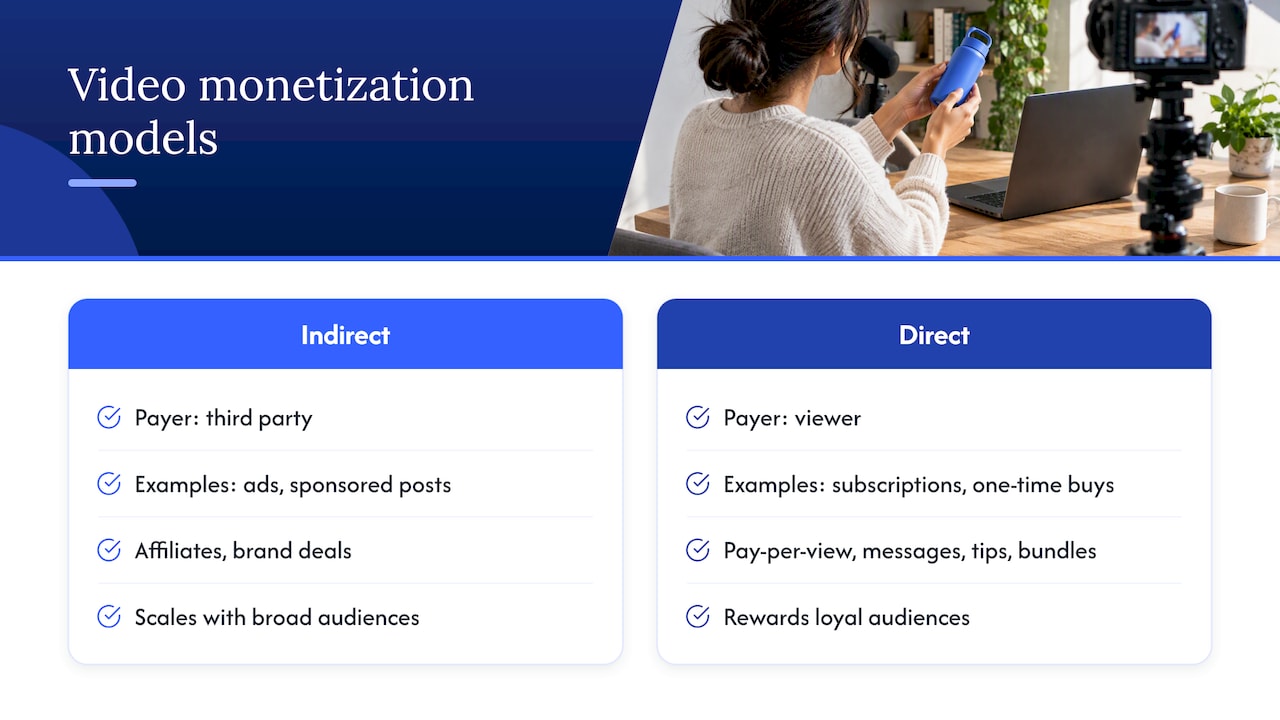
Indirect monetization. A third party pays, and viewers watch for free. Examples are advertising, sponsored posts, affiliate links and brand deals. Your job is to deliver attention.
Direct monetization. The viewer pays you. Examples are subscriptions, one-time purchases, pay-per-view, paid private messages, tips and bundles. Your job is to deliver value worth paying for.
Teachable’s overview of video monetization frames it the same way: different models that let your audience pay in exchange for video. Neither family is better in every case. Indirect models scale with big, broad audiences. Direct models reward smaller, loyal ones.
The main ways to monetize video
Advertising revenue share
The platform sells ad space against your video and splits the money with you. Thinkific’s breakdown explains that advertisers pay a set rate for every 1,000 ad views, and that YouTube keeps 45% of the ad revenue. EarnTrackr makes the same point and separates two numbers worth knowing:
- CPM is what advertisers pay per 1,000 ad impressions, before the platform’s cut.
- RPM is what you actually earn per 1,000 video views after that cut.
RPM is the figure to watch. The formula is simple: estimated earnings equal views divided by 1,000, multiplied by your RPM, as Tubelab explains.
Abonnements
Fans pay a recurring fee, typically monthly, for ongoing access to your videos and posts. Subscriptions turn a one-off viewer into predictable income, which is why they sit at the center of most direct-pay creator businesses. We cover the mechanics in our guide to subscription-based content and recurring revenue.
Pay-per-view and paid posts
A single video or post is locked until a fan pays for it. This suits premiere content, special releases and anything time-sensitive. Market research from Dataintelo describes pay-per-view as an important revenue stream for high-value, event-based or time-sensitive content.
Tips and live stream support
During a live stream, viewers can send money in real time. It rewards personality and interaction, and it often produces your biggest single-day spikes.
Private messages and custom requests
Fans pay to message you directly or to receive content made for them. It is one-to-one monetization, and it deepens the relationship with your most engaged supporters.
Bundles
Grouping several videos or posts into one purchase raises the average order value and gives newer fans a low-friction way to sample your catalog.
Sponsorships and affiliate deals
Brands pay you to feature their product, or you earn a commission on sales you drive. Sprout Social’s guide lists branded videos among the options and notes there is no single right way to monetize, since the best option depends on your content, audience and promotion strategy.
How the models compare
| Model | Who pays | Income pattern | Audience size needed | Control for the creator |
|---|---|---|---|---|
| Ad revenue share | Advertisers | Variable, tied to views and niche | Large | Low: platform sets ad rules and rates |
| Sponsorships and affiliate | Brands | Per deal, irregular | Medium to large | Mittel |
| Abonnements | Fans | Recurring, predictable | Small to medium | Hoch |
| Pay-per-view and paid posts | Fans | Per release | Small to medium | Hoch |
| Tips and live streams | Fans | Spiky, event-driven | Small to medium | Hoch |
| Private messages and bundles | Fans | Steady add-on revenue | Small to medium | Hoch |
The pattern is clear. Ads need scale. Fan payments need loyalty. A creator with 5,000 devoted followers can out-earn one with 500,000 passive viewers, depending on the model.
What does video monetization actually pay?
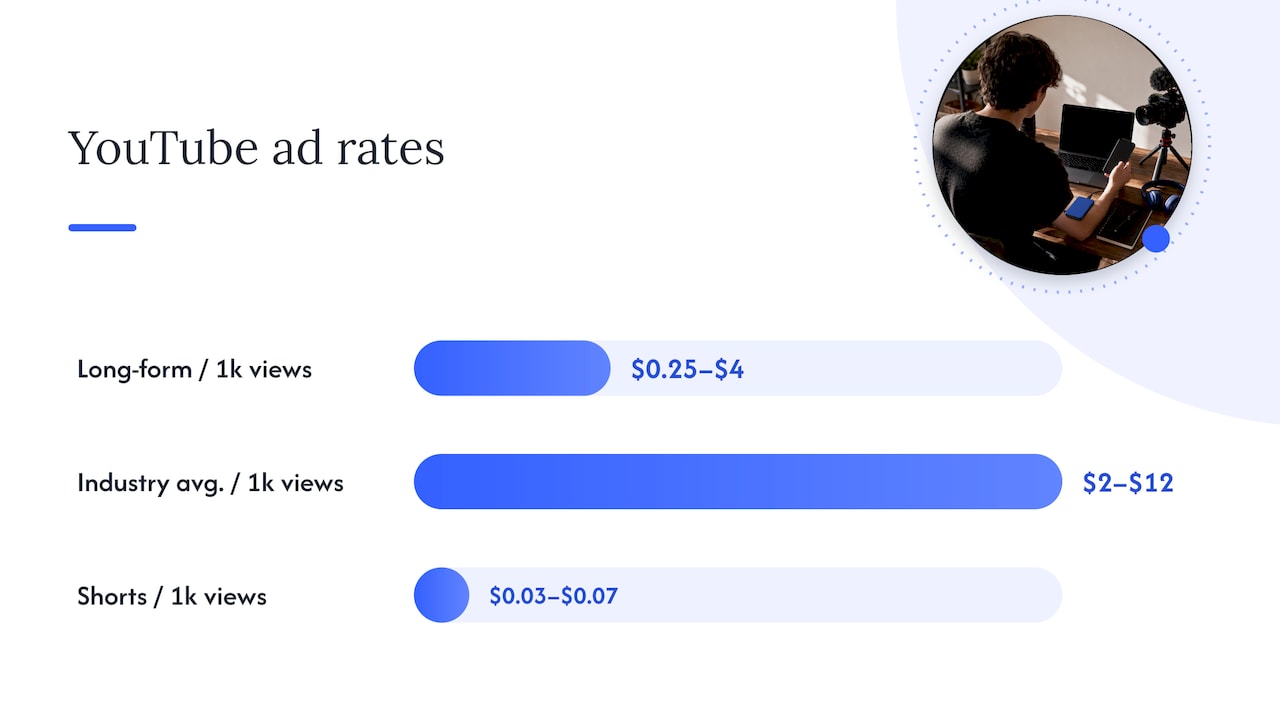
This is the question behind “how much do 1,000 views pay on YouTube?”, and the honest answer is that no fixed rate exists. Tubelab reports that, as of early 2026, creators typically see roughly $0.25 to $4 per 1,000 views on long-form video, while some industry averages put it between $2 and $12 depending on niche and audience. Shorts pay far less per view, often cited at $0.03 to $0.07 per 1,000 views.
Why the wide range?
- Niche. Per the YouTube Help page summary of how revenue varies, advertiser demand differs by topic. Finance and tech channels often command higher CPMs than entertainment.
- Audience. Viewer location and demographics change what advertisers will pay.
- Monetized views are not all views. Thinkific notes a common mistake is assuming every view earns ad revenue, and suggests only around half of total views may be monetized.
A quick worked example. Say a video gets 100,000 views and your RPM is $3. Using the formula above, that is 100 x $3 = $300. At $1 RPM, the same video earns $100. At $8 RPM, $800. The view count did not change, but the result moved by a factor of eight. That is why view counts are a poor predictor of income compared with engagement and niche.
Compare that with direct pay. If 300 fans each pay a monthly subscription, your income depends on the price you set and the retention you earn, not on an advertiser’s budget. We do not publish a typical figure here because it varies widely from creator to creator, but the logic is easier to forecast.
Direct monetization versus ads: which fits you?
Use these criteria to decide.
- Do you have a broad or a loyal audience? Broad and casual favors ads. Smaller and devoted favors subscriptions and paid content.
- How much control do you want? Under an ad program, the platform decides what is advertiser-friendly. With direct payments, you set the price, the content and the schedule within the platform’s rules.
- How predictable must income be? Recurring subscriptions smooth out the month. Ad income swings with seasons and advertiser budgets.
- What kind of content do you make? Educational, niche, personality-led and live content tend to suit direct pay. Entertainment aimed at mass reach suits ads.
- Who owns the relationship? On an ad platform, the audience belongs to the algorithm. On a direct-pay platform, fans follow you specifically.
Most creators end up layering models. Our guide to seven types of monetization methods for creators and the companion piece on seven proven revenue streams show how to stack them. Our data-led article on hybrid monetization looks at why mixing subscriptions with tips and paid content tends to work well.
A step-by-step way to start
- Define your content and who it is for. Monetization follows a clear promise. Vague channels earn vaguely.
- Pick a primary model. Choose one anchor: ads if you chase scale, subscriptions if you chase loyalty.
- Add one or two secondary streams. Tips, paid posts or bundles are the easiest first additions.
- Check the platform’s rules. Eligibility thresholds, review processes and content policies vary. Read them before you build a plan around them.
- Promote on purpose. Income follows audience. Our guide to promoting paid content covers practical tactics.
- Track what earns. Revenue per fan, retention and conversion tell you more than raw views.
The risk of over-monetizing
More monetization is not always better. Industry analysis summarized by Investopedia warns that excessive ad placement, or aggressive monetization of every small interaction, can erode audience trust and create a poor experience. Fans who feel nickel-and-dimed leave.
The fix is balance. Put the free value first, make paid offers feel like a natural next step, and keep every price tied to something fans clearly want. If you are “testing the waters” with a new paid format, start small and watch how your core fans respond before you scale it.
Our perspective: why direct monetization is a game-changer
We built Fanspicy around a simple belief: the creators who make the content should keep the relationship with their fans and a larger share of what those fans spend. Ad revenue share has its place, but it leaves creators exposed to rate changes, policy reviews and algorithms they do not control.
On Fanspicy, fans pay creators directly through subscriptions, exclusive content, paid posts, private messages, live streams, bundles and tips. Creators do not pay a fee to join or use the platform. We take a percentage commission per transaction, so we earn when creators earn. Our emphasis is on creators keeping a higher percentage of their earnings, owning their audience, choosing flexible ways to get paid, and moving content over from other platforms without starting from zero.
We also think the healthiest creator businesses are diversified. A subscription gives you a base. Live streams and tips give you moments of upside. Private messages and bundles reward your most loyal fans. When one stream dips, the others hold you up.
— fan
Where Fanspicy fits
If you are ready to move from views to paying fans, Fanspicy gives independent creators one place to sell subscriptions, exclusive content, paid posts, private messages, live streams, bundles and tips. Become a creator on Fanspicy to see how the tools work for your content, or explore the platform to see how fans subscribe, message and tip. For ideas on what to publish first, our list of content creation ideas for adult creators is a good place to start, and our complete guide to content monetization goes deeper on pricing and planning.
Common mistakes to avoid
- Treating views as income. Only monetized views earn, and rates differ enormously by niche.
- Relying on one platform and one model. A single policy change can cut income overnight. Diversify across streams.
- Ignoring eligibility rules. Missing a threshold, or going inactive, can switch monetization off.
- Pricing without a promise. Fans pay for a clear benefit: access, intimacy, convenience or exclusivity.
- Skipping promotion. Even excellent content needs a path to the people who would pay for it.
- Overloading fans with offers. Keep paid requests purposeful and spaced out.
FAQ
What are monetized videos?
Monetized videos are videos that can earn money for their creator. On ad-supported sites, that means ads can run on the video and the creator receives a share. On direct-pay platforms, it means fans pay for access through subscriptions, one-time purchases or tips.
What does it mean to monetize a video?
It means setting up a way for the video to generate income. You might enroll in an ad program, lock the video behind a paywall, include it in a subscription, or attach a sponsorship. The right choice depends on your audience size, content and goals.
How much do 1,000 views pay on YouTube?
There is no fixed rate. Tubelab’s 2026 analysis shows creators typically earning roughly $0.25 to $4 per 1,000 long-form views, with some industry averages higher. Niche, audience location and advertiser demand all move the number, and Shorts pay much less per view.
Do I need a big audience to monetize video?
For ad programs, usually yes, because eligibility thresholds and low per-view rates favor scale. For subscriptions, paid posts, tips and private messages, a smaller but engaged audience can be enough, since each fan pays you directly.
Sources
- YouTube Partner Program overview and eligibility, YouTube Help
- How Much Do YouTubers Make per 1,000 Views in 2026?, Tubelab
- How Much Money Do You Get Per View on YouTube?, Thinkific
- How Much Money Is 1,000 Views on YouTube?, EarnTrackr
- Learn How to Monetize, Investopedia
- Video Monetization 101, Teachable
- How to make money on YouTube, Sprout Social
- Fan Subscription Platforms Market Research Report 2033, Dataintelo