

Inhaltsübersicht
TL;DR:
- Instagram monetization involves earning income through native features, brand deals, affiliate programs, and direct sales. Success depends on building multiple revenue streams, audience trust, and a focused niche, not just follower count. Small creators can earn significantly using niche marketing, affiliate links, and digital products without needing a viral following.
Instagram monetization is the practice of earning income through your Instagram account by combining native platform features, brand partnerships, affiliate programs, and direct product sales. Understanding what is monetization Instagram means recognizing it as a multi-stream system, not a single paycheck. Nano-influencers earn $10–$100 per sponsored post, while micro-influencers earn $100–$500 per post and $200–$800 per Reel. Those numbers reflect real income potential, but only when creators treat monetization as a deliberate system rather than a side effect of posting.
What are the main methods to monetize Instagram accounts?
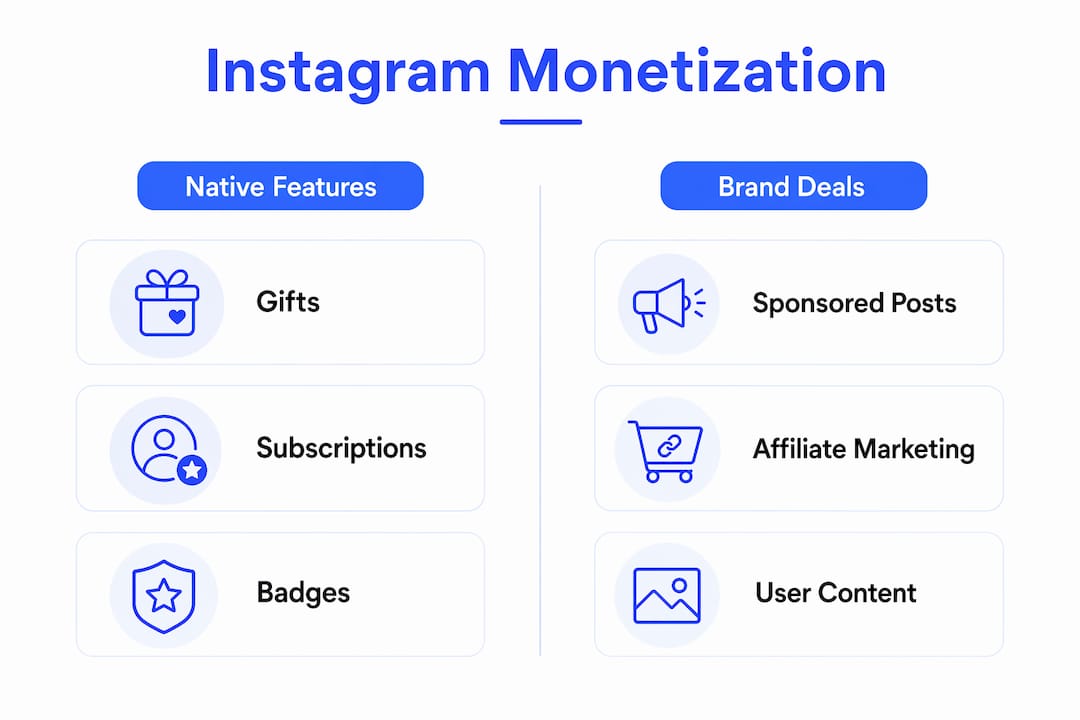
Instagram revenue generation falls into three broad categories: in-app native features, brand collaborations, and self-promotion. Each path has different eligibility requirements, payout structures, and income ceilings.
In-app native features
Instagram offers several built-in tools creators can use to earn directly on the platform. Gifts let followers send virtual tokens during live videos, and Gifts require just 500 followers to unlock. Subscriptions and Badges both require 10,000 followers and give fans a way to pay monthly for exclusive content or support creators during live streams. Some bonus programs are invite-only, meaning Instagram selects participants based on internal criteria.

One fee structure worth knowing: Meta takes 0% from Subscription revenue, but creators who manage subscriptions through iOS or Android apps pay a standard 30% app store fee. Managing subscriptions through a web browser retains roughly 97% of revenue. That difference is significant at scale.
Brand collaborations
Sponsored posts, affiliate marketing, and user-generated content (UGC) deals make up the brand collaboration category. Sponsored posts pay a flat fee per piece of content. Affiliate marketing pays a commission on sales generated through a unique link or code. UGC deals pay creators to produce content the brand owns and uses in its own advertising, regardless of the creator’s follower count.
Affiliate commissions range from 1% to 40%, depending on the program. Amazon Associates pays 1–4.5%, while niche platforms pay 10–30%. Niche affiliate programs consistently outperform general retail programs in commission rate, which is why creators with focused audiences often earn more per sale than creators with large but broad followings.
Self-promotion
Self-promotion means using Instagram to sell your own products, services, digital courses, or memberships. This path has no follower minimum and no platform fee on the sale itself. A creator with 2,000 highly engaged followers selling a $200 online course can out-earn a creator with 50,000 followers running low-commission affiliate links. The income ceiling here is set by the creator’s offer, not Instagram’s algorithm.
| Method | Follower minimum | Payout type |
|---|---|---|
| Gifts | 500 | Per gift received |
| Abonnements | 10,000 | Monthly recurring |
| Badges | 10,000 | Per live stream |
| Sponsored posts | None (brand-dependent) | Flat fee per post |
| Affiliate marketing | Keine | Commission per sale |
| Own products/services | Keine | Direct revenue |
How much can creators realistically earn on Instagram?
Earnings on Instagram vary widely, and follower count is only one variable. Engagement rate, niche specificity, content quality, and audience trust all determine how much a creator actually earns.
The benchmarks are clear at the lower end. Nano-influencers in the 1,000–10,000 follower range earn $10–$100 per sponsored post. Micro-influencers in the 10,000–100,000 range earn $100–$500 per post. These figures assume a single revenue stream. Successful accounts build stacked monetization systems using brand deals, affiliate links, and direct sales simultaneously to compound earnings. Stacking matters because no single stream is reliable enough on its own.
Several factors push earnings up or down:
- Engagement rate. A creator with 8,000 followers and a 9% engagement rate commands higher brand fees than one with 40,000 followers and a 1% rate.
- Niche specificity. Finance, health, and legal niches attract higher affiliate commissions and brand budgets than general lifestyle content.
- Content quality. Brands pay more for polished Reels and well-produced Stories than for casual snapshots.
- Audience trust. Followers who act on recommendations generate affiliate sales. Passive audiences do not.
The biggest misconception about Instagram income is that it becomes passive over time. It does not. Sustainable monetization requires consistent content, audience trust, and combining at least three revenue streams to achieve stable income. Creators who treat Instagram as a passive income machine typically plateau quickly.
Profi-Tipp: Track your revenue by stream every month. If one stream drops by 30%, you want to know before it becomes a crisis. A simple spreadsheet with columns for brand deals, affiliate income, and direct sales gives you a real picture of your income health.
What are the best practices for effective Instagram monetization?
The most effective Instagram monetization strategies treat the platform as a traffic source, not a final destination. Instagram functions as a top-of-funnel platform that drives followers to owned ecosystems: email lists, membership sites, and sales funnels where the creator controls the revenue environment. Platform payouts are subject to algorithm changes and policy shifts. Owned assets are not.
Here is how top creators build that system:
- Build an owned funnel first. Create a landing page, email list, or membership platform before focusing on Instagram monetization. Your Instagram content then serves as the entry point to that funnel.
- Use DM automation for instant delivery. Automated DM tools like Manychat trigger instant link delivery when followers comment on a post. A follower comments “link,” and they immediately receive a DM with your offer. This reduces friction and increases conversions.
- Qualify high-ticket leads before booking. High-ticket offers convert better through application forms or triage conversations than through public booking links. A $2,000 coaching program should not have a direct “book now” link in your bio. A short application form filters serious buyers from browsers.
- Avoid relying on native payouts alone. Meta’s native Instagram payouts are unreliable due to changing algorithms and shifting program eligibility. Treat Reels bonuses and Gifts as supplemental income, not a primary revenue source.
- Create content that drives action. Every post should have a clear next step: comment a keyword, click the link in bio, or reply to a Story. Content without a call to action generates views, not revenue.
Profi-Tipp: Place your highest-converting offer behind a keyword trigger in your Reels captions. When a viewer comments the keyword, they receive an instant DM with the offer link. This one tactic can turn a viral Reel into a direct sales event without any manual follow-up.
For creators building mehrere Einkommensströme, the funnel approach consistently outperforms relying on platform-native income alone.
How to start monetizing Instagram with limited followers?
A small following does not block you from earning. Creators with fewer than 5,000 highly engaged followers can generate significant revenue with the right offer and a focused niche. The path to early income does not require going viral.
The most accessible starting points for creators with small audiences include:
- Gifts. With just 500 followers, you can enable Gifts on live videos. Even a small but loyal audience will support creators they trust.
- Affiliate marketing. No follower minimum exists for affiliate programs. Joining niche affiliate programs with 10–30% commissions generates meaningful income even at low traffic volumes. A creator with 1,000 followers in the personal finance niche can earn more per click than a lifestyle creator with 50,000 followers.
- Digital products. An ebook, template pack, or mini-course costs nothing to create beyond time. Selling a $27 digital product to 50 buyers generates $1,350 with zero inventory or shipping costs.
- Services. Freelance writing, social media management, photography, and coaching are all sellable directly through Instagram DMs. No follower threshold applies.
- UGC content creation. Brands pay for content production regardless of your audience size. A creator with strong video skills and 800 followers can land UGC contracts by pitching brands directly.
The key insight is that niche depth beats audience breadth at the early stage. A creator posting exclusively about sourdough bread to 2,000 followers has a more monetizable audience than a general food creator with 15,000 followers. Brands and buyers in that niche know exactly who they are reaching. For creators exploring adult content monetization, the same principle applies: a focused, engaged audience converts at a higher rate than a broad one.
Wichtigste Erkenntnisse
Instagram monetization works best as a stacked system combining native features, brand deals, affiliate programs, and owned sales funnels rather than any single income source.
| Point | Details |
|---|---|
| Three core paths | In-app features, brand collaborations, and self-promotion each offer distinct earning structures. |
| Follower minimums vary | Gifts unlock at 500 followers; Subscriptions and Badges require 10,000. |
| Earnings depend on engagement | A 9% engagement rate at 8,000 followers outperforms a 1% rate at 40,000 for brand deals. |
| Owned funnels outperform platform payouts | Instagram should drive traffic to email lists or membership sites for stable, algorithm-proof income. |
| Small audiences can earn | Creators with under 5,000 engaged followers generate real revenue through affiliate programs, digital products, and services. |
What I’ve learned about building real income on Instagram
Most creators approach Instagram monetization backward. They chase follower counts and wait for brand deals to arrive, then wonder why income stays unpredictable. The creators I’ve seen build genuinely stable income do the opposite. They build the offer first, then use Instagram to fill it.
The platform is a traffic tool. Treating it as the destination is the core mistake. Algorithm changes, feature deprecations, and shifting payout structures are not edge cases. They are the norm. Creators who depend entirely on native Instagram income get hurt every time Meta changes its bonus program criteria. Creators with owned email lists and external sales funnels barely notice.
Audience trust is the actual asset. A creator with 3,000 followers who genuinely helps people in a specific niche can out-earn a creator with 300,000 followers who posts for reach. Trust converts. Reach does not, at least not reliably. Building that trust takes consistent content, honest recommendations, and showing up even when the algorithm is not rewarding you.
The other thing worth saying plainly: this is not passive. Monetizing Instagram content requires real work, real systems, and real patience. The creators who make it look effortless have usually spent two or three years building the infrastructure behind the scenes. Start building that infrastructure now, before you need it.
— fan
How Fanspicy supports creators building real income
Creators who want to move beyond Instagram’s native payout limitations need a platform built for direct monetization.
Fanspicy is a paid social media and live cam platform designed for creators who want to earn directly from their audience without depending on algorithm-driven payouts. It gives creators subscription tools, live streaming revenue, and a direct-to-fan monetization structure that complements an Instagram presence. Creators using Instagram as a top-of-funnel traffic source can direct followers to a Fanspicy profile where the actual revenue conversion happens. For creators ready to build a real monetization system, Fanspicy provides the infrastructure to make that work.
FAQ
What is Instagram monetization?
Instagram monetization is the process of earning income through your Instagram account using native features, brand partnerships, affiliate programs, or direct product and service sales. It requires combining multiple revenue streams for stable income.
How many followers do you need to monetize Instagram?
Gifts unlock at 500 followers, Subscriptions and Badges require 10,000 followers, and affiliate marketing or selling your own products has no follower minimum. Engagement rate matters more than raw follower count for most revenue methods.
How much do Instagram creators earn per sponsored post?
Nano-influencers with 1,000–10,000 followers earn $10–$100 per sponsored post. Micro-influencers with 10,000–100,000 followers earn $100–$500 per post and $200–$800 per Reel, depending on niche and engagement.
Does Instagram take a cut of subscription revenue?
Meta takes 0% of Subscription revenue directly. Creators who manage subscriptions through iOS or Android apps pay a 30% app store fee, but web-managed subscriptions retain roughly 97% of earnings.
Can you monetize Instagram with a small following?
Creators with fewer than 5,000 highly engaged followers generate real income through affiliate marketing, digital product sales, UGC contracts, and service offerings. Niche focus and audience trust matter far more than follower count at the early stage.