

Table of Contents
Uploading your content behind a paywall feels safe. But that assumption has cost creators thousands of dollars and their reputations. Even gated content on paid platforms can be screenshotted, ripped, redistributed, or exposed through platform-level data breaches. Secure content delivery protects against unauthorized access, piracy, DDoS attacks, and supports user privacy. It is not just about uploading files. It is a layered system of tools, protocols, and policies that work together to keep your digital assets yours. This guide breaks down exactly what secure content delivery is, how it works, and what you can do right now to protect your income and your audience.
Table of Contents
- What is secure content delivery?
- Core mechanics: Tools and techniques that keep your content safe
- Addressing privacy, piracy, and regulatory trade-offs
- Performance, pitfalls, and best practices for creators
- Future-proofing: Trends and recommendations for 2026 and beyond
- Secure your brand and earnings with the right platform
- Frequently asked questions
Key Takeaways
| Point | Details |
|---|---|
| Holistic protection | Secure content delivery shields your assets through a combination of CDNs, DRM, encryption, and access controls. |
| Privacy–security balance | Finding the sweet spot between piracy prevention and user privacy is vital for creator reputation and compliance. |
| Proven performance | Well-implemented security adds negligible latency while delivering content smoothly to a global audience. |
| Mistakes to avoid | Failing to set origin restrictions or tune your CDN leaves content exposed despite other protections. |
| Be future-ready | Embrace new tools like multi-CDN, edge DRM, and privacy-preserving verification to secure long-term profits. |
What is secure content delivery?
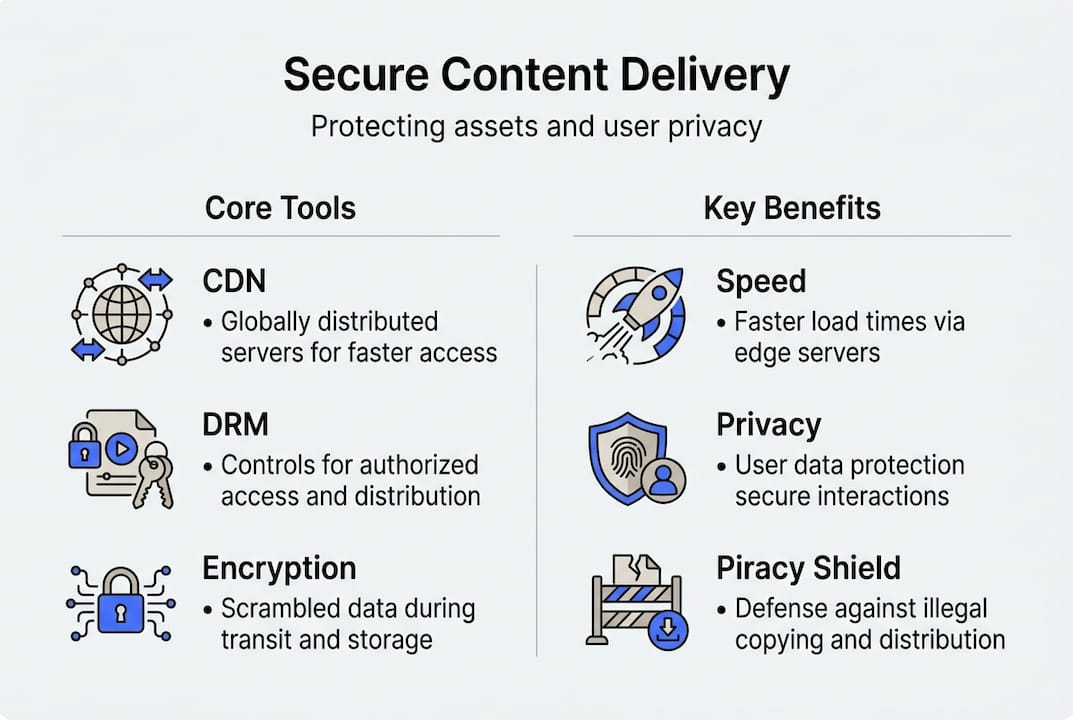
Secure content delivery is the practice of distributing your digital media to subscribers in a way that prevents unauthorized access, copying, or redistribution. Think of it like a bank vault with a delivery window. Your content stays locked up, but approved subscribers get a timed, encrypted pass to view it. The moment that pass expires, access is gone.
Traditional file uploads give you none of that. When you upload a video to a basic server, anyone who gets the direct URL can share it. There is no expiration, no identity check, no encryption layer. For adult creators building adult content business models around exclusive material, that is a serious vulnerability.
The main building blocks of secure content delivery include:
- Content Delivery Networks (CDNs): Distribute your content across global servers for fast, reliable access
- HTTPS/TLS encryption: Scrambles data in transit so it cannot be intercepted
- Digital Rights Management (DRM): Prevents downloading and restricts how content is played back
- Signed URLs and cookies: Grant time-limited, IP-restricted access to specific files
- Edge protections: Web Application Firewalls (WAF) and DDoS mitigation at the network edge
As Amazon CloudFront’s security framework outlines, secure content delivery means using CDNs, encryption, DRM, access controls, and edge protections for digital assets. For adult creators, the stakes are especially high. Piracy directly cuts revenue. Privacy breaches destroy subscriber trust. Legal exposure from mishandled user data can shut down your entire operation. Exploring content creation ideas is only worthwhile if you can protect what you create.
Core mechanics: Tools and techniques that keep your content safe
Now that you know the essentials, let us see how the main tools and techniques actually work for creators.
1. CDNs (Content Delivery Networks)
A CDN caches your content on servers around the world. When a subscriber in Tokyo requests your video, it loads from a nearby server, not your origin server in the US. This means faster load times and less strain on your main server. It also adds a layer of abstraction that makes direct attacks on your origin harder.

2. HTTPS and TLS encryption
Every piece of data traveling between your platform and your subscriber is encrypted. Without this, anyone on the same network could intercept the stream. TLS is non-negotiable for user privacy and platform credibility.
3. Origin access controls
This blocks anyone from bypassing your CDN and hitting your origin server directly. Without it, a determined attacker can pull your raw files straight from the source, skipping all your protections.
4. Signed URLs and cookies
These are temporary, personalized access tokens. A signed URL might expire in 30 minutes or be locked to a specific IP address. Even if someone shares the link, it will not work for anyone else. This is one of the most practical tools for creators selling time-sensitive or exclusive content.
5. Multi-DRM
As Akamai’s CDN security research confirms, multi-DRM encrypts streams and offers forensic watermarking and concurrent stream limits. Forensic watermarking embeds invisible, unique identifiers in each stream so you can trace a leak back to the specific subscriber who shared it. That is a powerful deterrent.
Review your digital content rights guide and understand content licensing before choosing a DRM solution, since your rights management strategy should align with your delivery setup.
| Feature | Simple hosting | CDN delivery | DRM-protected delivery |
|---|---|---|---|
| Speed | Slow, single server | Fast, global | Fast, global |
| Piracy protection | None | Low | High |
| Access control | None | Moderate | Granular |
| Leak tracing | No | No | Yes (watermarking) |
| Cost | Low | Medium | Higher |
The types of content and revenue you produce should guide which tier you invest in. High-value video content warrants DRM. Static images might only need signed URLs.
Pro Tip: Use multi-DRM if you want maximum control and leak tracing. If a subscriber ever leaks your content, forensic watermarking lets you identify exactly who did it and take action.
Addressing privacy, piracy, and regulatory trade-offs
While the technical side is vital, you also need to consider the practical and ethical trade-offs of your security choices.
The tension between piracy protection and user privacy is real. The more data you collect to verify and track users, the more sensitive information you hold. That creates risk. A breach of your subscriber database is arguably worse than a leaked video.
Age verification is a prime example. Full ID checks confirm age but collect sensitive personal data. Attribute-based proofs, sometimes called zero-knowledge proofs, confirm that a user meets an age threshold without revealing their actual identity. As 2026 adult platform privacy research notes, protection methods like DRM and encryption can create honeypot risks and regulatory pressures under GDPR and the Digital Services Act (DSA), and push some users toward VPNs to evade verification.
Here is a quick comparison of verification approaches:
| Method | Privacy level | Piracy risk | Regulatory risk |
|---|---|---|---|
| Full ID check | Low | Low | High (data storage) |
| AI age estimation | Medium | Medium | Medium |
| Attribute-based proof | High | Low to medium | Low |
| No verification | High | High | Very high |
Key considerations for creators navigating this space:
- Regulations like GDPR and DSA are actively shaping what platforms can collect and store
- Protecting fan anonymity is not just ethical, it is a competitive advantage that builds loyalty
- VPN usage among subscribers can undermine geo-restrictions and IP-based access controls
- The role of platforms in handling compliance means you should choose platforms that absorb regulatory burden on your behalf
“The goal is not to collect everything you can. It is to collect only what you need, protect it rigorously, and give users confidence that their privacy is respected.” This balance is what separates sustainable creator businesses from those that collapse under legal or reputational pressure.
Monitor your analytics for unusual access patterns. Sudden spikes from a single region or IP range often signal VPN evasion or credential sharing.
Performance, pitfalls, and best practices for creators
So what does success look like, and what are the mistakes to avoid as a content creator?
Top CDNs deliver sub-30ms latency and 99.99% uptime, but poorly tuned security can add unwanted overhead. Security overhead adds roughly 8 to 15ms of latency if your configuration is not optimized. For most subscribers, that is invisible. But if you stack multiple untuned security layers, the delays compound and buffering becomes a real problem.
Common pitfalls creators run into:
- Origin leaks: Forgetting to lock down your origin server so it only accepts requests from your CDN
- Cache poisoning: Attackers manipulate cached responses to serve malicious content or bypass paywalls
- Rate-limit bypass: Bots hammer your endpoints to scrape content or brute-force access tokens
- VPN circumvention: Subscribers use VPNs to bypass geo-restrictions or IP-based signed URL controls
- Expired certificate neglect: Letting TLS certificates lapse, which breaks HTTPS and destroys subscriber trust instantly
Best practices you can implement right now, drawn from CDN security frameworks:
- Use mutual TLS (mTLS) to authenticate both the server and the client, not just one direction
- Apply forensic watermarking to every premium video stream
- Set proper cache headers (s-maxage) to control what gets cached and for how long
- Retain access logs for at least 90 days so you can investigate incidents
- Build a multi-CDN failover plan so a single provider outage does not take you offline
For creators managing payment security alongside content delivery, these practices overlap. Secure delivery and secure transactions share the same foundation of encryption and access control. If you run live streaming for adults, real-time DRM and low-latency CDN configuration become even more critical since live content cannot be re-served from cache the same way on-demand content can.
Pro Tip: Have a mitigation plan ready before a DDoS attack happens, not after. Multi-CDN failover means that if one provider goes down under attack, traffic automatically reroutes. Without it, a targeted attack can take your entire income stream offline in minutes.
Future-proofing: Trends and recommendations for 2026 and beyond
Finally, let us look at how you can stay resilient and profitable no matter how the security landscape shifts.
Three major trends are reshaping secure content delivery right now. Zero-trust architecture assumes no user or device is trusted by default, requiring continuous verification at every access point. Edge DRM moves rights enforcement closer to the subscriber, reducing latency while maintaining protection. Forensic watermarking is becoming standard rather than premium, as leak incidents have made it a baseline expectation for serious platforms.
On the regulatory side, attribute-based verification and multi-CDN strategies are set to shape secure delivery in the next few years. Governments are pushing for age verification that does not require storing sensitive ID data, which means privacy-preserving methods will become the compliance standard, not just a nice-to-have.
Here is a practical checklist for creators building a future-ready security stack in 2026:
- Audit your current platform’s CDN and DRM capabilities and ask for documentation
- Switch to attribute-based or AI-based age verification if you are still using full ID checks
- Enable forensic watermarking on all premium video content
- Set up multi-CDN failover with at least two providers
- Review your data retention policies to align with GDPR and DSA requirements
- Test your origin access controls by attempting a direct bypass yourself
- Explore future content ideas that leverage secure delivery as a selling point, such as time-limited exclusive drops
Creators who treat security as infrastructure rather than an afterthought will be the ones still earning in five years.
Secure your brand and earnings with the right platform
Ready to take control? Here is how you can secure your digital assets, protect your community, and grow your income.
Professional creators do not bolt security on after the fact. They build on platforms that handle CDN delivery, DRM, access controls, and regulatory compliance as standard features. That means less technical overhead for you and more time creating.
Fanspicy is built for creators who take their business seriously. The platform combines secure content delivery with privacy-first tools, giving you the infrastructure to protect your work without needing a technical team behind you. Creators like jackiepott and baddiemi are already using the platform to grow their subscriber base while keeping their content locked down. If you are ready to move beyond basic uploads and build a genuinely secure, profitable creator business, Fanspicy gives you the foundation to do it.
Frequently asked questions
What is the fastest way to protect videos from piracy?
Multi-DRM encrypts streams and limits concurrent playback, making it the most effective real-time defense against most piracy methods when combined with a leading CDN.
Does strong security slow down content delivery?
Not meaningfully. Security overhead adds 8 to 15ms with properly tuned security features, which is imperceptible to end users under normal conditions.
How can I verify age while respecting user privacy?
Use AI estimation or attribute-based token proofs instead of full ID checks. These confirm age eligibility without storing sensitive personal data.
What are common mistakes in secure content delivery?
Origin bypass, cache poisoning, and VPN circumvention are the top gaps exploited by attackers. Forgetting to restrict origin access is the single most common and costly oversight.
Is secure delivery only needed for video files?
No. Secure delivery methods apply to videos, images, audio files, and documents. Any digital asset you monetize deserves the same protection as your premium video content.